



Tune in to listen
Bounce FM

Nigerian politicians have always known that a hungry population is an easily managed one.
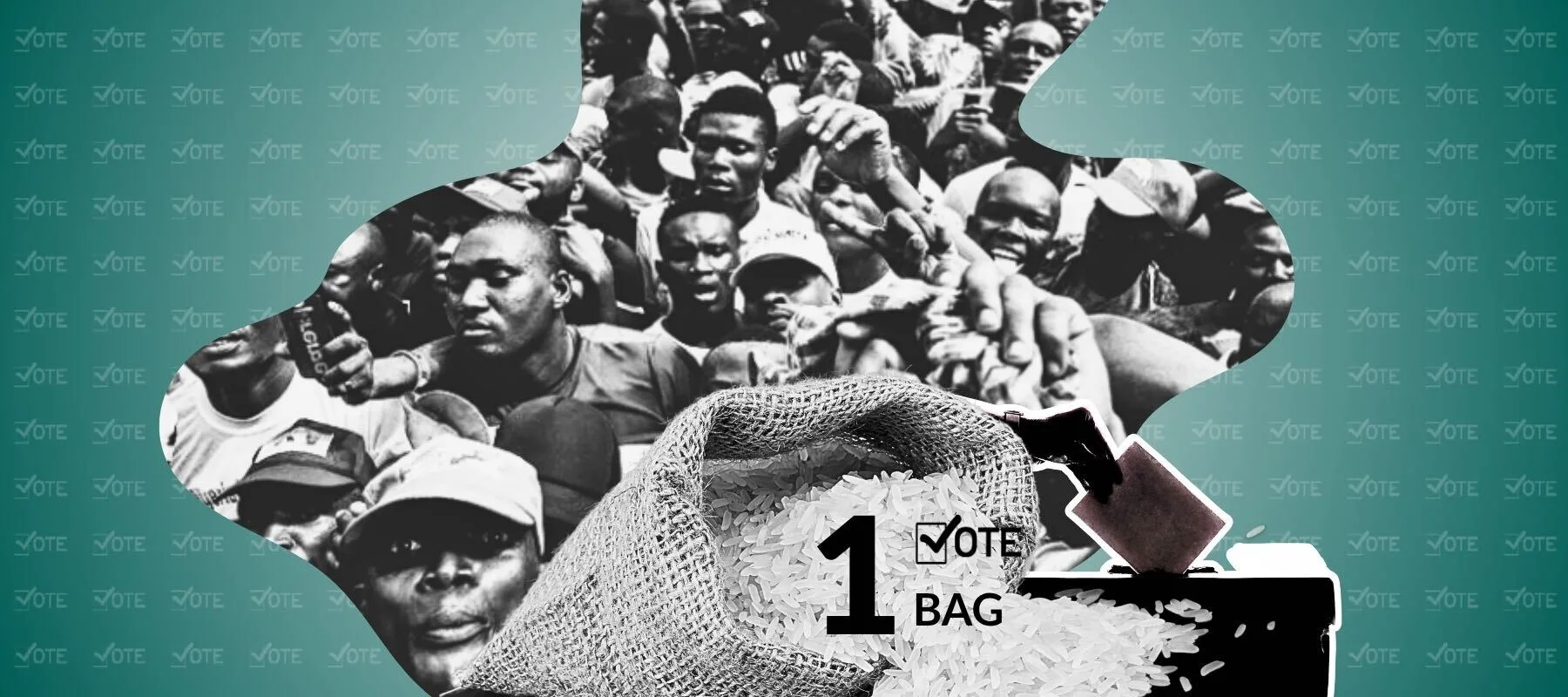
Are you even a serious Nigerian politician if you have not started sharing rice?
It is that time again. The season of rice. Not exactly as food, but as communication. Rice as governance. Rice as a policy response to the complex socioeconomic challenges facing Nigerians, distributed in markets, photographed, and circulated as proof of care. In this logic, a politician who has not shared rice with his face on it does not care about you. One who has done so cares very deeply, at least until Election Day.
The checklist writes itself. Rice? Check. Face on the bag? Check. You are not a real politician without these moves.
With less than a year until the 2027 elections, rice is back in the mix. One enthusiastic supporter recently posted photos of a distribution exercise and captioned it: “Strategy and Execution.” To some, that caption is absurd. But the person was not entirely wrong. Rice has helped win elections in this country. It is a tried and trusted “strategy.”
Strategy and Execution. pic.twitter.com/unn7gbTM1W
— Ubi Franklin Ofem (@ubifranklin1) March 27, 2026
The practice has a name: stomach infrastructure. And like most things in Nigerian political life, it has a patron saint. Former Ekiti State governor Ayo Fayose did not invent the idea of feeding voters — Lamidi Adedibu had been perfecting amala politics in Ibadan long before — but Fayose industrialised it. He won Ekiti in 2014 on the back of it, then created an actual government ministry to institutionalise it. By the 2015 presidential election, both major candidates were distributing branded foodstuffs nationwide, each trying to out-give the other while the conversation about governance quietly and mostly left the room.
If rice/groundnut oil is per person, collect nd vote for BUHARI/OSINBAJO. LOBATAN. Not dis degrading Garri/sugar. pic.twitter.com/9a9jYLj9DC
— Auntie Mi (@doyinmojisola) March 27, 2015
And it is not difficult to see why this strategy works. Roughly 63 percent of Nigerians are multidimensionally poor. When a bag of rice appears in a community where three square meals are not guaranteed, moral outrage about vote-buying is a luxury most households cannot afford. Decades of misgovernance have hollowed out living standards to the point where immediate, tangible relief feels more real than any promise of long-term development. Collecting the rice, in that context, is not stupid. It is survival arithmetic. You take what is certain now because the promises have never arrived.
The problem is not the people collecting. The problem is a political class that has decided this transaction is enough, that feeding a community for one afternoon earns four years of unaccountable governance, and that the conversation can stop at the bag.
Because what the rice does, functionally, is end the conversation. Every bag distributed is a question that never gets asked. You have been in office for three years, what happened to the power sector you promised to improve? Here is rice. The roads in this local government have not been touched since 2022. More rice. You are in the opposition now, but you were once with the ruling party. What are you planning to do differently this time if elected? Even more rice.
“Give me road, you bring rice. Give me education, you bring rice. Secure the border, you bring rice.” pic.twitter.com/hBfC0PdzaX
— @𝗼𝗻𝗲𝗷𝗼𝗯𝗹𝗲𝘀𝘀𝗯𝗼𝘆 (@OneJoblessBoy) March 24, 2026
With the 2027 general election less than a year away, those questions deserve to be asked, loudly and often. What are you going to do about electricity: not a committee, not a roadmap, but a specific and accountable plan? What about the roads, the schools, the hospitals where patients buy their own gloves? And for the opposition, what are the viable alternatives to what the current government is doing? Criticism of the incumbent is not a manifesto.
Moreover, real infrastructure has a different timeline from rice. You cannot eat a transformer, but it powers businesses that feed families for years. A rehabilitated road does not present as well as a food distribution, but it cuts transport costs for market women every single day.
Nigerian politicians have always known that a hungry population is an easily managed one. The smarter calculation, for anyone actually interested in governing, is that a population whose material conditions genuinely improve becomes much harder to buy cheaply. Better infrastructure is, in the long run, bad for stomach infrastructure.
The rice will finish in days. The question is whether the silence it buys will last longer.