



Tune in to listen
Bounce FM

Why do our political leaders continue to leave doctors and medical facilities at home to take these medical trips and why is the trend likely to continue?
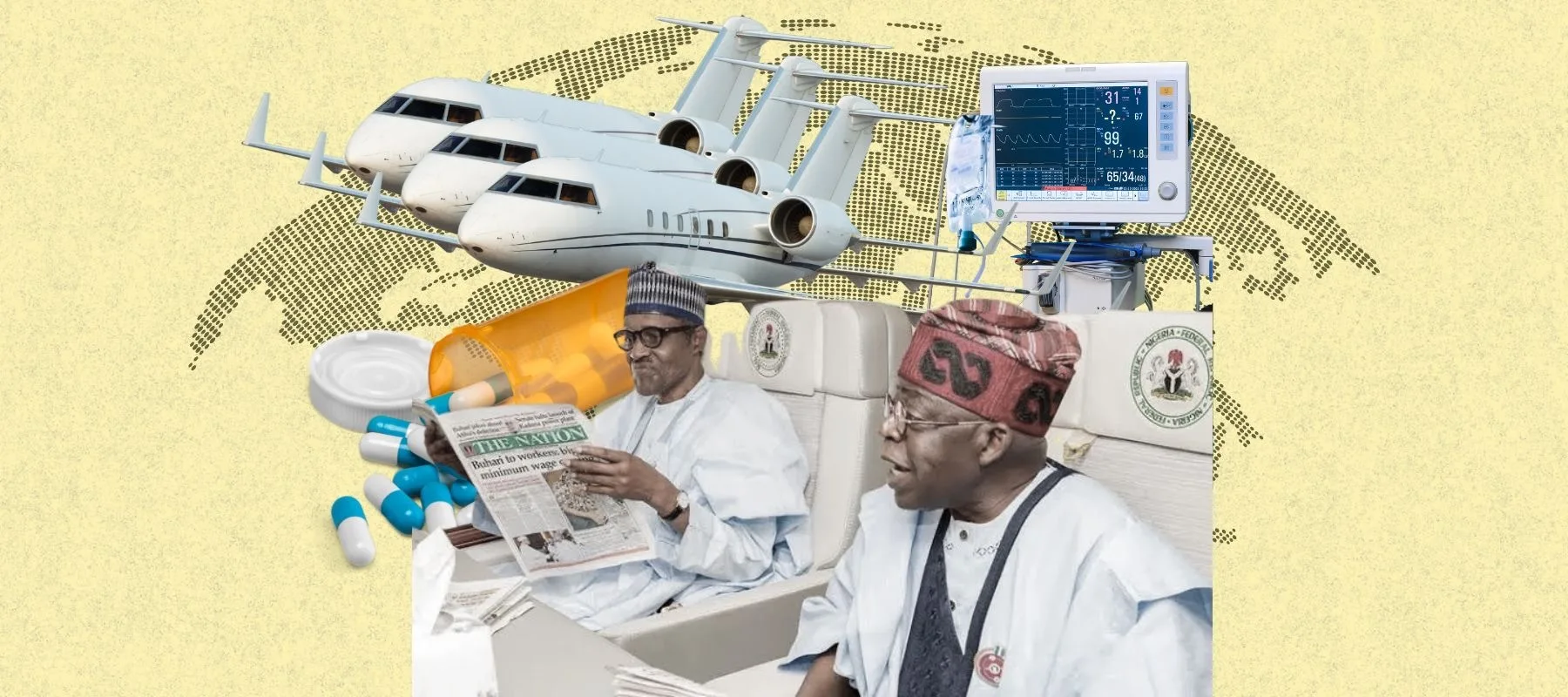
When Femi Adesina, former presidential spokesperson, recently said that former President Muhammadu Buhari could have died a long time ago if he had relied on Nigerian hospitals, he reignited the troubling conversation around medical tourism. “If he had said, ‘I will do my medicals in Nigeria’ just as a show-off or something, he could have long been dead because there may not be the expertise needed in the country.” Those were the words of the spokesperson of a president who spent eight years in office and eventually died in a foreign hospital about two years after leaving office.
But that’s hardly surprising. In 2017, the BBC listed Buhari as one of the African presidents who had an “apparent lack of faith in the health systems at home”, saying he is “the first among equals”. The data backs up the British broadcaster. During his eight-year tenure, the late former president spent at least 200 days in London for medical treatment. At one point, he spent 103 consecutive days in London receiving healthcare. The nature of his illness was never disclosed. His long absences came to symbolise a broader disengagement from public institutions, particularly the ones his government was meant to strengthen. Buhari came to power in 2015 promising to rebuild Nigeria’s broken institutions, but left office in 2023 with the country in worse shape.
Under his watch, the economy slipped into two recessions. Armed groups seized large parts of the north. Inflation, unemployment and poverty soared. His government’s response to the 2020 #EndSARS protests, when soldiers opened fire on unarmed demonstrators in Lagos, drew international condemnation. Even the anti-corruption campaign that had helped bring him to power came to be seen as selective. The state decayed under his watch, and the health system was no exception. His administration pledged to invest in healthcare, but spending remained far below African Union (AU) benchmark. The AU benchmark, also known as the Abuja Declaration, was a commitment by African governments to allocate at least 15% of their national budgets to the health sector. However, Buhari’s last budget on health constituted only a meagre 4.84% of the total budget.
Still, the former president was far from alone in his controversial reliance on medical tourism. His successor, President Bola Tinubu, is known for taking medical trips to Paris every now and then. Other politicians and Nigerians with means also participate in medical tourism. According to a report from the Central Bank of Nigeria (CBN), Nigerians spent about $2.38 million on foreign healthcare-related services from January to June 2024.
So why do they leave doctors and medical facilities at home to take these medical trips and why is the trend likely to continue? The simple answer: substandard health facilities and a dwindling number of medical personnel in Nigeria.
For example, Nigeria is objectively the world’s most dangerous nation to give birth in. According to the most recent United Nations (UN) estimates, compiled from 2023 figures, one in 100 women die in labour or in the following days. In 2023, Nigeria accounted for 29% of all maternal deaths worldwide. That is an estimated 75,000 women dying in childbirth in a year, which works out at one death every seven minutes. And these tragedies didn’t happen by mistake. In 2021, there were just 121,000 midwives for a population of over 200 million, and less than half of all births were overseen by a skilled health worker, according to the BBC. It is estimated that Nigeria needs 700,000 more nurses and midwives to meet the World Health Organization’s (WHO) recommended ratio.
There is also a severe shortage of doctors. In April, the Coordinating Minister of Health and Social Welfare, Professor Muhammad Pate, said over 16,000 Nigerian doctors had left the country in the past five to seven years in search of greener pastures abroad. Pate also revealed that the doctor-to-population ratio is now 3.9 per 10,000, a sharp contrast to the WHO recommendation of one doctor for every 600 people in a functioning healthcare system.
The health minister, who appeared helpless, lamented that the departure of nurses and midwives had also depleted the country’s healthcare workforce. He said the migration of health professionals from developing countries is not new, but it has accelerated in recent years. It is therefore no surprise that medical tourism is thriving in Nigeria more than ever. The standards are in the gutter, and the people who can help — elected officials — prefer to seek treatment abroad rather than build a functioning healthcare system that could lift Nigeria’s health sector out of its current crisis.
Unfortunately, there seems to be no incentive for elected officials to stop this stream of foreign medical spending. There is no law mandating them to receive healthcare in the country, and no sustained political pressure from Nigerians to end the practice. Even as young Nigerians expressed outrage on social media over Adesina’s blunt and seemingly insensitive comments, there were few, if any, calls for the federal, state, and local governments to overhaul the health sector and commit to high-quality care for all, including elected officials.
Until there is a concerted effort by government and citizens to revamp Nigeria’s healthcare system, medical tourism will continue to thrive and regular Nigerians will continue to express fruitless outrage. No person with access to foreign medical care wants to have a baby under a system where one woman dies in childbirth every seven minutes.