



Tune in to listen
Bounce FM

The true measure of To Kill a Monkey wasn’t its capacity to surprise us with a shocking conclusion, but rather its ability to impress us with masterful filmmaking.
The thing with storytelling — whether through film, literature, music or art — is that the originality of your tale often takes second place to the way you tell it. More often than not, someone else has told the story you are trying to tell; someone will tell it again. What distinguishes your work is its form: the shape, lens and language through which your version enters the world. A great artist bends the familiar into something distinctive. To Kill a Monkey (TKAM), the new eight-part crime thriller created, written and directed by Kemi Adetiba, is telling a story that Nollywood has already told many times, and often more convincingly. From Tade Ogidan’s Owo Blow to Odunlade Adekola’s Oyenusi, the Nigerian film industry is replete with stories of the fallen man, of a man seduced, consumed, twisted and destroyed by the rapacious quality of wealth. It is a genre of moral reckoning, urban tragedy and didactic inevitability. That familiarity was never the problem. In fact, it’s why anticipation ran high.
And that anticipation wasn’t misplaced. Adetiba is, after all, the mind behind King of Boys, a politically charged crime epic that validated her as one of Nollywood’s most intelligent mainstream filmmakers, particularly as a woman in a traditionally male space. Add to that her penchant for cinematic spectacle and a compelling cast, and To Kill a Monkey should have yielded a sleek and satisfying entry into the canon of Nigerian crime dramas. Instead, it was an eye-rolling exercise in wasted potential; brimming with ideas but weighed down by bloated plotting, poor emotional scaffolding and a central narrative that collapses under its own incoherence.
Adetiba attempts to interpret this well-known subject matter through the prism of a digitalised world. Artificial intelligence, deepfake technology, surveillance capitalism and cybercrime are all interwoven into the traditional arc of poverty-driven crime. This effort might have pulled off something inventive, had the storytelling not been so erratic. The eight-episode structure devolves into a languid sprawl littered with plot holes, forced twists and character developments that go nowhere.
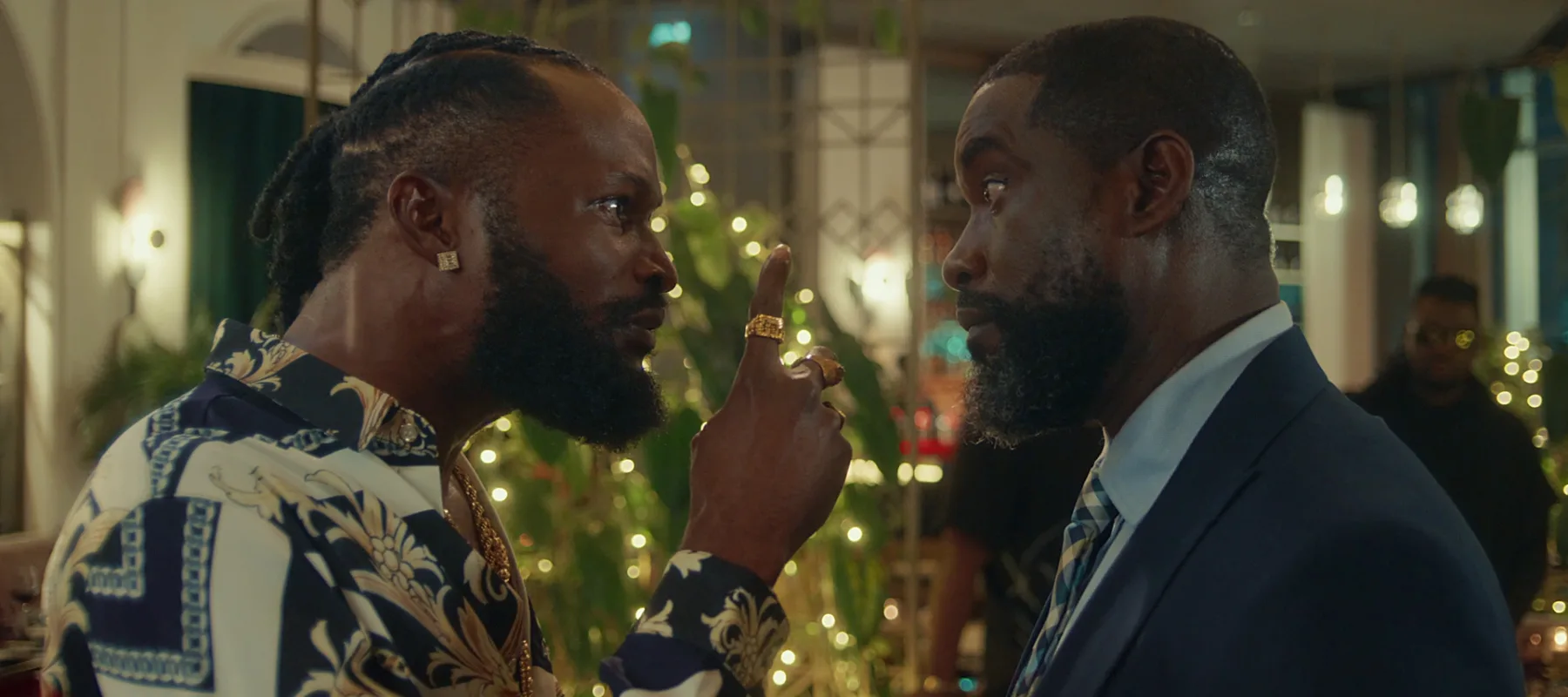
The cast, to their credit, perform their roles with admirable intensity. Bucci Franklin plays Oboz, an Edo-bred hypermasculine crime boss whose financial success has failed to elevate his taste. He is a man drowning in wealth but bone-dry of class, his nouveau-riche anxieties manifesting in a parade of gaudy clothing and ostentatious decor. His wife, played capably by Lilian Afegbai, embodies the luxuriant matriarch who knows her place in the hierarchy of a criminal empire. She is the ‘day one’, the ride-or-die who savours the spoils of her husband’s sins, tolerating his philandering with the assurance that she is the port to which his ship will always return. And in a way she’s right.
The real protagonist, however, is William Benson’s Efe, a morally ambiguous, soft-spoken, brilliant everyman whose brilliance is positively stifled by circumstance. Struggling to fund a deepfake detection software that no one wants to back, he becomes ensnared in Oboz’s world. His descent into crime is believable. We feel his desperation as he is buffeted by misfortune, making his eventual capitulation to the criminal underworld feel tragically predetermined. In fact his luck is so abysmal, you start to believe his ex-manager was right: God does not like him. However, when wealth arrives, it acts as an accelerant for his latent flaws, transforming him into a selfish, greedy, hypocritical, conniving, womanizing, cold and violent man (a change artfully foreshadowed in flashes from his past such as when he stared longingly at an ‘elegant’ woman on his workplace TV). He’s so holier-than-thou that Oboz nicknames him “Jesus cousin.” He sees the rot in everyone but himself. To him, he’s not a criminal, just a man doing what he must. The end justifies the means. And the end, in his version, is taking care of his family. But as Oboz mockingly challenges, “Wetin concern taking care of family with 33 million naira Rolex wey dey your hand?”
His long-suffering wife, played with poise by Stella Damasus, is one of the emotional anchors of the series. She is supportive but tires out as his newly-found fortune curdles his personality into something callous and cruel. In one of the few convincingly written moments, she confronts his coldness with disbelief, so betrayed by the man he has become that she holds onto romanticised memories of their hardship before wealth poisoned him.
Anyways, a Nollywood story about bad guys barely exists without the good guys hence Bimbo Akintola who characterizes a demoted inspector whose grief fuels her investigation. She is a broken shell of a woman who has lost everything: her job, her family, her certainty. Her obsession with finding the truth gives the series its moral compass. But even this is weakened by leaps of logic that border on parody. At one point, she briefly sees Efe years earlier in a hospital corridor, frantic and broke, raging about his stolen funds to nurses who couldn’t care less. She registers his face only in passing. But three years later, she recalls him vividly — in a dream, no less — triggered by her dead son calling out to her. It is a moment of such profound narrative laziness, such a blatant deus ex machina, that it shatters any semblance of realism.
At eight episodes, the story is stretched far too thin. Instead of using the long runtime to build suspense and develop characters, the pacing drags, killing any momentum. The intended emotional gravitas of the betrayal scene at the series’ climax falls flat. Oboz, for all his theatrical cruelty, has always orbited one sacred principle: trust. His entire world is constructed on the brittle bones of loyalty, sealed through rituals, bonded by blood, enforced through violence, physical and metaphysical. So when the realisation hits — that the castrated non-man who he made into a man has come to unmake him — it is a betrayal that is so paralytic, so spiritually disemboweling that he’s stilled by dismay and life is literally knocked out of him. The treachery of his brother-in-arms should have been dramatized as nothing less than an apocalyptic schism. But because their emotional dynamic was not explored with sufficient depth nor was it fully developed, there is no sense of tragic kinship undone. Just two men turning on each other, two excellent actors performing what ought to be anguish. A crime drama’s limbic resonance hinges on empathic identification. I’m a notorious movie crier, and this should have been my moment even for a man as corrupt as Oboz. That’s what strong writing does: it makes you feel the knife twist anyway. But the complexity required to make me ache for a fallen antihero simply wasn’t there.
That sense of detachment defines much of the viewing experience. Characters make choices that feel arbitrary. Emotional stakes are introduced but not sustained. The suspense isn’t taut enough, we are not held in a vice, not on edge, not stuck in a state of alertness or unease, with quickening pulses and racing hearts. Plot threads are abandoned without resolution. The script tries to dazzle with complexity, but complexity without coherence is confusion. The audience is never invited to fully feel for any of these characters. We cannot relate to their choices or decisions therefore we are not really invested in their fates.
What the series does achieve, however, is a refreshing representation of the Niger Delta — a region often sidelined in mainstream Nollywood — from the language choices to the accent and the overall cultural signifiers. The acting, almost across the board, is commendable. Even when the script collapses, the cast carry on, giving their roles the sincerity the story does not quite earn. There are flickers of brilliance in the cinematography: the skillful implementation of chiaroscuro in a few shots, the smoke-drenched ritual scenes, the wet, oily glisten of Lagos at night. The editing, too, has flashes of intention. Still even these flourishes do not save the story.
In crime narratives of this ilk, the terminal victory of good over evil is often a foregone conclusion. The true measure of To Kill a Monkey wasn’t its capacity to surprise us with a shocking conclusion, but rather its ability to hold our attention, to entertain us, to impress us with masterful filmmaking and storytelling, making the progression of the plot gripping even with a predictable outcome. Regrettably, throughout the series, the prevailing sensation was one of merely rushing forward to see the inevitable dénouement and be done with it.
Adetiba has already proven she can direct gripping, layered narratives. King of Boys remains a landmark work, not only for its scope and ambition, but for its confidence. To Kill a Monkey lacks that confidence. It tries to do too much, say too much, mean too much, and just like Oboz, tries too hard to look like it belongs.