


Tune in to listen
Bounce FM

The fight persists even as the NMDPRA leadership has changed, with Saidu Aliyu Mohammed replacing Ahmed in December.
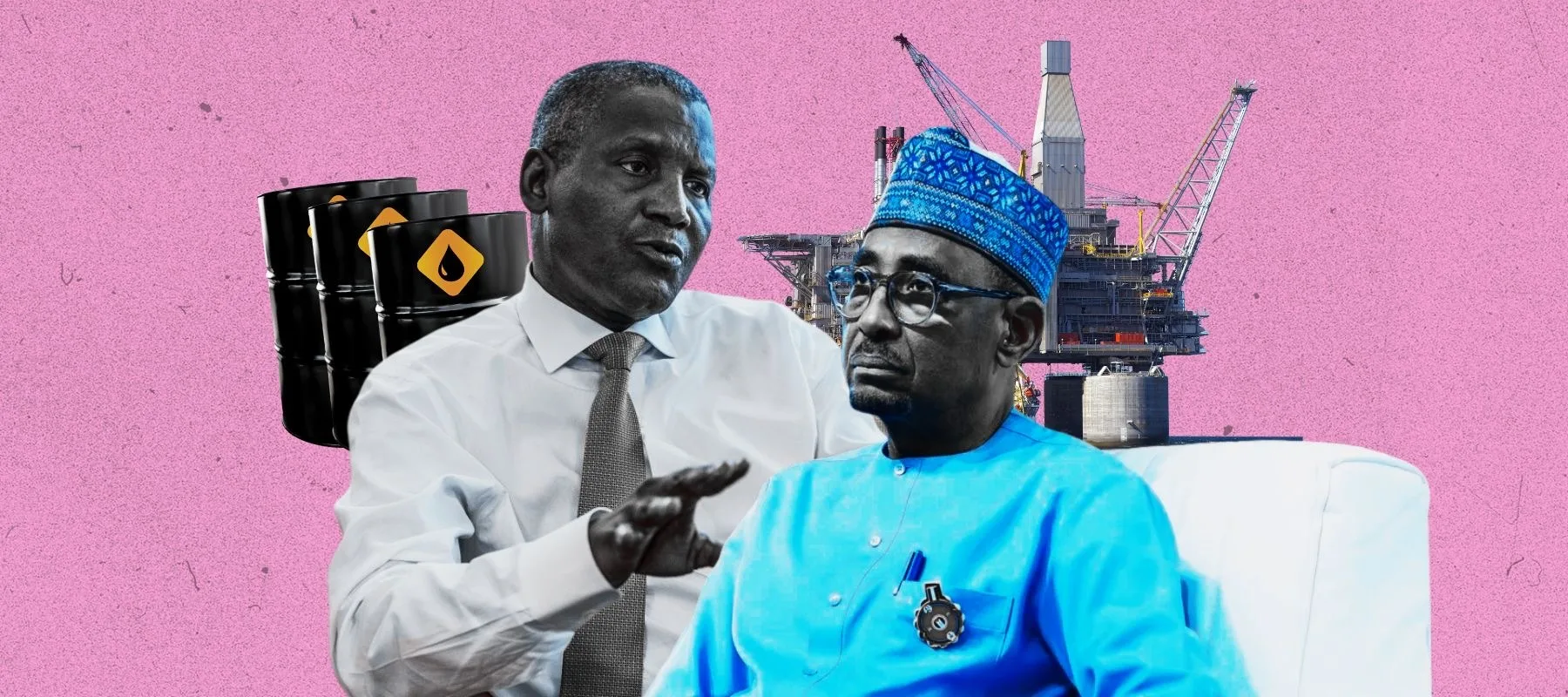
When the Chief Executive Officer (CEO) of the Nigerian Midstream and Downstream Petroleum Regulatory Authority (NMDPRA), Farouk Ahmed, abruptly resigned on Wednesday, December 17, 2025, many observers assumed that the troubles surrounding the top petroleum regulator had departed with him. A few who did not initially share that view soon reconsidered on Wednesday, January 7, 2026, when the Independent Corrupt Practices and Other Related Offences Commission (ICPC) announced that the Chairman of Dangote Group, Aliko Dangote, had withdrawn his petition against Ahmed.
Dangote had submitted a petition to the commission on December 16, 2025, accusing the then NMDPRA CEO of “corruption and financial impropriety.” In the petition, sent through his lawyer and Senior Advocate of Nigeria (SAN), Ogwu Onoja, the serial entrepreneur called for Ahmed’s arrest, investigation and prosecution, alleging that he was “living beyond his means” as a public officer.
In an extraordinary press conference on Sunday, December 14, 2025, Africa’s richest man shocked many Nigerians by accusing Ahmed of economic sabotage and corruption. But more was to come the following Tuesday, December 16, in a paid newspaper advert in which Dangote claimed that Ahmed had spent about $5 million on the secondary school education of four of his children in Switzerland. According to the billionaire businessman, the schools attended over a six-year period included Montreux School, Aiglon College, Institut Le Rosey and La Garenne International School. He presented estimates of annual tuition, living expenses, air travel and upkeep, multiplied across four children and several years of study. Dangote claimed the annual cost per child stood at $200,000, amounting to $800,000 yearly for all four children.
He further explained that the total living expenses and air travel per child over six years came to $1.2 million, or $4.8 million for the four children combined. Overall, he estimated that the cost of tuition and upkeep amounted to $5 million. Dangote added that Nigerians deserved to know the source of such funds “paid by a public officer while many parents in his home state of Sokoto cannot afford to pay ₦10,000 in school fees for their children and wards.”
What many did not know, however, was that these blockbuster accusations were not the opening act. In fact, the billionaire had — almost quietly — been at war with the former NMDPRA boss for more than a year by that point. After months of discontent over the agency’s issuance of import licences — which Dangote deemed unnecessary, given his belief that his refinery could supply the entire country — the oil magnate took a decisive step on September 6, 2024 — just over 16 months ago — by filing a suit, marked FHC/ABJ/CS/1324/2024, at the Federal High Court in Abuja.
In the suit, Dangote Refinery sought ₦100 billion in damages against the NMDPRA for allegedly continuing to issue import licences to Nigerian National Petroleum Company Limited (NNPCL), Matrix Petroleum Services Limited and five other companies for importing petroleum products such as Automotive Gas Oil (AGO) and jet fuel (aviation turbine fuel) into Nigeria. The refinery argued that these products were already being produced domestically without any supply shortfall. It further contended that the NMDPRA violated Sections 317(8) and (9) of the Petroleum Industry Act (PIA) by issuing import licences that should only be granted where a proven supply deficit exists.
Days after the suit was filed, three oil companies whose import licences would have been invalidated — Matrix Petroleum Services Limited, A.A. Rano Limited and AYM Shafa Limited — filed a motion urging the court to dismiss the suit. They argued that only the NMDPRA and the NNPCL are legally empowered to determine petroleum product shortfalls in Nigeria, not Dangote Refinery. At the heart of the dispute was a rejection of monopoly. While Dangote Refinery sought to position itself as the sole supplier of petroleum products to Nigeria, the NMDPRA, its then CEO, Ahmed, and other stakeholders, such as Matrix and Rano, considered such dominance undesirable and risky.
That fear of monopoly directly influenced the decision of the Federal Competition and Consumer Protection Commission (FCCPC) to file a motion on January 5, 2025, seeking to join the suit as a co-defendant. “There are grounds from the plaintiff’s case for believing that the plaintiff (Dangote Refinery) is attempting to create a monopoly situation in relation to the production and distribution of petroleum products in Nigeria through the machinery of the court,” the FCCPC stated in the motion filed by its legal team led by Barrister Olarenwaju Osinaike. The commission argued that Nigeria operates a free-market economy that allows individuals and entities to participate across sectors without undue restriction.
Dangote Refinery, in its response, denied any monopolistic intent, stating that the suit was aimed solely at revitalising local petroleum refining. Nevertheless, several stakeholders, including the Petroleum Products Retail Outlets Owners Association of Nigeria (PETROAN), have accused the refinery of attempting to dominate Nigeria’s downstream petroleum sector.
Although Dangote withdrew the suit on July 28, 2025, these disputes over import licences are closely linked to an intense price war between Dangote and oil importers. The billionaire’s refinery has often been accused of abruptly slashing ex-depot prices to undercut importers who cannot match such reductions without incurring heavy losses. The refinery, however, maintains that this strategy reflects healthy market competition.
In practice, oil importers have struggled to keep pace with Dangote Refinery’s significantly lower pricing. In December 2025, the refinery announced the commencement of nationwide sales of premium motor spirit (PMS), commonly known as petrol, at ₦739 per litre across all MRS Oil Nigeria Plc filling stations. In January 2026, it sought to expand further by offering members of the Independent Petroleum Marketers Association of Nigeria (IPMAN) direct fuel purchases at ₦699 per litre. To stay competitive, many oil importers are being forced to sell PMS at rates below their costs and cheaper than Dangote-backed MRS Oil’s ₦739. For example, NIPCO reportedly sold PMS at ₦738 per litre, SAO filling stations sold it at ₦735, while Akiavic offered the product at ₦737, as of Sunday, January 11. An AP filling station beside an MRS outlet in Mowe, Ogun State, was said to have dropped its price to ₦736 per litre as well.
The price war persists even as the NMDPRA leadership has changed, with Saidu Aliyu Mohammed replacing Ahmed. Nearly a month into his tenure, Mohammed has refrained from issuing new import permits, although the importation of petroleum products and crude oil is expected to continue in the short term. Another issue certain to remain active in the short term is Dangote’s crusade against Ahmed. Barely two days after the ICPC announced the withdrawal of his petition, Dangote escalated matters on Friday, January 9, 2026, by approaching the Economic and Financial Crimes Commission (EFCC). In the new petition, he urged the EFCC Chairman, Ola Olukoyede, to investigate Ahmed for “financial misconduct, violation of the code of conduct for public officers, and related offences.”
With Dangote facilitating the exit of a key regulator within days and sustaining a campaign against him nearly a month after his resignation, a critical question now looms: will the new NMDPRA CEO seek to avoid the wrath of Africa’s richest man by accommodating his interests, or will he resist the influence of the most powerful businessman on the continent?