



Tune in to listen
Bounce FM

BSide traces their stories and journeys, including how they are using the most incredible tools to craft and weave narratives.
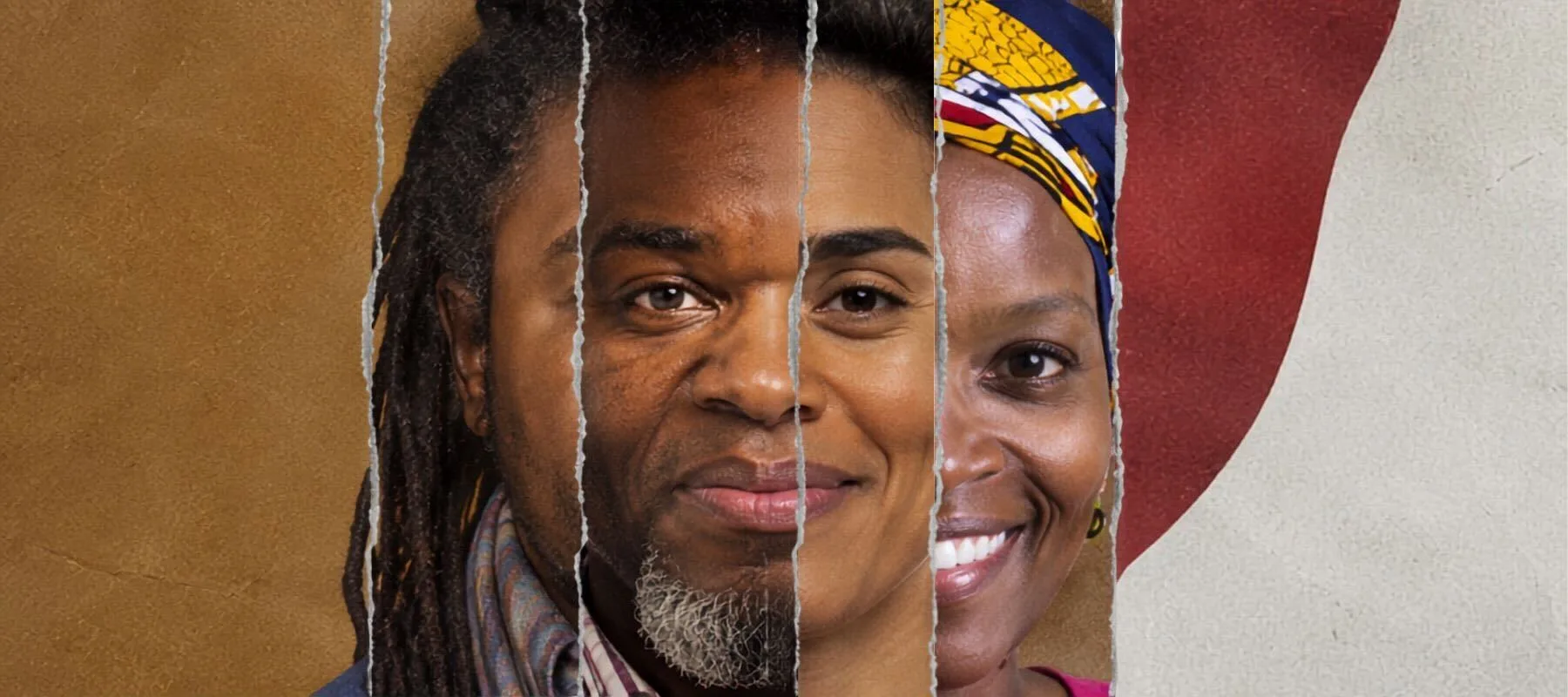
Walk into the Barack Obama Presidential Center and two of the first artworks you will encounter were created by Africans. One is by Ethiopian artist Julie Mehretu. The other by Nigerian artist Njideka Akunyili Crosby. It is another reminder that contemporary African art is no longer emerging, it has arrived.
Embedded in the exterior on the North side of the Museum Building at the centre is a multi-storey painted window, approximately 83 feet high by 25 feet wide. The painting, Uprising of the Sun by Mehretu, was inspired by a quote from President Obama’s speech during the 50th anniversary of the Selma marches on March 7, 2015. Visiting the Obama Presidential Center, it is impossible to miss the gigantic, majestic piece of artwork which welcomes you.
Ethiopian-American Artist Julie Mehretu Pays Tribute to Afewerk Tekele with a Monumental Painted Glass Window at the Obama Presidential Center.” #obamacenter pic.twitter.com/GjcNAxVXQv
— ምን ይሻላል ? (@Zesemir) June 20, 2026
Another artwork that would be difficult to miss is the first joint portrait of the former US president and his wife, Michelle. According to Obama, the piece, made by Crosby, reflects so many chapters of the couple’s story. The portrait is on display in the centre’s Hope and Change lobby on Level 1 of the museum.
It was great joining Njideka Akunyili Crosby — a gifted Nigerian-born, Los Angeles-based artist — to unveil our first portrait together. This piece reflects so many chapters of Michelle and my story, and we’re thrilled that it will be on display in the Hope and Change lobby at… pic.twitter.com/8yFkyjV55D
— Barack Obama (@BarackObama) June 15, 2026
But these artists are not the only ones flying Africa’s flag high globally. There are many others showcasing the continent’s creative minds. BSide traces the stories and journeys of Africa’s top visual artists and how they are using the most incredible tools to craft and weave narratives. Here are ten of them, in no particular order:
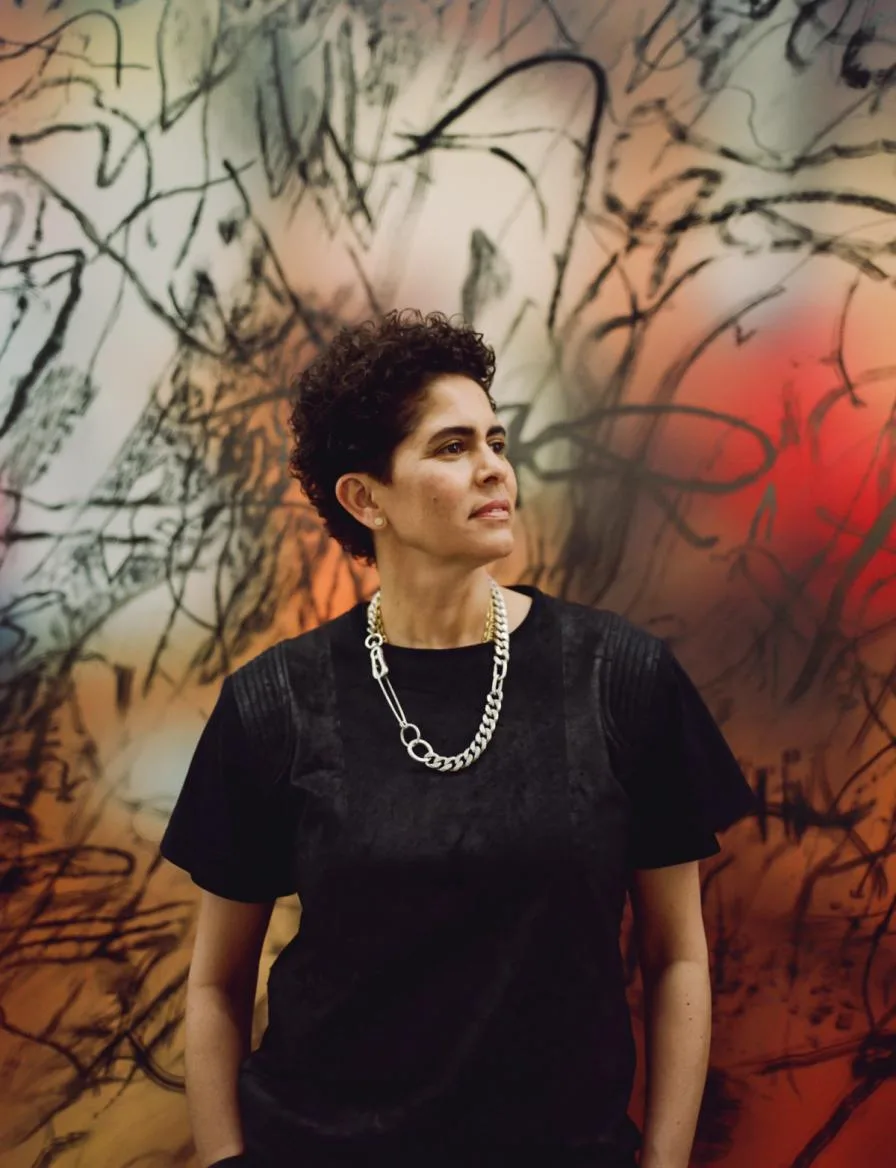
Born in Addis Ababa, Ethiopia, and raised in Michigan after her family fled political upheaval, she earned her Master of Fine Arts (MFA) from the Rhode Island School of Design. Her paintings are dense, explosive canvases layered with architectural drawings, city grids, and blurred photographic imagery from global conflict; surfaces that feel simultaneously like aerial maps of cities in collapse and archives of human movement. Uprising of the Sun was her first time working on glass, a departure from the large-scale wall murals that made her name, and the result is impossible to ignore from the street.
Michelle and I think that Julie Mehretu’s art installation, titled “Uprising of the Sun,” will be one of the most important aspects of the Obama Presidential Center and an iconic contribution to the South Side and the city of Chicago. We can’t wait for you to see it. pic.twitter.com/1m63mZwVjt
— Barack Obama (@BarackObama) September 9, 2024
But the Obama Presidential Center is just one entry in a long record. In 2023, Mehretu’s painting Walkers With the Dawn and Morning sold for $10.7 million at Sotheby’s New York, making her one of the most expensive living painters in the world. She also held the previous record of $9.3 million. She received France’s Ordre des Arts et des Lettres in 2025 and is a 2026 Art Basel Awards medalist. She also co-founded AFMAC, running creative workshops across five African cities to build lasting pan-African cultural infrastructure.
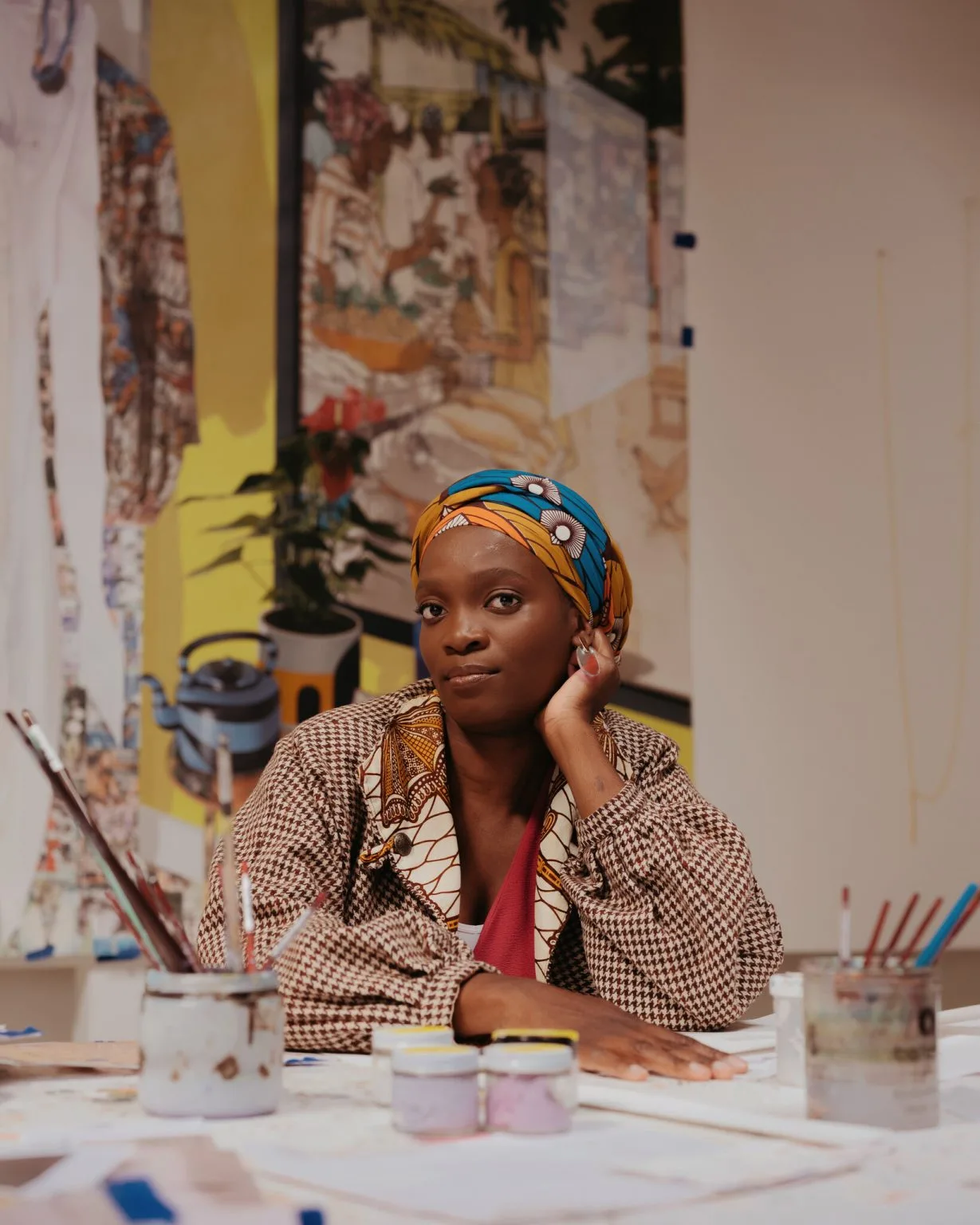
The daughter of the late Professor Dora Akunyili, Nigeria’s formidable former Director-General of the National Agency for Food and Drug Administration and Control (NAFDAC), Njideka Akunyili Crosby built a practice as distinctive as her lineage. Working in Los Angeles, she creates densely layered compositions that combine painting, drawing, charcoal, pastel, and Xerox photo transfers of images drawn from Nigerian magazines, family photographs, and personal archives. The surfaces hold two worlds at once: domestic scenes weighted with embedded cultural memory, always with something new buried inside the image.
Barack and I were so honored to have @AkunyiliCrosby create our portrait for the Obama Presidential Center. Her artistic brilliance shines through — and the way she infused such life and joy into the piece is truly extraordinary. We love it, and we think everyone who visits the… pic.twitter.com/3raI6ac2cj
— Michelle Obama (@MichelleObama) June 15, 2026
Her international breakthrough came with a 2015 solo show at the Hammer Museum in Los Angeles, followed by the MacArthur “Genius” Fellowship in 2017. She has since exhibited at MoMA, the Metropolitan Museum of Art, the Tate, and the National Portrait Gallery in London. The Obama Presidential Center commission — The Obamas: Springing Forth (2026) — is the crowning moment of a career that has been ascending steadily for over a decade. The nine-by-twelve-foot work, hanging permanently in the centre’s main lobby, layers archival imagery, family albums, and cultural touchstones, including a view of Michelle Obama’s Chicago childhood home and the MLK bust that stood in the Oval Office during Obama’s presidency.
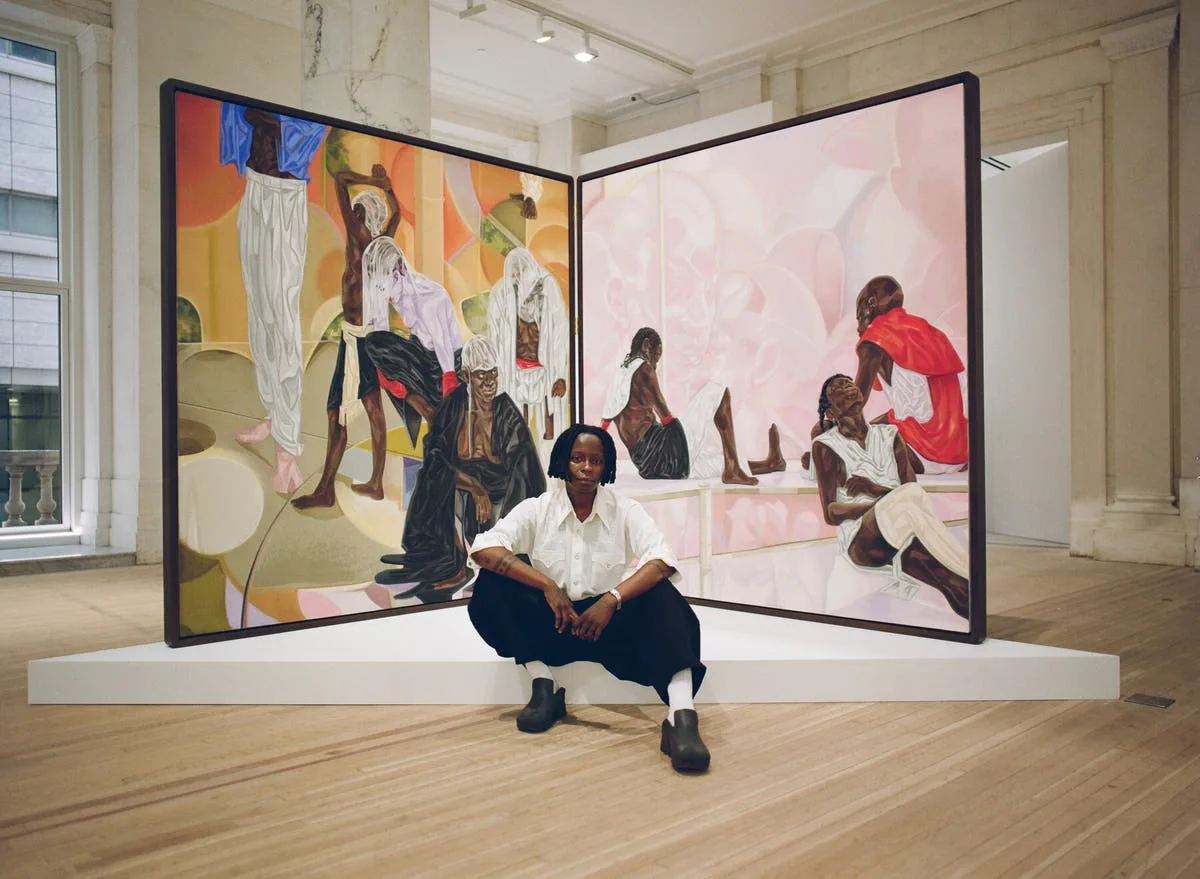
Few artists working today command surfaces the way Toyin Ojih Odutola does. Born in Ilé-Ifẹ, Nigeria, and raised in Huntsville, Alabama, she builds her work almost entirely through drawing — ballpoint pen, graphite, coloured pencils, charcoal, pastel — constructing thick, richly textured topographies of Black skin that read like geography and psychology at once. To look closely at her work is to discover that the surfaces themselves are portraits.
Her defining conceptual move is world-building through fiction: she invents elaborate aristocratic Nigerian dynasties — the UmuEze Amara Clan, the House of Obafemi — constructing alternate histories free from colonial rupture, populated with figures of leisure, ambition, and queer intimacy.
‘a parting gift; hers and hers, only’- a countervailing theory. by toyin ojih odutola pic.twitter.com/31t3m87gzY
— the.v𝐢be (@thejpgvibe) August 27, 2022
Her 2017 Whitney Museum solo show To Wander Determined, which earned an essay from Zadie Smith, announced her to the world. She has since exhibited at the Barbican, the Hirshhorn, SFMOMA, and Kunsthalle Basel; contributed to the Nigerian Pavilion at the 60th Venice Biennale in 2024; won the Joyce Alexander Wein Artist Prize that same year; and appeared on TIME100 Next in 2025. Her Representatives of State (2016–17) sold for $1.9 million at Sotheby’s in May 2024, and her concurrent 2025 solo shows at Hamburger Bahnhof in Berlin and Jack Shainman Gallery in New York marked a new peak in a career that keeps raising its own ceiling.
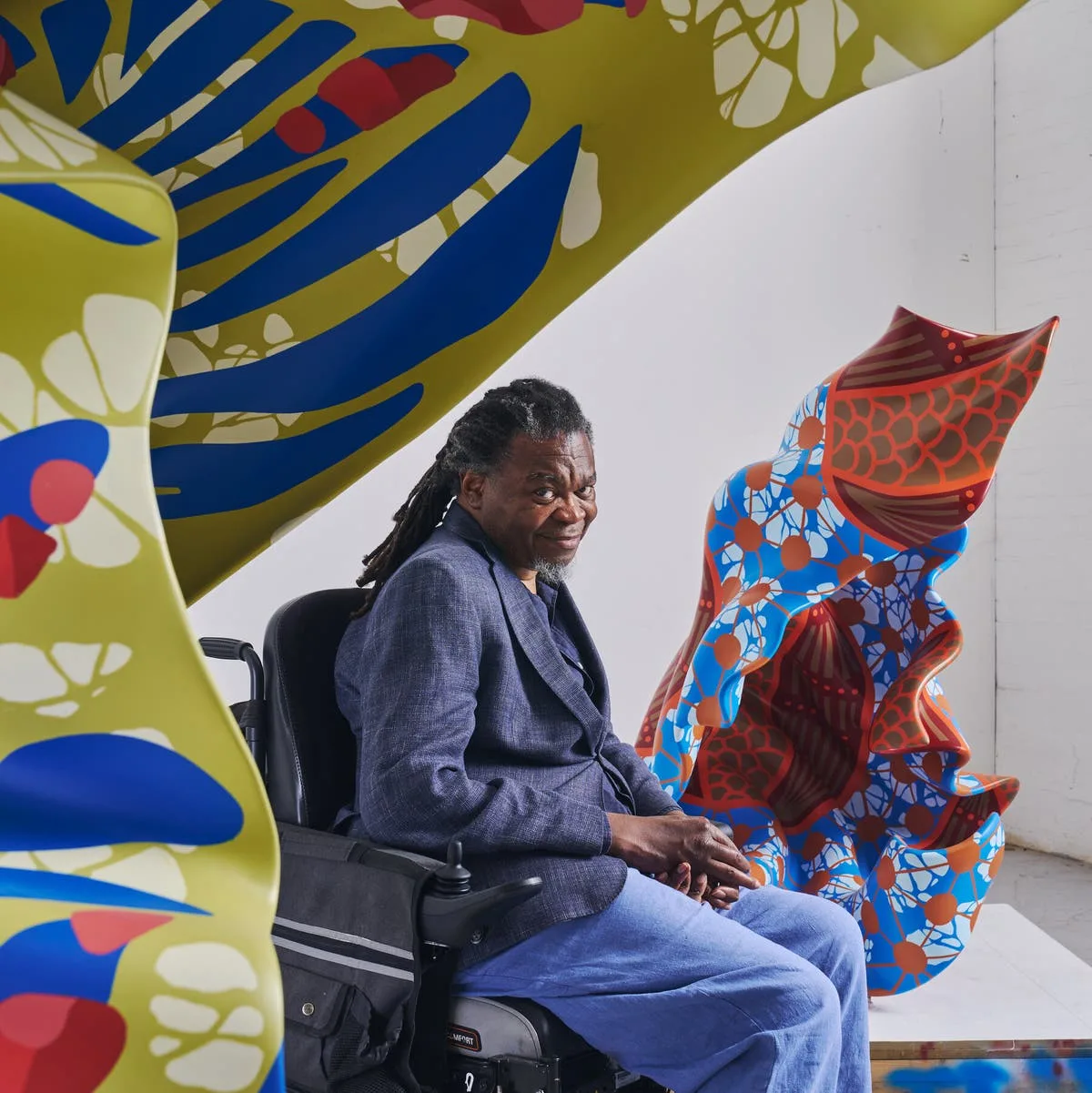
Yinka Shonibare’s art is built on an exquisite contradiction. His signature material — the brightly coloured Dutch wax batik fabric known across West Africa as Ankara — is not African at all. It was designed by European manufacturers to imitate Indonesian textiles and sold to the colonies, then adopted as a symbol of African identity and independence. Shonibare uses it to dress headless mannequins, reimagine Western art-historical scenes, and drape across sculptural forms, turning the fabric’s layered history of trade, cultural appropriation, and postcolonial identity into the very medium of his critique.
THE SWING (AFTER FRAGONARD), Yinka Shonibare, 2001 pic.twitter.com/ETXy22i3aY
— Artists of Colour (@artistsofcolour) March 8, 2025
Born in London and raised in Lagos before returning to England for art school, he was part of the Young British Artists generation at Goldsmiths in the late 1980s. A Turner Prize nomination in 2004 and an MBE the following year — which he kept in his professional name, calling it “the notion of the Trojan horse” — cemented his reputation. He was elevated to CBE in 2019 and Royal Academician the same year. In 2024, he exhibited at the Serpentine and contributed Monument to the Restitution of the Mind and Soul to the Nigerian Pavilion at the 60th Venice Biennale. In 2025, he opened his first major solo showcase in Africa at Fondation H in Madagascar, and was announced as part of the team designing the permanent national memorial to Queen Elizabeth II in London’s St James’s Park. His Commonwealth Wind Sculpture is due for installation there in 2027.
Artist Yinka Shonibare shares his vision for his Queen Elizabeth Memorial Commonwealth sculpture.
Find out more about the memorial ➡️ https://t.co/ADOs3YYFvkhttps://t.co/7TmeNfBZQF#CommonwealthDay@SHONIBARESTUDIO @RoyalFamily @FosterPartners pic.twitter.com/6azjUCi8ld
— Cabinet Office (@cabinetofficeuk) March 9, 2026
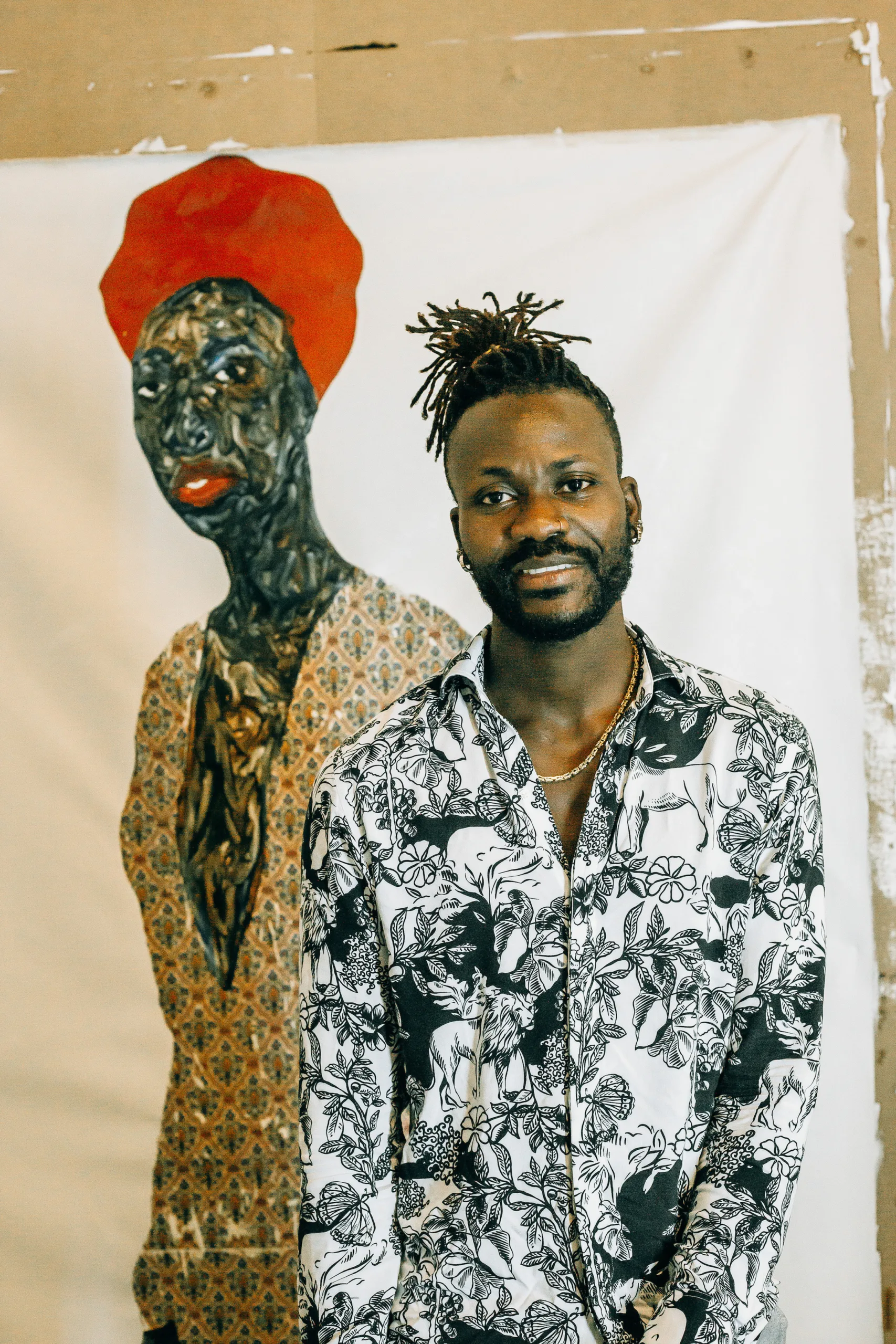
Amoako Boafo’s story is one of the more improbable in contemporary art. He grew up in Osu, Accra, raised by his mother who worked as a househelp after his father died. He could not afford art school, so he played semi-professional tennis until a man his mother worked for paid his tuition at Ghanatta College of Art and Design. He later moved to Vienna for his MFA.
Monstera Leaf Sleeves, 2021
© Amoako Boafo (Ghanaian painter, b. 1984) pic.twitter.com/jIIvDVkH2A— Brindille (@Brindille_) March 7, 2025
His breakthrough technique is deceptively simple: he paints skin with his fingers rather than a brush, leaving visible fingerprints that create thick, immediate, tactile surfaces. The figures — friends, acquaintances, public figures — are typically isolated on bold single-colour backgrounds, confronting the viewer without mediation. In 2018, Kehinde Wiley found his work on Instagram and passed it to his gallerists. Things moved fast from there: Rubell Museum residency, Dior collaboration, gallery representation, and three paintings launched into space on a Blue Origin rocket. In April 2025, his debut London solo exhibition at Gagosian reconstructed the courtyard of his childhood home in Accra inside a West End gallery. He also runs dot.ateliers, a residency programme in Accra built to give emerging Ghanaian artists the support he never had. His works once sold for a few thousand dollars. They now command millions.
"I Do Not Come to You by Chance," an exhibition of new work by Amoako Boafo, is now on view at Gagosian, Grosvenor Hill, London: https://t.co/bT9YVeeTNi pic.twitter.com/VwwlmH7n4x
— Gagosian (@Gagosian) April 14, 2025
An exhibition of new work by Amoako Boafo, titled "I Do Not Come to You by Chance," is now on view at Gagosian, Grosvenor Hill, London: https://t.co/bT9YVeeTNi pic.twitter.com/MlkKLDrm4R
— Gagosian (@Gagosian) May 3, 2025
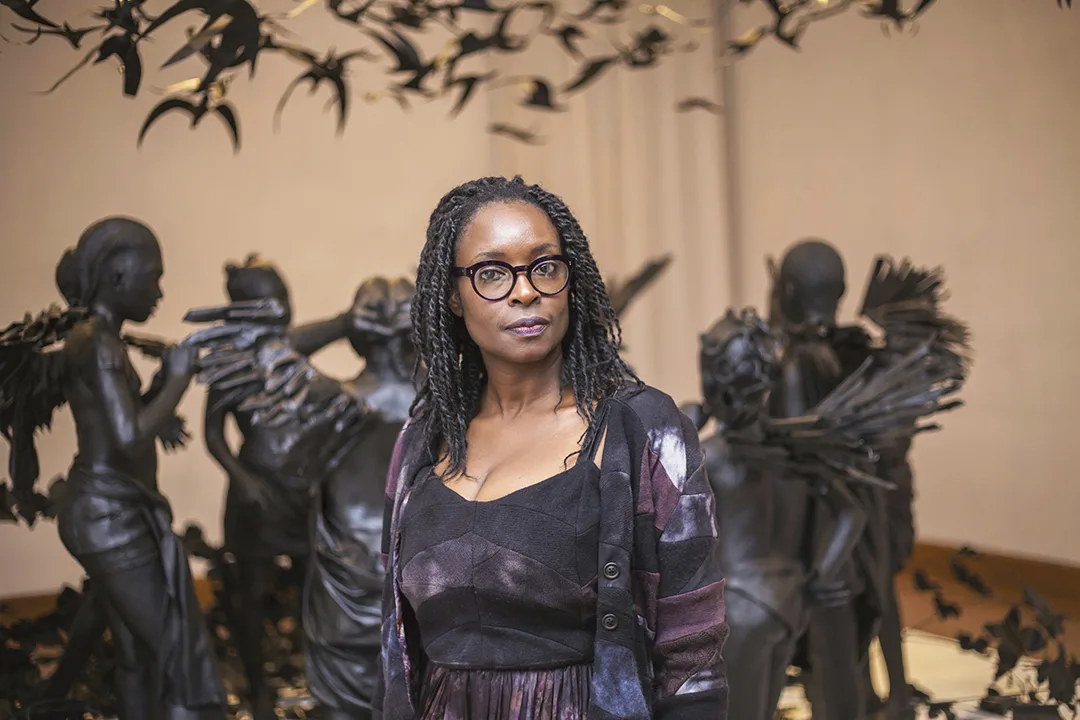
Peju Alatise trained as an architect, and you can feel it in her work; the attention to scale, space, and structure that makes her installations physically arresting before you even begin to read them. But what drives the work is not form; it is urgency. She is a storyteller rooted in Yoruba cosmology and feminist politics, building sculptures and installations that hold children’s rights, women’s experiences, and the realities of contemporary Nigeria as their subject matter.
‘Missing’ by contemporary Nigerian artist Peju Alatise, her response to the kidnapping of 234 girls from Chibok in Nigeria #womensart pic.twitter.com/jBUujbmN0J
— #WOMENSART (@womensart1) August 1, 2018
Her sculpture Nine-Year-Old Bride (2013) coincided with a Nigerian parliamentary debate on child marriage. Missing responded directly to the Chibok abductions. Flying Girls (2016) — eight life-sized winged girls mid-flight, drawn from the imagined inner world of Sim, a nine-year-old girl rented out as a domestic servant in Lagos — became her international calling card when it was shown at the 57th Venice Biennale in 2017, part of Nigeria’s debut pavilion. Her 2024 London show We Came With The Last Rain at Rele Gallery continued her sustained exploration of girlhood, escape, and the weight of being unseen. She is a Smithsonian Institution fellow and divides her time between Lagos and Glasgow.
PEJU ALATISHE and her award winning sculpture.
TITLE: FLYING GIRLS
Inspired by the juxtaposition of a nine year old ‘house girl’ she met in Lagos and the girl’s imaginary world of birds and butterflies, Peju Alatishe created a captivating piece of art. pic.twitter.com/68SXo2LwPQ— MORÍÌKẸ́ (@omoduduwa) June 23, 2024
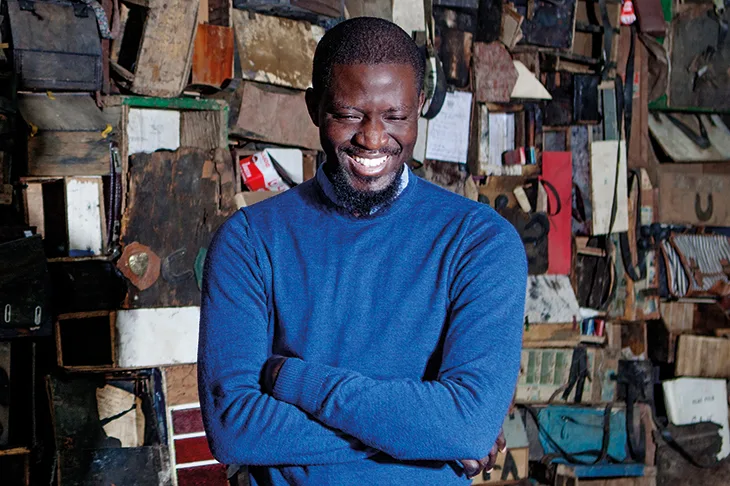
Few artists in the world right now occupy the position Ibrahim Mahama does at the intersection of art object, community infrastructure, and political philosophy. Working from Tamale in Northern Ghana, he builds monumental installations from jute sacks used to transport cocoa beans, batakari robes, rubber tyres, and the heavy canvases pulled off long-haul trucks and railway parts. For the Ghanaian artist, these materials tell the stories of people and the economies that shaped their existence.
THE RED CLAY Studio in Tamale created by Ibrahim Mahama (Artist) An unforgettable journey of memories and untold stories… 🤔🤔🤔 Go see it for yourself, totally worth the visit! #TeamMooove pic.twitter.com/l17EamfS40
— Kofi Kinaata (@KinaataGh) November 10, 2025
His installation Out of Bounds at the 2015 Venice Biennale established him internationally. Since then his work has been shown at documenta in Kassel, the Kochi-Muziris Biennale, and major museums including the Centre Pompidou and LACMA. In December 2025, he became the first person from Africa to top ArtReview‘s Power 100, the annual global ranking of the most influential figures in contemporary art. He also won the inaugural Art Basel Gold Award in the Established Artist category. In June 2026, he unveiled The God of Small Things on the Münsterplatz in Basel, a vast textile installation that distills all of these threads into a single, unmissable public statement.
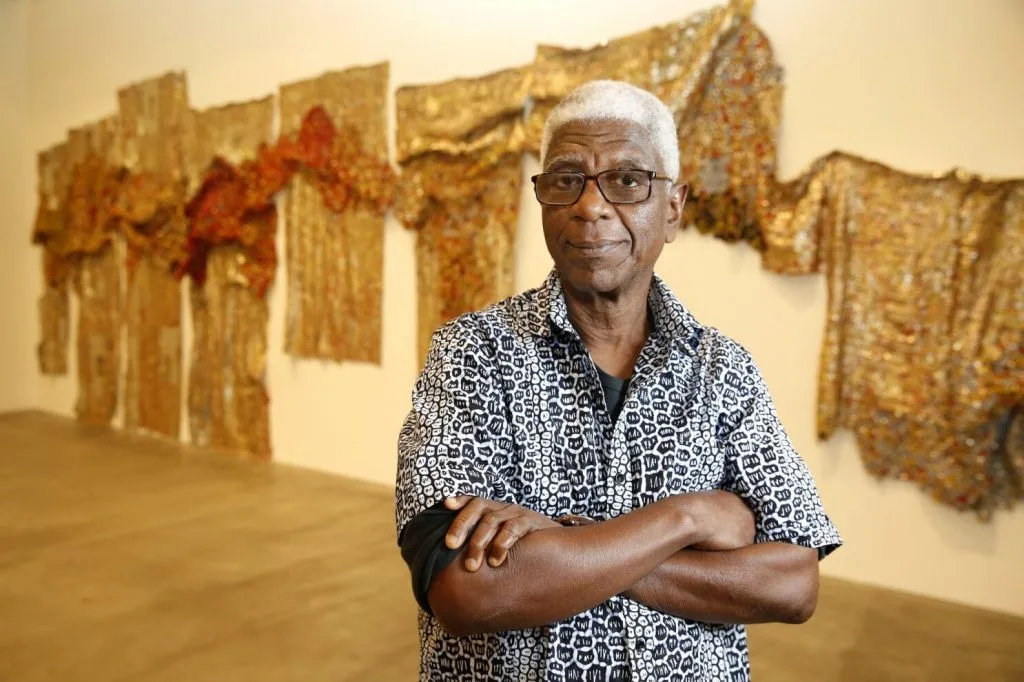
El Anatsui is the elder statesman of this list, and arguably the one whose influence runs deepest. Born in the Volta Region of Ghana, he spent over four decades teaching sculpture at the University of Nigeria, Nsukka, while gradually building one of the most globally recognised bodies of work in contemporary art. His signature form — thousands of aluminium bottle caps sourced from recycling stations, stitched together with copper wire into shimmering, cloth-like wall sculptures that can be reshaped for every installation — is instantly recognisable and endlessly surprising.
"Between Earth and Heaven" captures the space between the physical world and the spiritual realm.
Ghanaian artist El Anatsui hand-crafted this monumental “metal tapestry” from everyday materials like recycled bottle caps, transforming the ordinary into something transcendent.… pic.twitter.com/4yxVfubAUm
— The Metropolitan Museum of Art (@metmuseum) August 6, 2025
The bottle caps are not decorative. They connect to histories of alcohol trade along colonial routes, to waste, consumption, and the circular economics of postcolonial West Africa. In 2023, Anatsui was selected for the Hyundai Commission at Tate Modern’s Turbine Hall, among the most prestigious public art slots in the world, presenting Behind the Red Moon. For 2025–26, he designed the Safety Curtain commission for the Vienna State Opera. Now past 80, he remains in active production between studios in Nsukka and Tema. Museums across nearly every major continent own his work.
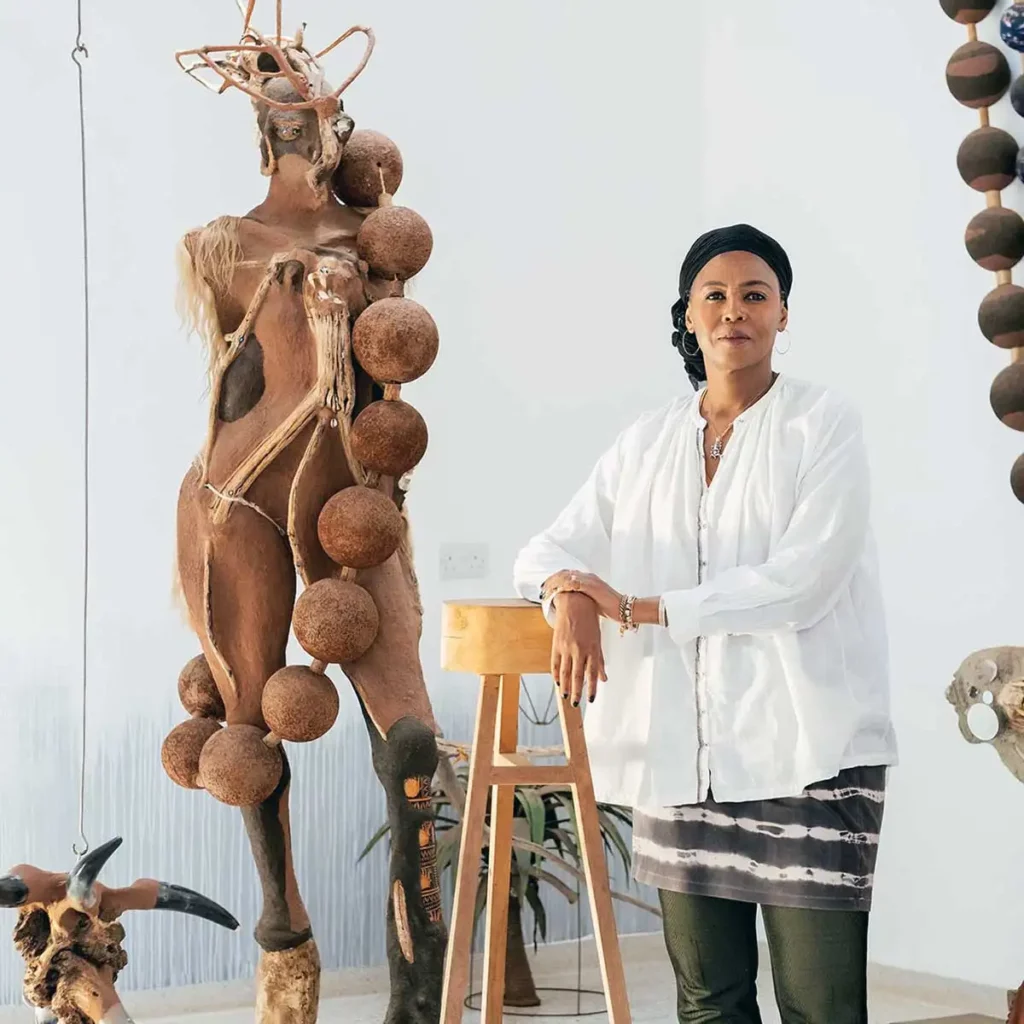
Wangechi Mutu began her career making collages that cut up fashion magazines, medical illustrations, and pornographic imagery to construct hybrid female figures — part woman, part animal, part machine — set in dystopian landscapes. The work was unsettling in the best way: beautiful and grotesque at once, sharp in its critique of how Black female bodies have been packaged, consumed, and erased.
IN KILLING FIELDS SWEET BUTTERFLY ASCEND, Wangechi Mutu, 2003 pic.twitter.com/3IcBow7pzz
— Artists of Colour (@artistsofcolour) January 21, 2022
Born in Nairobi and trained at Cooper Union and Yale, Mutu has expanded her practice over three decades into large-scale bronze sculpture, film, video installation, and performance. In 2019, she made history by becoming the first artist to fill the Metropolitan Museum of Art’s Fifth Avenue facade niches — empty since 1902 — with four nearly seven-foot bronze sculptures titled The NewOnes, will free Us: powerful seated women drawing on the caryatid tradition of both African and Western art history, reasserting Black female authority on one of the world’s most recognisable cultural buildings. In 2023, the New Museum in New York dedicated a full retrospective to her — over 115 works spanning three decades — which then travelled to the New Orleans Museum of Art in 2024.
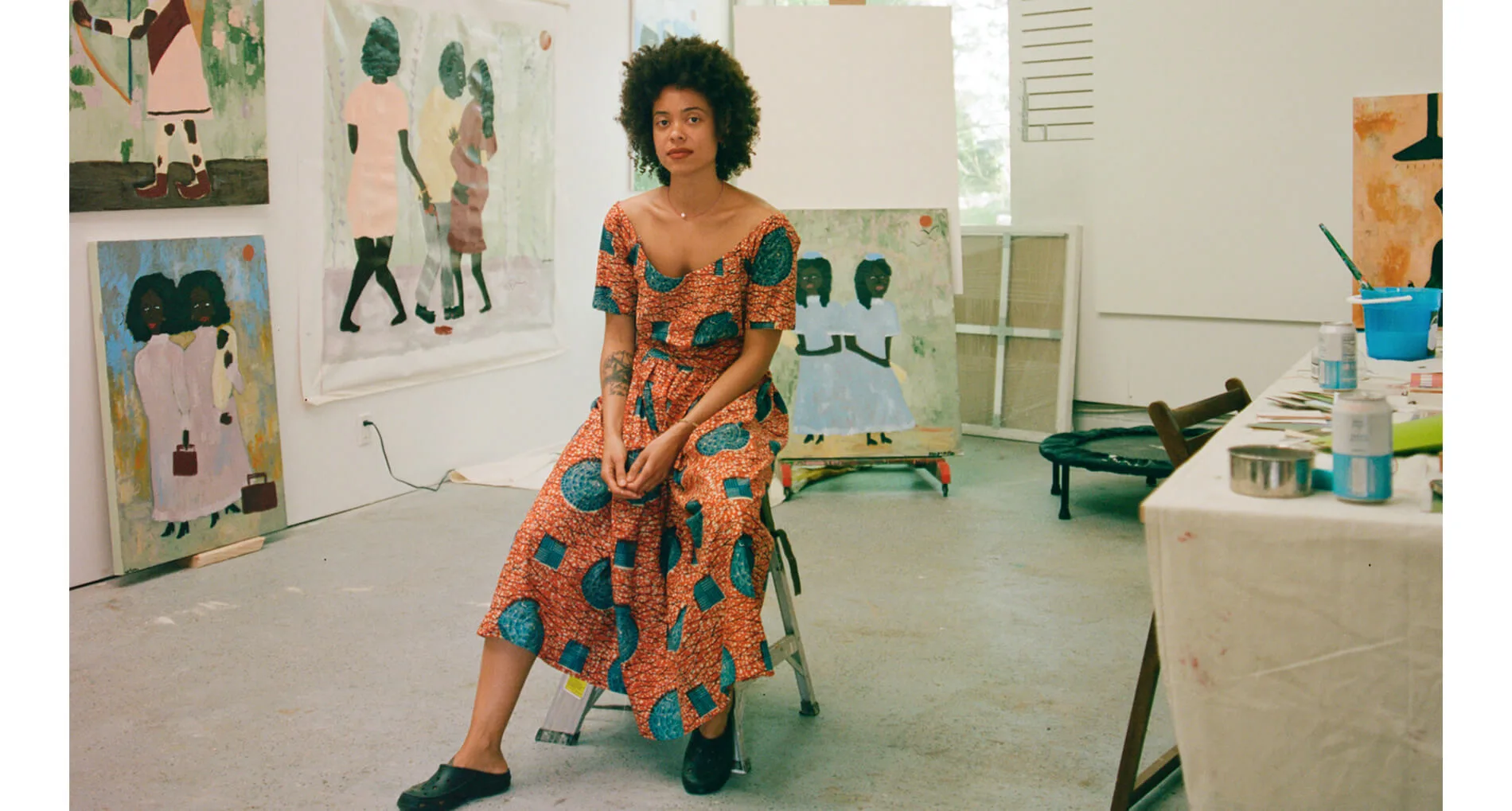
Born in Maputo, Mozambique, and raised across several countries including Haiti and the US, Namoda originally studied cinematography and that instinct for narrative runs through everything she paints. Self-taught, she started showing her work in a friend’s living room in Los Angeles.
LURDES, VANIA, & MARIA ON SUNDAY IN QUELIMANE TOWN, Cassi Namoda, 2021 pic.twitter.com/87j0ALL7VF
— Artists of Colour (@artistsofcolour) July 26, 2021
Her dreamlike figurative paintings place recurring characters — a brutalised Mozambican woman named Maria, conjoined twins, fierce suns — inside post-colonial landscapes where African indigenous religion collides with Western mythology. Her first gallery show was in 2017, and she quickly gained traction among collectors and curators. In 2020, she painted the cover of Vogue Italia. Her work is held by the Pérez Art Museum Miami, the Studio Museum in Harlem, and Jumex Mexico City. From September 18, 2026, to February 21, 2027, she will present her first institutional US solo show at the Institute of Contemporary Art, Virginia.