



Tune in to listen
Bounce FM

Just hours before kickoff of the 2026 World Cup in North America, the experiences of visiting delegates have become the defining talking point of what was supposed to be the…
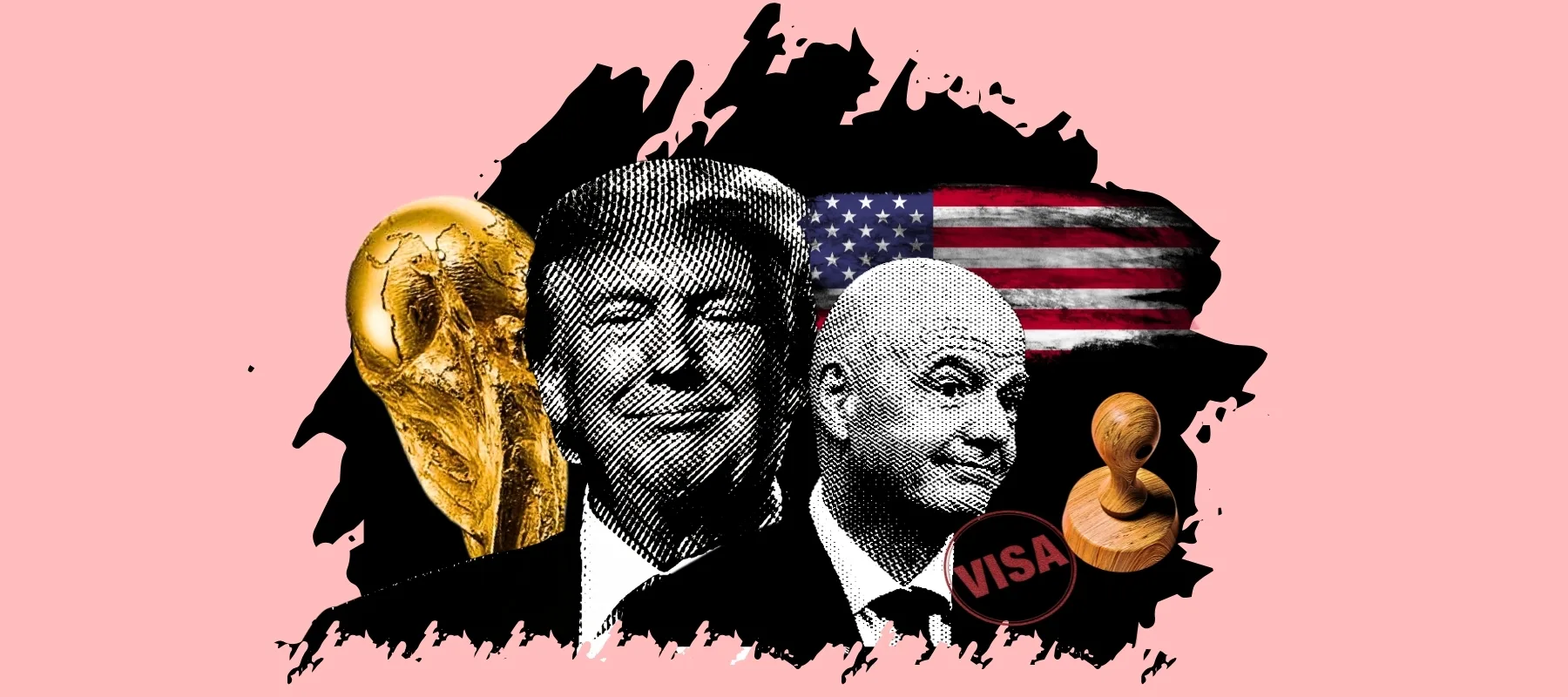
When FIFA officially announced that the United Bid of the United States of America, Canada and Mexico had won the rights to host the 2026 World Cup on the eve of Russia’s 2018 edition, the prevailing sentiment was one of unity across borders.
“Hosting the 2026 FIFA World Cup is a rare and important moment to demonstrate that we are all truly united through sport,” said Carlos Cordeiro, then President of U.S. Soccer and Co-Chair of the United Bid. “We are humbled by the trust our colleagues in the FIFA family have put in our bid; strengthened by the unity between our three countries and the CONCACAF region; and excited by the opportunity we have to put football on a new and sustainable path for generations to come.”
Eight years on, with kickoff less than a day away, those words couldn’t be more hollow.
One thing about global festivals like the World Cup is that they crack the world open in a way that brings to the fore the diverse nuances of our identities, interactions and relationships as a people. Visiting delegates arrive colourful and proudly distinct, carrying the very best of their countries with them, but there is only so much a host nation can choreograph about what the world sees: its politics, social underbelly, religious tensions and broader national realities are exposed to unprecedented scrutiny. It is, inevitably, one of the costs of volunteering to be stewards of the game.
And nowhere is that reality more apparent than in the United States currently. Less than 24 hours before Mexico takes on South Africa in what will be a replay of the 2010 opener, and it is hot — figuratively and literally — in North America. Not much is being discussed in terms of the football set to be staged; rather, the experiences of visiting delegates have emerged as the major talking point of the build-up. The United States, as chief host, with 75 per cent of the tournament’s 104 matches (including every quarter-final, semi-final and the final), carries the heaviest share of that responsibility. By most accounts, it is struggling to live up to it.
A lot has been said about the fiasco involving the 2025 CAF Referee of the Year, Omar Artan. Set to become the first Somali to officiate at a men’s World Cup, Artan, who flew from Istanbul carrying a diplomatic passport issued specifically to ease his travel after earlier visa difficulties, was barred from entering the USA at Miami International Airport after being questioned for about 11 hours, and has since been stood down from officiating duties by FIFA. While initial statements from U.S. Customs and Border Protection were vague, fresh reports allege the officials denied the Somali referee entry due to “association with a suspected member of a terror organisation.”
Somali referee Omar Artan was about to realise a dream of officiating at the World Cup, until he was denied entry to the United States.
It can take officials around 20 years from first blowing a whistle to being selected for international matches. You can become a brain surgeon… pic.twitter.com/Jy0QOPGwxW
— The Athletic | Football (@TheAthleticFC) June 9, 2026
With Somalia being on the President Donald Trump administration’s travel ban list, Artan’s entry into the country was always going to raise a scuffle, but with a diplomatic passport in hand, one would not have been naive to expect better. The World Cup was poised to be the 34-year-old’s and the Somali football community’s first appearance on the world stage (the Somali national team has never qualified for the World Cup), but the alleged findings, pending further developments, override mounting sentiments that have been brewing. But for what it is, there are other arising matters compounding the concerns.
Before Artan’s fiasco, the Senegalese delegation underwent a detailed security check at the airport upon arrival in the United States, while the national teams of Iran, Uzbekistan and Belgium also faced heightened security checks, including handheld pat-downs and searches carried out with police dogs, with some delegation members enduring lengthy questioning. Iran striker Aymen Hussein was detained and interrogated for roughly seven hours at Chicago’s O’Hare International Airport, and the team’s photographer was held for more than ten hours and ultimately denied entry into the United States.
Fans have not been spared either. About 40 of 42 members of a Moroccan supporters association, the Sports Association of Moroccan National Team Fans, were denied U.S. visas after months of preparation and investment in ticketing, accommodation and travel plans. With a near-spotless record of supporting the Atlas Lions abroad: at Russia in 2018, Qatar in 2022, and even the Paris Olympics, no substantial explanation was given for the visa rejection of Morocco’s 12th man. “No clear reasons were given for the visa refusals,” said the group’s head, Azzedine Al Attaraoui. “We just want to support our national team.”
Iranian Football Federation announces the 8% ticket quota allocated to Iran has been revoked by the U.S., leaving the federation currently unable to distribute tickets to supporters.
A case study in political interference, discrimination and FIFA looking the other way. pic.twitter.com/UsU3g2t3Ui
— Leyla Hamed (@leylahamed) June 9, 2026
Similarly, Iranian fans are also in limbo ahead of their campaign opener against New Zealand at the Los Angeles Rams’ stadium on June 15. According to reports, FIFA has also revoked the ticket allocation for Iranian fans for the team’s three World Cup games in the United States, adding to the tension between the U.S. and Iran. The press is also on the receiving end, with scores of journalists from Iran and Africa reported to have been denied entry despite being accredited.
As one of the world’s most tightly regulated immigration destinations, the USA perhaps has justification to maintain its border policies, and from a sovereign standpoint, that is its prerogative. But from a sporting standpoint, it is a damning failure.
While it goes without saying that FIFA cannot be held responsible for the policies of a sovereign nation, let alone a global superpower like the United States, it’s in the crosshairs for ignoring the cues. Even if it is a stretch to think the world football governing body would wilfully ignore the premonitions of ensuing catastrophe, it is not much of one. After all, Donald Trump’s USA has been unequivocal about the America First stance in all its dealings. The signs were there when the Republican signed an executive order entitled Protecting the American People Against Invasion on his first day back in the Oval Office, followed by travel bans levelled largely against countries in Africa and the Middle East, a pause on immigrant visas to over 70 nations, and restrictive visa bond payment requirements. It was clear then that America was neither positioned nor primarily concerned with playing gracious host to the rest of the world under any circumstances.
But instead of taking those cues and salvaging the situation as best as possible, the Gianni Infantino-led FIFA glossed over the legitimate concerns being raised. Infantino’s responses to calls about the unwelcoming and segregatory atmosphere in the USA have consistently missed the point. “There are a lot of misconceptions out there. Everyone will be welcome in Canada, Mexico and the United States for the FIFA World Cup next year. This process will be smooth; it will ensure that those who qualify will be able to come with their fans,” the FIFA president said in 2025.
Now that the bubble appears to have burst, with the competition yet to even begin, it becomes increasingly difficult to understand why FIFA has seemingly lost its voice on issues that directly affect the inclusiveness the expanded World Cup was supposed to represent.
To be clear, the USA being the USA, it would be naive to clamour for far-reaching action against the United States, especially at this point, not that the football body even has the impetus to try. But what FIFA cannot do is fold its arms while the situation plays out like this and plead non-interference in politics, not when it got Qatar to override its own border policies and simplify access for African and Middle Eastern fans through the Hayya card, and not when it got Russia to make similar concessions. Both edition had their flaws and controversies, but they barely strayed from one of the primary tenets of the Mundial.
Whatever the justification, hosting the World Cup comes with an obligation to receive the world, to be hospitable, or, at the very least, to pretend to be. This has never been a thankless endeavour, and it is more lucrative now than at any other point in history. FIFA is projecting revenues of $8.9 billion from this tournament, up from the unprecedented $7.5 billion from Qatar 2022 and almost double what the 2024 Olympics returned. With that much at play, it shouldn’t be too much for FIFA and its chief host to play ball the way it’s intended.