



Tune in to listen
Bounce FM

The scenes captured through IShowSpeed’s lens were Nigeria unfiltered to the world, without the cover of curation.
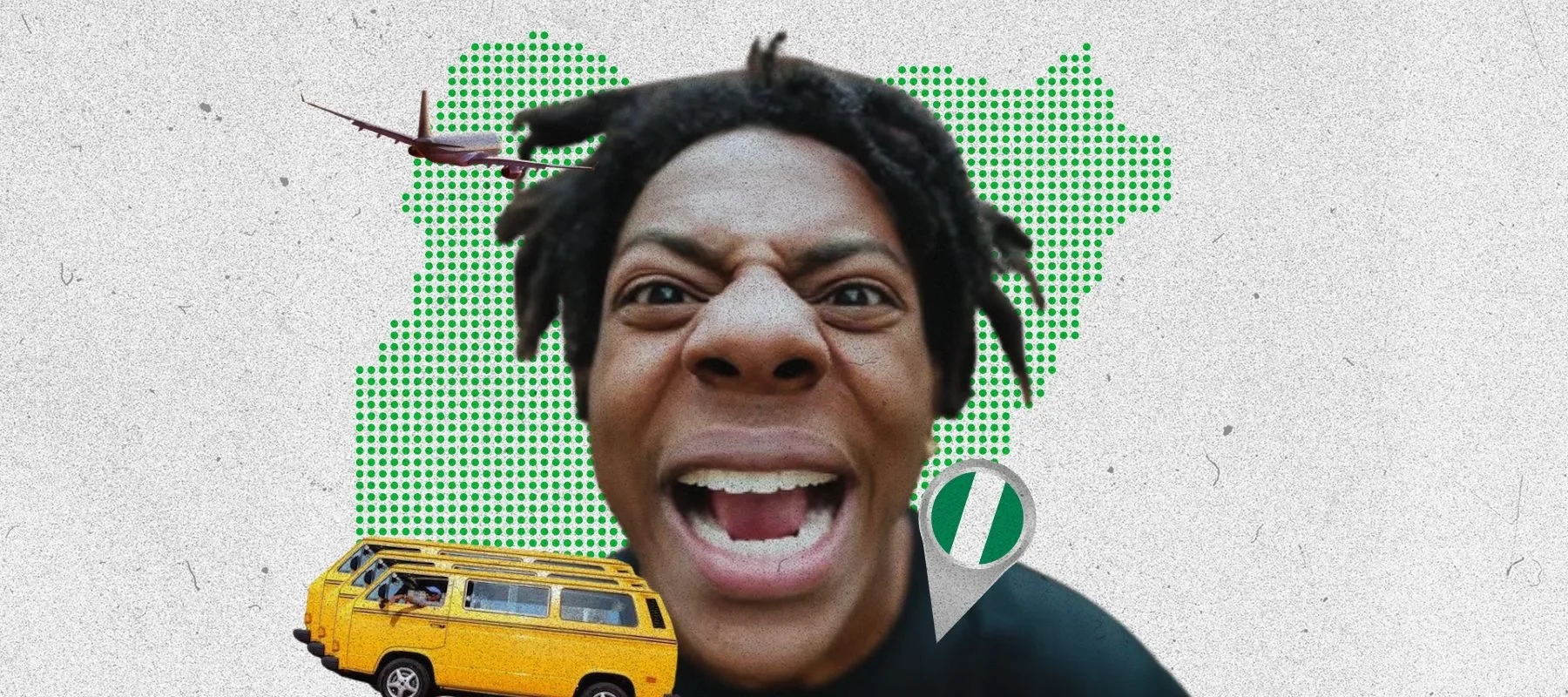
Last Wednesday, January 21, 2026, Nigeria was host to famous streamer IShowSpeed on his 20-country Africa tour, which kicked off on December 29, 2025, and concluded on Tuesday, January 27. The streamer has built his brand around loud, exaggerated, and at times aggressive reactions, which have become central to his online persona. He arrived in Nigeria to significant fanfare on the streets of Lagos. Donning the Super Eagles’ home jersey and sitting through the escape hatch of an open-roof SUV, he rode through the city as hundreds of people flocked alongside his convoy.
iShowSpeed finally lands in Lagos, Nigeria for his stream 🇳🇬pic.twitter.com/cA3FU4WtsE
— 𝐀𝐬𝐚𝐤𝐲𝐆𝐑𝐍 (@AsakyGRN) January 21, 2026
That was not an uncommon scene anywhere in Nigeria for famous people. Nigerians are easily drawn to celebrity worship. But another, equally unsurprising scene played out as IShowSpeed livestreamed the streets of Nigeria to his 49.9 million subscribers. The streamer had barely begun his five-hour, 20-minute broadcast when some overzealous men accosted him, and one started begging for something he couldn’t comprehend.
“I’m not following what y’all are saying here,” iShowSpeed responded to the noise.
Only seconds later, he would understand what the men wanted. As the SUV began to move and the excited crowd followed, they started to yell, “Show love!” Nigerians are no strangers to this lingo, often used as a tacit way of begging for money. But for a foreigner and first-time visitor like IShowSpeed, the meaning was lost on him. Some even directly accused him of not showing love. “You no show love,” one unimpressed guy said in pidgin English. With confusion written all over the streamer’s face, he repeatedly asked his accosters, “What? I don’t understand what y’all are saying.”
🚨WATCH: iShowSpeed is left in disbelief just 10 minutes into his Lagos, Nigeria stream after being approached by countless beggars.
He admits he had no idea he’d come across so many and genuinely believed Nigeria was one of the more developed countries pic.twitter.com/UmMNSKfwOo
— richo (@richo) January 21, 2026
Recognising their target’s cluelessness, the men decided to help. They gestured with their hands to mimic money and followed up with shouts of “money, money, money.” As the SUV picked up speed, so did the guys who wanted “love.” Some hailed the streamer as Number 1 even as he struggled to make sense of what was happening.
Moment Egbon adugbos on Lagos Island told iShowSpeed to give them money but he said he don’t understand them. 😂 pic.twitter.com/fW0sn8d1OH
— 𝐀𝐬𝐚𝐤𝐲𝐆𝐑𝐍 (@AsakyGRN) January 21, 2026
“What the fuck are you saying?” iShowSpeed yelled back.
Sadly for the “love” seekers, he did not “show love,” and they relented. But less than five minutes later, the world-famous streamer met a different group of men who ran after his vehicle and again started shouting “show love” and “money, money, money.” If you were a foreigner not familiar with this behaviour, you would be convinced these men were coordinating, but it’s highly unlikely that they were.
“We love you bro,” they continued yelling, hoping for IShowSpeed to spray some cash, as some Nigerian celebrities have been known to do. For emphasis, this was a different group from the previous one, but the attitude was the same, reflecting a pervasive culture of begging common among residents.
Notably, the “love” seeking was not limited to a certain age group; both old and young participated. Around the 27:40 mark of the YouTube livestream, an elderly man with a white beard, likely in his late 60s, could be seen joining in the ritual.
The scenes captured through IShowSpeed’s lens were Nigeria unfiltered to the world, without the cover of curation. For Nigerians familiar with this culture, the behaviour was not surprising, but many still found it disappointing.
What it says about Nigeria is not necessarily poverty. Yes, 62.9% of residents — just under 133 million people — were deemed multidimensionally poor in a 2021-2022 survey by the National Bureau of Statistics (NBS), and the situation has only worsened since, but this begging attitude reveals a more sinister character: entitlement.
Before arriving in Nigeria, IShowSpeed had been in Mozambique, Rwanda, Zimbabwe, and Zambia, all countries poorer than Nigeria, and there were no similar scenes of begging in any of those countries. The average Nigerian sees someone they perceive as rich, and the first thought that comes to mind is to beg for money. They see you buy a car and ask you for ₦10,000, and you dare not say you do not have it, because your new car signals that you are rich enough to give to all who seek “love.” They call you a liar or a stingy person if you refuse to “show love.”
That attitude does not necessarily come from a place of want or need, but often from an unearned sense of deservingness.
Begging in Nigeria has evolved beyond the desperate outstretched palm of hunger. It has become, in many cases, a social language — a reflex, a performance, sometimes even a demand. The phrase “show love” is revealing not because it is uniquely Nigerian, but because of what it implies: that your possessions are incomplete until they are shared and that your presence in public comes with an obligation to settle strangers.
This is why the begging culture in Nigeria is often loud, aggressive, and unembarrassed. It is not always the quiet plea of someone crushed by hardship; it is the confident expectation of someone who believes you owe them something simply because you have more. The poor beg in many societies, but entitlement begs differently. Entitlement does not ask; it insists. It does not wait; it chases after your car.
And Nigerians have normalised this insistence.
The street-side demand for “love” is now so common that it has seeped into everyday life. It is no longer restricted to the visibly impoverished child who harasses you for money on your way out of Palms Mall, Ibadan, or any other seemingly affluent location in Nigeria. It is the able-bodied man running after a convoy. It is even the elderly man who has learned that public pity can be monetised. The act has become detached from survival and attached instead to opportunity.
What makes it more troubling is how socially sanctioned it has become. Refusing to give is often framed as wickedness or selfishness. Wealth is treated not as the reward of labour but as evidence of excess, and excess, in the public imagination, must be shared. To withhold is to be selfish. The beggar is morally elevated; the one who says no is morally diminished.
This is not to deny poverty. Nigeria is poor in immeasurable ways. But poverty alone does not produce this brazenness. The culture is inflated by patronage and performative generosity — politicians spraying cash, influencers rewarded for access rather than effort, and a system that teaches people that money is not earned but extracted from those above. The poor beg the middle class. The middle class beg the rich. The rich beg the government. The local government chairman prostrates and begs the governor. The governor begs the president. Everybody is begging somebody for something.
So when IShowSpeed rode through Lagos, what followed him was not simply poverty running behind a car. It was a society so accustomed to asking that it no longer knows how to welcome without demanding. And perhaps that is the real culture shock — not his, but ours, when we see ourselves clearly through an unfiltered foreign lens.