


Tune in to listen
Bounce FM

The point was never for celebrities to be able to recite political theories or fix geopolitics. It’s about making forgetting expensive.
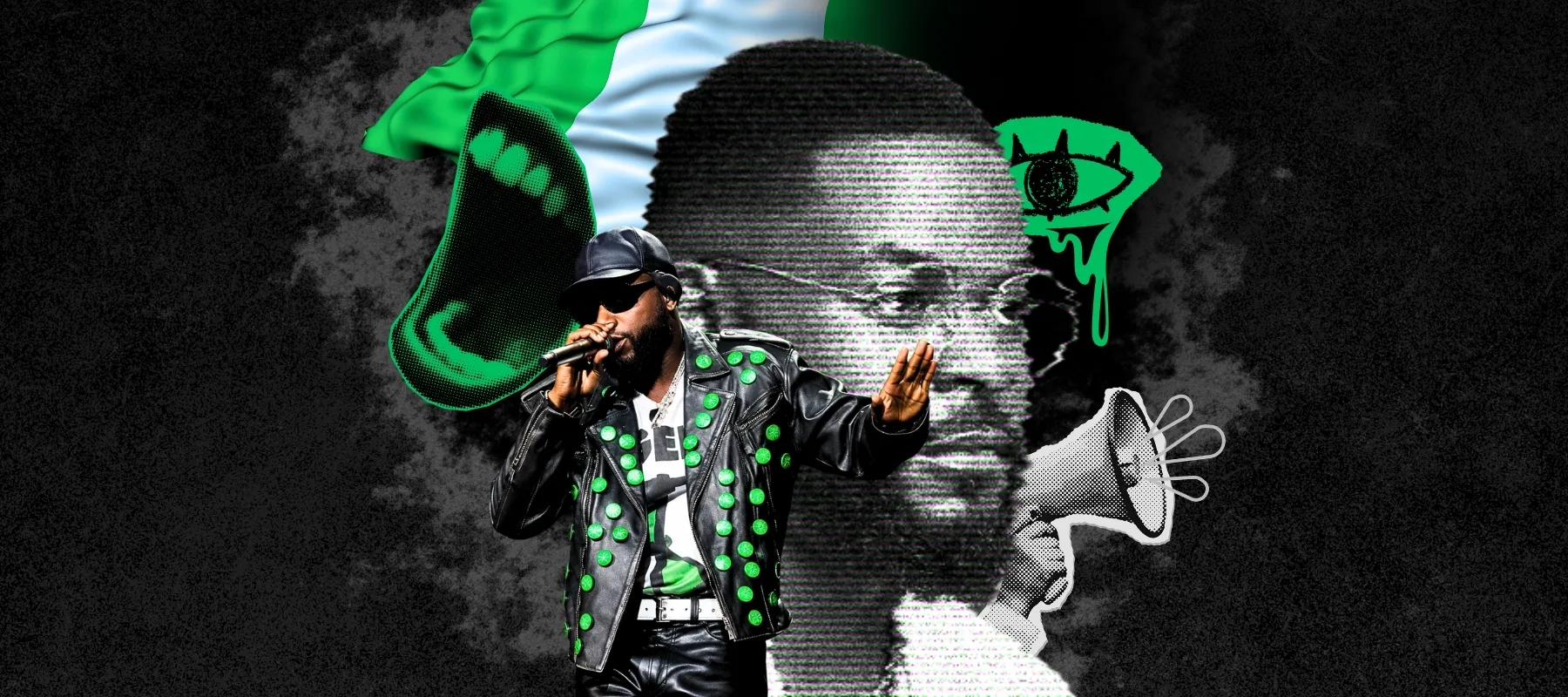
When Afrobeats star Davido stepped onto the stage of the FIFA World Cup 2026 Countdown Concert on Wednesday, June 10, 2026, in Los Angeles, it wasn’t his black leather jacket that caught the eye, nor his baseball cap with ear flaps. It was the green pins, each bearing the name of one of more than 40 abducted schoolchildren and teachers from Oriire Local Government Area, Oyo State. Across the back of the jacket, “BRING THEM HOME” ran in white graffiti-style lettering.
But eight weeks after the schoolchildren and their teachers were violently snatched from their classrooms on May 15, 2026, federal and state governments have yet to bring them home. On Sunday, July 5, BBC News Africa published a clip of Davido explaining what was behind the outfit. “There’s no image to protect if little kids are being kidnapped,” he said, dismissing the idea of staying silent on Nigeria’s security challenges to protect the country’s image.
“There’s no image to protect if little kids are being kidnapped.”
Afrobeats star Davido tells Focus on Africa's Waihiga Mwaura why he wore pins bearing the names of 39 abducted children and seven teachers during his 2026 World Cup performance. pic.twitter.com/LgRnsTg3Vd
— BBC News Africa (@BBCAfrica) July 5, 2026
On his motivation, the Grammy-nominated singer said he believes he has the power to “let the world know through our own means” what is happening “back home.” “When I say our own means, where’s my power? My power is in music, performances. We have these students that have been missing, still not found. So yeah, I use my platform to project what’s really going on,” he told the broadcaster.
That is exactly the attitude singers and celebrities should adopt, one rapper Falz openly shares. Like Davido, Falz’s latest project draws attention to the plight of the Oyo schoolchildren and staff who have spent nearly two months in captivity. The cover art of his new EP, Break Time, depicts an abandoned classroom, a nod to the abduction. It is not new territory for Falz, who in 2019 released the critically acclaimed Moral Instruction, an album that explicitly criticised Nigeria’s political leadership, corruption, and hypocrisy. True to form, his new project tackles the recurring cycle of corruption, hypocrisy, religious extremism, socio-political tension, and recent terrorist abductions.
Not everyone agrees celebrity activism matters. Some believe celebrities with huge platforms should stay quiet, because no one is listening anyway. In June, Nollywood actress Dayo Amusa sharply responded to an X user questioning celebrities voicing opinions online: “Who are you to tell them what to say and what not to say? You think the politicians care about what we say? If you can’t control your parents at home, leave us alone.”
Who are you to tell them what to say and what not to say? You think the politicians care about what we say? If you can’t control your parents at home, leave us alone..
Some of your parents are bonafide members of these parties, yet you come online to monitor what celebrities do… https://t.co/JzmP1quRHN
— I am Dayo Amusa (@iamdayoamusa) June 4, 2026
Many Nigerian celebrities share that view, and it isn’t restricted to Nigeria. During his monologue at the 2020 Golden Globes, comedian Ricky Gervais told celebrities to keep their political opinions to themselves: “If you do win an award tonight, please don’t use it as a platform to make a political speech… You’re in no position to lecture the public about anything. You know nothing about the real world. Most of you spent less time in school than Greta Thunberg.”
But here is what critics like Amusa and Gervais miss: the point was never for celebrities to be able to recite political theories or fix geopolitics. It’s about making forgetting expensive. Twelve years ago, it took a hashtag and voices as far-reaching as former US First Lady Michelle Obama’s to keep #BringBackOurGirls in the world’s eye long after Chibok stopped leading the news back home. That attention did not rescue every girl. But it made silence costlier for the people whose job it was to act, and kept the story alive long enough that the world — and the Nigerian government — could not simply move on.
That is why the Mussa case deserves the same energy Oriire got. On the very same day gunmen struck the schools in Oyo, armed men abducted at least 42 students from Mussa Primary and Junior Secondary School in Askira/Uba LGA, Borno State, while classes were in session. Same day, same horror, a fraction of the attention because no big voice picked it up the way Davido picked up Oriire. They remain in captivity.
The pattern hasn’t stopped. On Monday, June 29, gunmen struck again in the same local government area, storming Government Day Secondary School, Lassa, during NECO exams and abducting dozens more students and a teacher. More than a week later, 36 of them — 25 girls, 11 boys — are still missing.
To be fair to Davido, he likely doesn’t know about Mussa or Lassa; his attention, like most of the country’s, has been fixed on Oyo since May. But that’s the risk of leaving advocacy to a handful of voices. Whoever they’re not looking at gets forgotten, sometimes twice over. Dozens of children from two separate Borno schools are still out there, and they need the same jackets, the same pins, the same refusal to let their names disappear.
We don’t need less celebrity activism. We need more of it, spread wide enough that no abducted child in Nigeria has to wait for the right celebrity to notice before the world starts asking where they are.