



Tune in to listen
Bounce FM

The problem is not that Lagos smells; the problem is why it smells, and how the reasons are representative of the political class responsible for its governance.
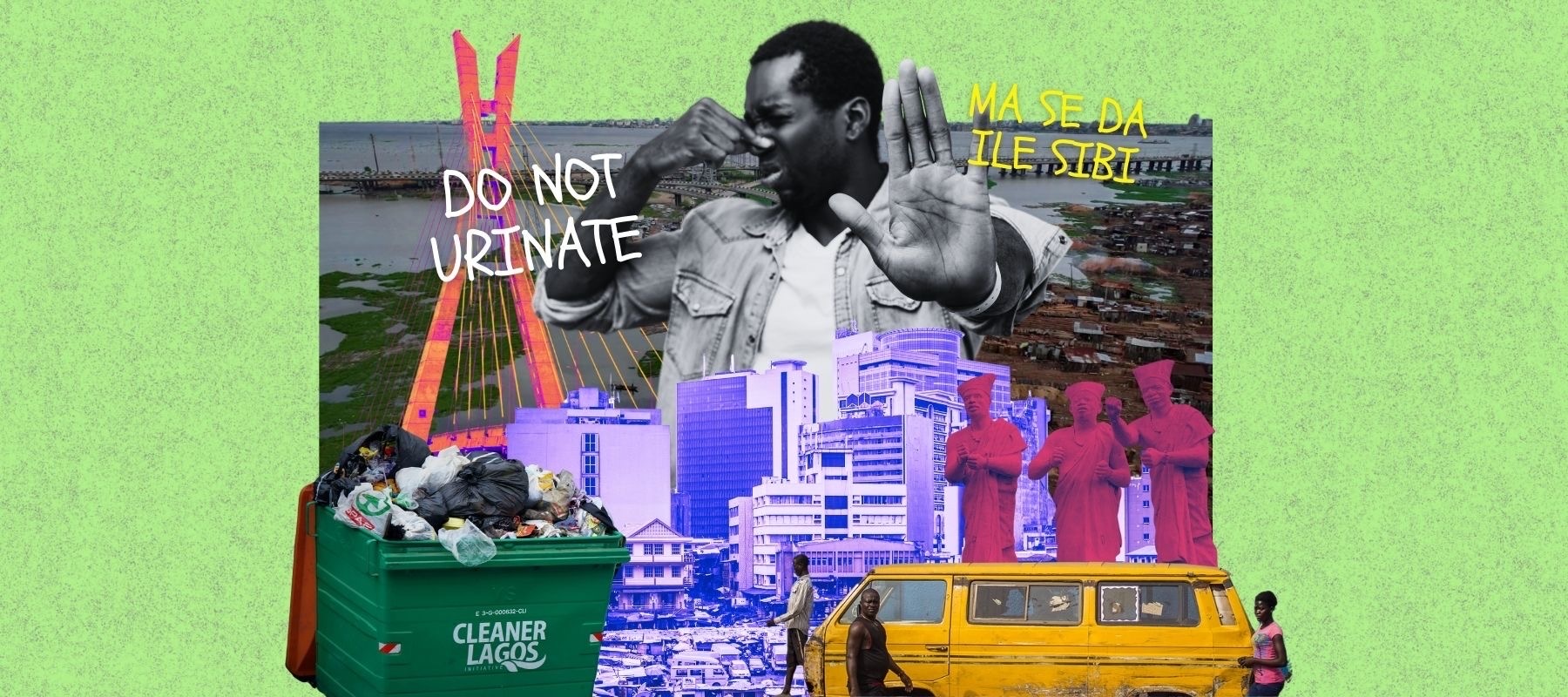
Smell has always been political, but a renewed sensitivity to its deeper undertones has emerged, amplified by social media, specifically in viral controversies like Dr. Ally Louks’ research and Lagos’ “smell” discourse.
Thrilled to say I passed my viva with no corrections and am officially PhDone. pic.twitter.com/4qwCyFYocX
— Dr Ally Louks (@DrAllyLouks) November 27, 2024
lagos does not smell. 'smell' does not fully capture the urgency of its putridness. lagos has a stench. a malodour. it stinks, just like its sister in madness, onitsha.
— janet meziem. (@meziemjanet) November 11, 2024
In The African City: A History, Bill Freund describes how African metropolises have long been sites of tension between state-imposed modernity and the organic, unregulated realities of urban life. Lagos, Nigeria’s commercial capital and a city of immense multiplicities, validates this. As stated earlier, the city has become a recurring subject of the contentious smell debate: is Lagos a smelly city? And more importantly, what does it mean to say that a city smells?
Smell, as anthropologists and historians have long observed, is never neutral. It is one of the most primal of human senses, bypassing language and rationality to strike at something older, something deeply ingrained. The French historian Alain Corbin, in his seminal work The Foul and the Fragrant, argued that smell has historically been a battleground for class and morality, with the scents of the poor often deemed offensive in ways that justified their exclusion from public life. The odor of a place, too, has long been a way to mark certain populations as unclean, backward, in need of intervention. In the 19th century, European cities embarked on aggressive sanitation campaigns not only to curb disease but to rid urban centers of what the elites saw as the offensive, uncontrolled smells of the working class.
For many Africans, the language of odor is often the language of colonialism as the relationship between smell and power in Nigeria has deep colonial antecedents. Historian John Iliffe observes in Africans: The History of a Continent (1987), that European colonial administrators often described African cities as places in need of sanitation campaigns, not solely for public health reasons but to impose a particular aesthetic and moral order, reinforcing a civilizational hierarchy where European spaces were framed as sanitary and rational while African cities were seen as chaotic and unhygienic. In the late 19th and early 20th centuries, Lagos underwent major sanitation campaigns, not necessarily to improve living conditions for Nigerians, but to make the city more habitable for the British elite.
The imposition of Western urban planning ideals sought to impose order upon what the colonial administration perceived as the formlessness of the indigenous city. Akin Mabogunje’s notes in Urbanization in Nigeria, reinforces this as it explains that the restructuring of Lagos’s drainage systems, waste management, and residential zones was not merely about public health but also about controlling movement, segregating populations, and reinforcing the colonial state’s authority. However, these interventions often failed to address the root causes of Lagos’s urban challenges. The influx of migrants, the expansion of informal economies, and the persistence of colonial economic structures meant that sanitation and waste management remained secondary to the broader demands of capitalist development. Post-colonial Nigerian cities inherited not only inadequate infrastructure but also the ideological frameworks that shaped colonial urban planning — ones that prioritized elite comfort over systemic transformation.
Few remarks provoke as much immediate defensiveness as the claim that Lagos smells. This defensiveness stems, in part, from the longstanding notion that attacks on Lagos are veiled attacks on the Yoruba identity and an indictment of the people rather than the failing political class. As the former capital of Nigeria and the economic hub of the country, Lagos has always been a site of migration, drawing in people from across Nigeria. However, the question of who owns Lagos has been politically sensitive. During the 2023 general elections, ethnic tensions flared as political figures weaponized claims of indigeneity, arguing that non-Yoruba Nigerians (particularly Igbos) were attempting to wrest control of the city’s economic and political future. In this climate, even a comment about the city’s smell can be interpreted as an extension of these broader conflicts: an attempt to delegitimize Lagos’s status or frame it as an unlivable, failed experiment.
Moreover, it also reflects Lagos’s complicated relationship with global perception. For decades, Nigerian intellectuals have critiqued Western portrayals of the country as a land of dysfunction and decay. Chinua Achebe, in The Trouble with Nigeria (1983), lamented how narratives of African disorder often obscure the ingenuity and resilience of its people. Similarly, Wole Soyinka has frequently criticized the way Africa’s complexities are reduced to singular, demeaning tropes. The accusation that Lagos is “smelly” thus seemingly activates a historical anxiety: that the city is once again being reduced to a caricature. Therefore, for some Lagosians, the charge that their city is “smelly” is reminiscent of an old, wearying stereotype, the one in which Africa is framed as unruly, chaotic, always in need of fixing. It is not that Lagosians, perhaps, do not recognize their city’s sanitation issues — few people are as vocally critical of Lagos’s dysfunctions as the people who live in it — but to say that a place smells bad is, historically, to say that it is out of control, that it requires intervention. Of course, this is partly why the accusation stings.
Thank you Yoruba land. Thank you Lagos State. Thank you to all at NYSC Lagos including all the officials for making my service year in Lagos a good story. I am a proud Eko Korper.
Lagos is not a smelly place. Lagos is a land of abundance and prosperity and opportunity pic.twitter.com/mKQT32gVuI
— OluGbenga (@AdewunmiGbeng14) March 15, 2025
The problem is not that Lagos smells; the problem is why it smells, and how the reasons are representative of the political class responsible for its governance. The sensory experience of Lagos, home to approximately 22 million people, is inextricable from its infrastructural realities. The city has long been characterized by a mix of industrial emissions, market waste, overcrowded drainage systems, and the humid coastal air that intensifies organic decomposition. Recognizing the urgent need for environmental reform, former Lagos State Governor Babatunde Fashola (2007–2015) implemented a series of urban beautification and sanitation policies aimed at mitigating the city’s long-standing odor problem. Under his administration, large-scale tree-planting initiatives were introduced, both as an environmental measure and as a natural filtration system to absorb pollutants and improve air quality. Fashola also sought to professionalize the Lagos Waste Management Authority (LAWMA), expanding its operations to cover more districts while introducing public awareness campaigns to discourage indiscriminate waste disposal. However, as subsequent administrations struggled to maintain consistent policies, the sanitation issues worsened as Lagos expanded without a commensurate investment in waste infrastructure.
The political management of Lagos’s environmental challenges also reflects broader patterns of neoliberal urbanism in African megacities. Following Victoria Henshaw’s observations in Urban Smellscapes, the politics of urban sanitation is often dictated by which areas are deemed economically valuable, leading to a situation where business districts and high-income residential zones receive better waste collection services than informal settlements. Many economically-disadvantaged areas and large markets crucial to the city’s food distribution network, continue to be overwhelmed by organic waste, much of which decomposes in open-air conditions exacerbated by Lagos’s humid climate.
LAGOS STINKS !!!
Iyana-iba stinks
Igando/ oko filling stinks
Ojota stinks
Ajah under bridge linking to Addo road stinks.Fix the mess instead of trying to shut people up.
— Road to Rich Aunty (@Ayomiepat_) March 16, 2025
Equally significant is Lagos’s topography. As a coastal city built on a network of islands and low-lying land, it is prone to flooding, particularly in areas with inadequate drainage. The combination of standing water, industrial runoff, and domestic waste creates an environment where certain smells become inescapable. The canals of Lagos Mainland, for example, were originally designed for drainage but have, over decades, become repositories for refuse. The reclamation of land for real estate developments has further disrupted natural drainage systems, worsening the problem. Also, Lagos’s energy structure plays a crucial role in its olfactory profile. The widespread use of diesel generators due to unreliable electricity supply means that large parts of the city are enveloped in the acrid scent of burnt fuel, a phenomenon that Nigerian poet Niyi Osundare once described as the “black fog of broken promises” in Random Blues for Lagos.
Major cities around the world, from New York to Paris to Mumbai, have historically been described in olfactory terms. New York City, for instance, has long been criticized for its summer scents, caused by garbage accumulation, subway heat, and rat infestations. Paris in the 19th century was famously the subject of widespread complaints about open sewage and rotting waste. If Lagos is sometimes an olfactory assault, it is because governance structures have failed to create an effective system of urban maintenance.