



Tune in to listen
Bounce FM

Take away the billboard’s performance metrics, Rema should never be reduced to such demeaning circumstances.

Once again, Western media have chosen to be ridiculous in their recognition of Afrobeats — a music that has achieved global impact beyond the U.S and its success-defining metrics. And the Billboard’s acknowledgement of Rema as a one-hit wonder is yet another reminder that should be taken with heavy disgust.
On February 15, 2026, American chart publication Billboard released an article headlined “The 25 Biggest One Hit Wonders of the 21st Century” via its X page. Initially published on June 30, 2025, it appears the piece was reshared to spite rather than to reflect the corrections made to the list.
While the article included the names of American artists who have struggled to maintain or replicate the success of the Hot 100, their inclusion of one of Africa’s biggest stars is a form of ridicule of the continent. And a distasteful impression of our music.

Inside the Billboard’s publication, the writer satirically ascribed being a one-hit wonder as an achievement and a blessing, rather than a slur. The list included names like Caribbean stars Kelvyn Lyttle and OMI, whose hit songs “Turn Me On” and “Cheerleader” reached the Hot 100 top 10. And have since not been able to peak the chart the way their hits did.
Afrobeats star Rema was also tagged a “one-hit wonder” for his inability to reproduce the remarkable chart success of his global anthem “Calm Down.” A single that peaked at No. 3 on the Hot 100, and remains the highest and longest charting Afrobeats song in the chart’s history.
While the writer is entitled to their preconceived notions, the maligned undertones throughout the read are condescending. And frankly, the Billboard can do with what they please for their American acts; what Nigerians wouldn’t take is the disrespect of one African pop most prolific hitmakers.
For years, we’ve celebrated the recognition of Nigerian music by American media. But the moment when the narratives are intentionally concocted, silence should never be echoed. While the Billboard’s article ranked the songs and artistes based on the varying performance on their charts, dubbing artistes as one-hit wonders is more eye-sore than laughable. Especially when the said artistes are based outside of America.
Billboard’s chart has always been based on the commercial success in America. Isn’t it questionable that the publication decisively brands artistes outside their region with the “one-hit wonder” tag?
Rationalising this narrative begs the question of whether American acts should be held to the same standards by other regional institutions.
Longevity and consistency on the Billboard’s Hot 100 is a testament to an artiste’s prominence and will continue to remain a pivotal marker. But when failing to replicate that level of success becomes a defining marker on their artistry, then questions need to be raised.
“Calm Down” is still one of the biggest African pop songs of the 21st century, with its impact surpassing its historic run on the Billboard Hot 100. Does failing to score another Hot 100 hit in just two years make him a “one-hit wonder”? At this juncture, it’s not inappropriate to conclude that the publication is racially biased to hold Rema by the same standard as American stars whose successes are driven by the Billboard Hot 100 entries.
For an artiste with an array of top-charting hits and has also landed six top 10s on U.S. Afrobeats Songs, there’s no world where Rema is a one-hit wonder. Take away the billboard’s performance metrics, Rema should never be reduced to such demeaning circumstances.
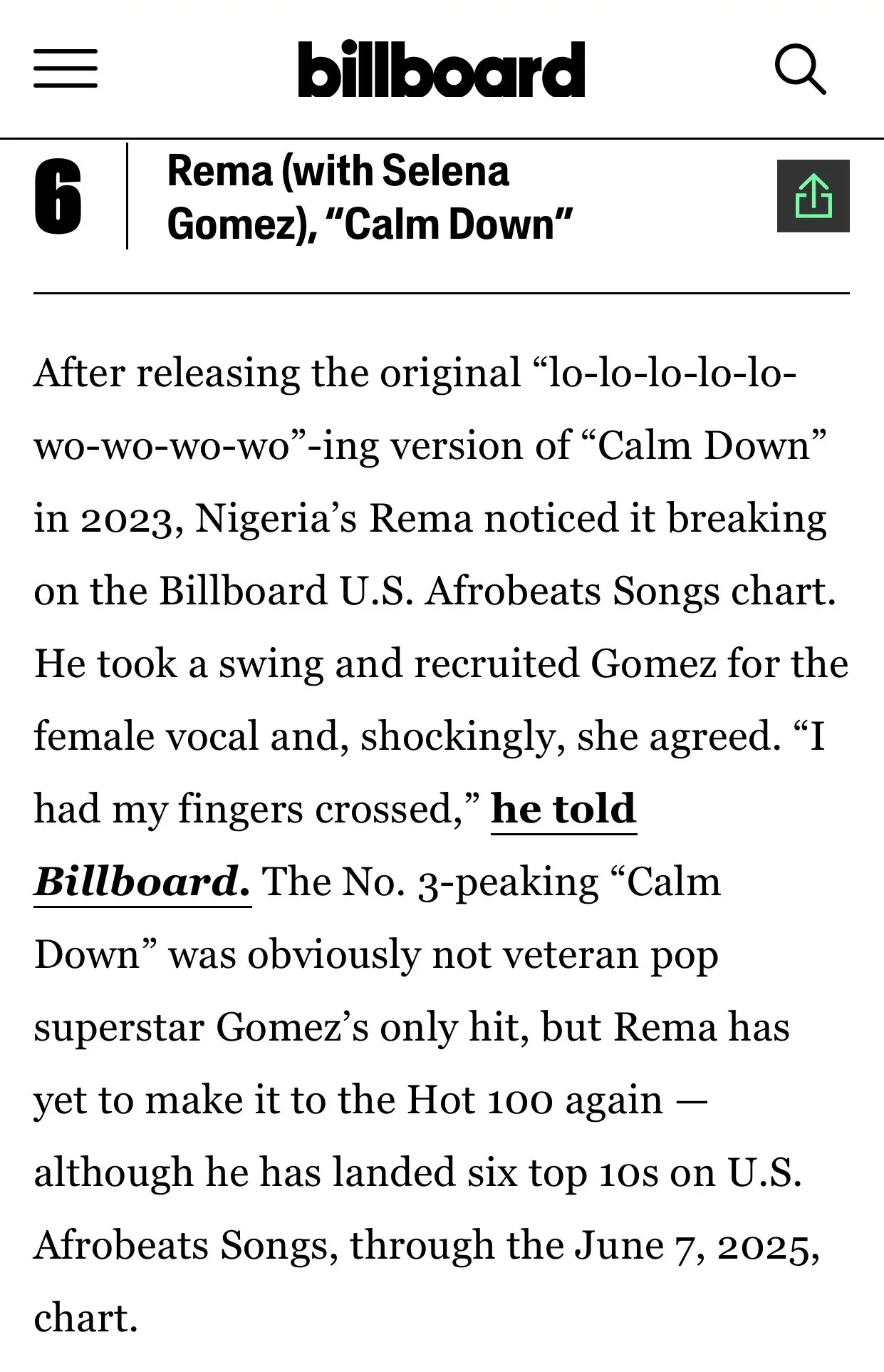
The inclusion of the Afrobeats star in the list alone attracts a weary concern, but more essentially, the condescending tone in which he was described. The misappropriation of his global stardom and the original release against the remix with Selena Gomez strips away every hit-making exploit from the artiste.
Yet, Rema’s hit-making days are not over as the Nigerian star has frequented the Billboard Hot 100 again. Via his stellar verse on Don Toliver’s “Secondhand,” he landed himself at the No. 29 spot, debuting on the chart less than a year after being tagged as a one-hit wonder.
This just highlights the atrocious narrative the international publication has perpetuated. The moment we begin to rationalize it, the moment we accept a false narrative that tears Afrobeats apart as a movement. This is beyond Rema’s “Calm Down”; this is a downplay on the most prominent exports in the global music industry.
And for what it’s worth, Rema’s just getting started. And he will be paying a visit to Billboard’s more than they can think of.