


Tune in to listen
Bounce FM

So long as we exist under capitalism and skewered racial dynamics, we all remain perpetually vulnerable to beauty standards that can never truly be attained.
Do you know how exhausting it is to keep up with all the things women are supposed to do to be (and stay) beautiful? Shave your body hair, cover up your “blank fingernails,” keep your lashes full but not too fake, show up in a fresh bussdown wig or a silk press. Your breasts have to be perky, your stomach flat, your thighs thick but not too thick; actually maybe have a thigh gap but also a fat ass, and don’t forget your arms must stay slim. Your chin should be sharp (no double chin!), your skin clear, your makeup flawless but natural (clean girl aesthetic), your body curvy but sexy, not sloppy. There is no winning. Women live inside a dizzying mess of beauty standards designed to keep them in constant work, constant anxiety, constant buying.
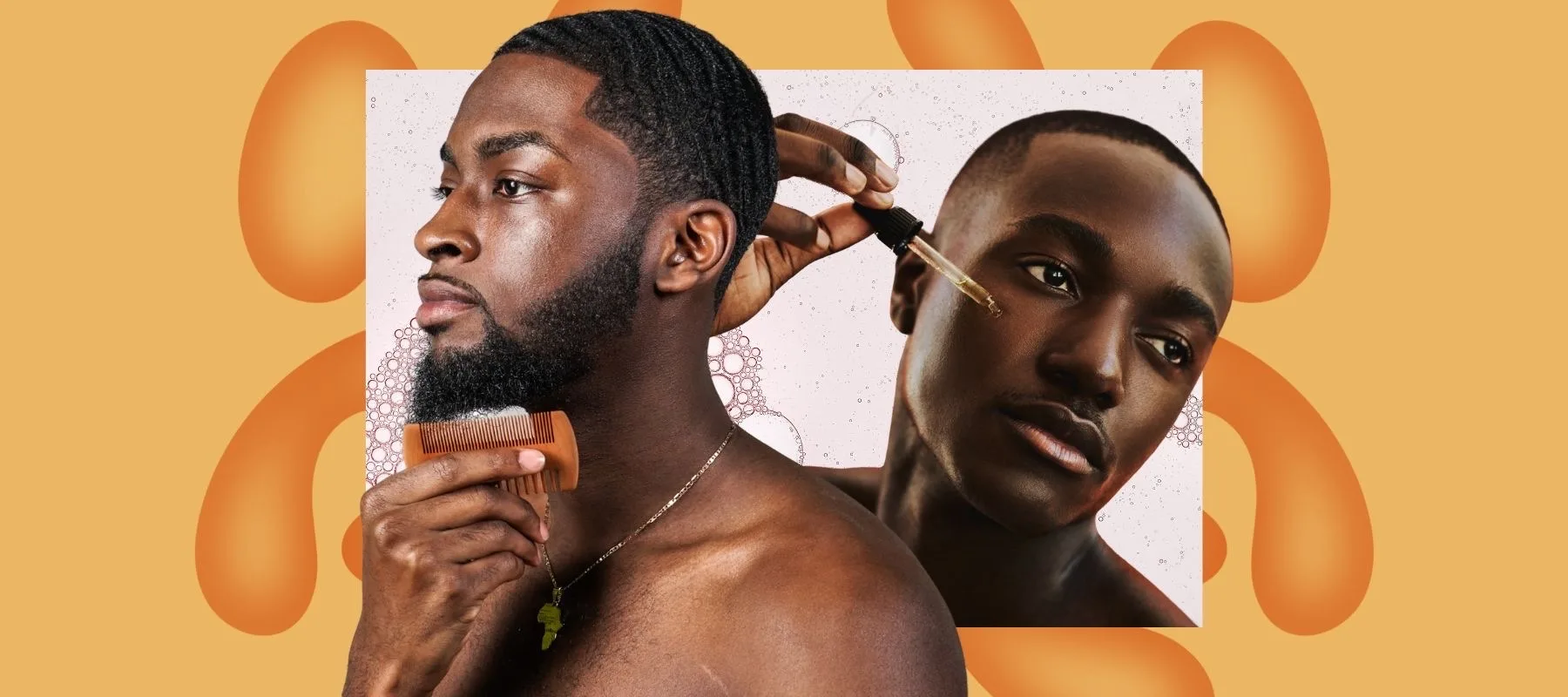
But what about men? Do they, too, have this pressure to conform to beauty standards? It may seem otherwise but the simple answer is yes. It is impossible to exist within capitalism and patriarchy and have no insecurities. Men, specifically Black and African men, have their own deeply-felt insecurities, most times about balding, their features (in fact, featurism is one of the major ways African men are written off beauty), having no beard, being short, too fat, too darkskinned—sometimes too lightskinned. Just as women are socialized in patriarchy to perform for the male gaze, men are also socialized to perform for the male gaze. Here’s how.
Masculinity is never constructed in isolation. It is relational, bound up in hierarchies among men and in the ways men imagine themselves to be evaluated by other men. A key part of male beauty standards is that they are primarily for the consumption of other men. Within heterosexuality, cis-men present themselves to other men, seeking validation, while women remain the signifiers of whether that presentation has succeeded. A man’s attractiveness is often judged by his ability to attract desirable women, which in turn boosts his status within his male peer group. “How did he pull her? What does it say about him that she chose him?”
The gym is a perfect example of this homosocial hierarchy. The primary audience for a man’s sculpted physique is fundamentally the other men who have been conditioned to internalise the six-pack, the broad chest, the V-cut waistline, the biceps and the chiseled jaw, as the ideal male form, one that grants him social and capital value. The muscular physique is a sign of strength and status, and the female partner, in this scenario, becomes a trophy, all of which are crucial currencies in this homosocial marketplace. Capitalism has seized on this, creating a massive industry of supplements, workout plans, and grooming products that promise a body that meets the approval of this male-centric social order. The final goal, of course, is to be seen as a man capable of “bagging” a desirable woman, but the path to that goal is often paved with the approval of one’s male peers.
Colorism has made it so that light-skinned men are often coded as “pretty boys,” desirable but feminized, while darker-skinned men are racialized as carrying brute strength and hypermasculinity. This means that light-skinned men are judged as less masculine compared to dark-skinned men. But because colorism is pervasive, it’s still light over dark. That’s why men are also the target market for skin lightening and bleaching products: capital and desirability attach to lightness no matter what.
Furthermore, scholars have argued that male beauty is rarely divorced from power. Patriarchal power often insulates men from the harshest physical judgments. A man can be conventionally unattractive and still hold immense power, his wealth and status acting as their own form of appeal. Unlike women, who have been commodified as aesthetic objects, men’s appearance is often judged through the lens of virility, wealth, or status. What this means, as Pierre Bourdieu suggested in Masculine Domination (2001), is that men who are considered “ugly” are not automatically stripped of social value. But it is patriarchy itself that enables them to wield their bodies without total social disqualification. Truth be told, their unattractiveness can become legible as masculinity itself, sometimes even intensifying their authority.
Where ugliness is used to affirm masculinity in men, it is used to strip femininity from women. This is so potent that politically ugly men (politically ugly here meaning bodies that fall outside the capitalist, colonial framework that dictates what is desirable) can use their patriarchal power to openly mock a women, irregardless of whether she is conventionally desirable or not because that position gives him a means not only to externalize their own insecurities through devaluing women, but most importantly to demand the dues which they believe they are owed: the unrelenting demand that women perform for their gaze, the male gaze. Nigerian political activist Obiageli Ezekwesili, for instance, has been repeatedly scrutinised for her appearance in ways no male politician of similar rank has been or ever would be.
These bloggers just like screaming headlines. I was actually responding to a comment truthfully.
I stand by my words. It is what it is.
Oby is very, very intelligent and has some principles. But she does not have a beautiful face! Truth is bitter, but better. #TableShaker pic.twitter.com/ibSc4woKJc
— Reno Omokri (@renoomokri) February 3, 2022
Men are not immune to the pressures of beauty. They may not always vocalize their anxieties about their appearances, instead keeping them private and festering beneath a veneer of masculine stoicism, but they remain haunted by the gaze of other men and the power of capitalism. They are judged, and they judge themselves. But the standards they are held to are different, and the consequences for failing to meet them are less severe. For women, it is compulsory and punishing. For men, it is optional and stratified by class; they can often afford to lose a few points on aesthetics. Notwithstanding, so long as we exist under capitalism and skewered racial powers, we all remain perpetually vulnerable to beauty standards that can never truly be attained.