



Tune in to listen
Bounce FM

This Seyi Vibez’s new release is a miss between execution and evolution. Or maybe Seyi Vibez needs to take a step back and drop his pen.
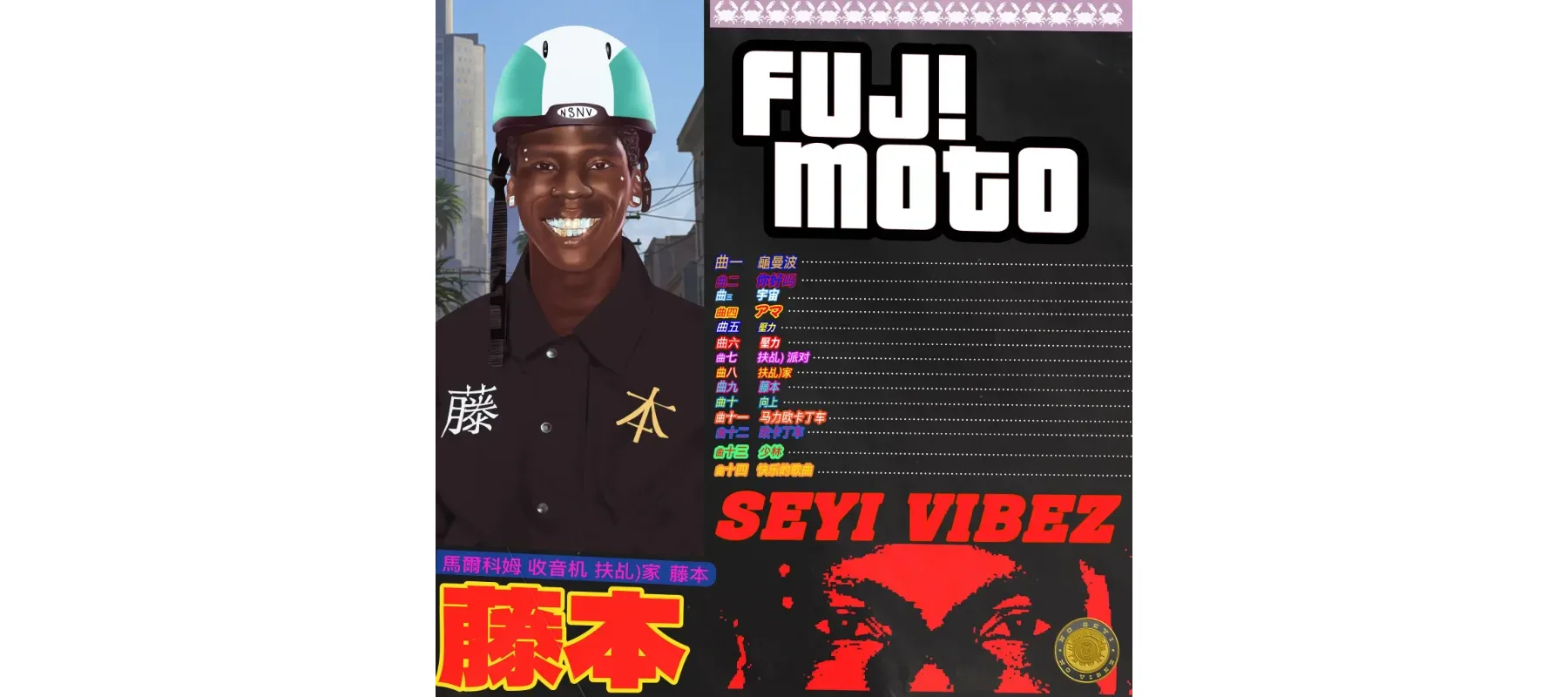
The journey of sonic experimentation isn’t just in its outcome but in its purpose. For most artists, it begins with a Western appeal, but for Seyi Vibez, it identifies with self-exploration. Thus, after a wave of hit and top-charting records, Seyi Vibez relentlessly returns with his seventh studio album, Fuji Moto.
The project is branded with Japanese aesthetics: its title in Japanese translates to “Wisteria origin,” and the album cover mimics an anime expression. This signals Seyi’s interest in cross-cultural sounds and audience. But the sonic architecture of this project is expected to trace its way to the roots of his artistry, Fuji. However, this highlights one thing: Seyi Vibez has cemented his place as an emblem of Nigerian street-pop, but he’s also pushing toward a deeper self-interrogation that could carry him beyond the confines of the streets. Except the path he’s taking leans more toward a craving for Western appeal than any real venture into sonic experimentation.

On the 14-tracked LP, the street luminary delivers a posh version of Seyi Vibez, painting themes of hedonism, braggadocio, and vulnerability in colours that appear foreign to the street kid in Ikorodu. However, he manages to sustain these realities with the assistance of music acts such as French Montana, Trippie Redd, and Olamide, while holding on to long-term producers, Dibs, and Larrylanes.
The opening track, “Tortoise Mambo,” sees Seyi Vibez deliver a braggadocious narrative of his artistry. Riding a swaggering, newly sharpened flow, he stacks himself against major names, flaunting his range with nods to Saheed Osupa, Ed Sheeran, and Bob Marley. While Seyi is not one to shy away from tooting his horn, this is a common performance, especially for Fuji musicians. The 57-second track doesn’t garner striking remarks, but the beauty lies in its production.
Following the intro track is “How Are You”, a House-leaning record built on dominant log drum patterns, a piano melody, and DJ scratches. The Dibs-produced track’s impressive delivery picks up in the simplistic choral voices of children — a signature element from his previous project, Children of Africa EP. The tempo carries smoothly into “Universe,” one of the album’s standout songs. Opening again with the children’s choir, this track showcases Seyi’s vocal prowess and songwriting, which feels true to artistry. He lets himself be vulnerable while sweet-talking a love interest. The production, still reminiscent of Amapiano, features catchy, high-pitched synths and mellifluous background vocals.
The cadence drops on “Ama,” a midtempo track produced by Mally Mall. Arguably the main highlight of the album, this track showcases Seyi’s effortless pen game and polished vocals. With a finely executed production, the tracks reveal vulnerability and reinforce his deep desire for his muse. The impression heightens with the collaboration between Seyi Vibez and the female background voice. The theme shifts slightly on the “Pressure” remix featuring American artist French Montana. This track reflects Seyi’s interest in Western appeal, where he delivers polished lyrics centered on a love interest. French’s verse neither overshadows Seyi’s nor stands out in a significant way, but the collaboration may expose Seyi Vibez to the broader audience he’s aiming to reach.

The next run of songs is expected to pull him back to his roots while still clinging to Western culture. And if anything, Seyi Vibez has shown in the past that it’s his ability to redefine traditional sounds in Afrobeats.
Yet, “Fuji Party” lands as a lackluster track with the less incorporation of Fuji elements. The striking production, marked by Japanese sounds, features foremost street-hop rapper Olamide, whose electrifying verse fails to make a lasting impression. At best, this is a catchy track for street carnivals similar to the Mara sound of “Shaolin.” Except it doesn’t hold much ground, nor does it evoke the Fuji spirit of parties. But Larrylane’s excellently produced “Fuji House” steps in, sustaining the uptempo cadence. Unlike the previous track, Seyi Vibez delivers a noteworthy listen that aligns with his core artistry. Over a stellar production that seamlessly blends two genres, Seyi glides through minimal Fuji and House with swaggering flow and lamba. While the talking drum hovering over the log drums stands as a highlight, the theme doesn’t fall far from the realm of bravado. A similar pattern appears on the themed track “Fuji Moto,” though elements of Seyi’s Afro-Adura sensibilities seep through. Holding onto the Yoruba Fuji tradition, he folds in Japanese cultural references. On this downbeat track, he offers prayers and aspirations in Yoruba while name-dropping various Fuji moto clans from Japan. It’s a track expected to highlight the cultural fusion between the two regions, but it falls short of it.
The theme and cadence shift with the motivational track “Up,” featuring American trap artist Trippie Redd. In this unexpected collaboration, Trippie Redd’s chorus and verse shine through the hip-hop/R&B production, while Seyi tops it off with his aspirational verse. You can perceive the American influence beneath his lyrics and melody, despite clinging to his culture. But it’s another finely executed production where Nigeria meets the diaspora.

The previously released tracks from the Children of Africa EP, including “Mario Kart,” “Happy,” and “Shaolin,” follow through to the end with “Pressure” closing the album. What once felt like a cohesive body of work on the EP shifts in tone with their inclusion here. The thematic gap between the first nine tracks and the remaining songs creates a stark contrast rather than a seamless listening experience. Still, for what it’s worth, their presence will likely boost the album’s commercial reach.
On the surface, Fuji Moto delivers a masterful execution of genre-blending sounds and cultural fusion. The album’s standout tracks, “Universe” and “Ama,” don’t tilt towards any element of Fuji, yet capture listeners with their stellar production and songwriting, unlike the ‘Fuji-titled’ tracks.
It appears that Seyi Vibez’s embarking on self-exploration fails to meet its purpose. Hence, this new release exposes the loose thematic cohesion that characterizes an album expected to be rooted in ‘cultural elements’ but struggles to strike a balance between the former and Western appeal. It’s a miss between execution and evolution. Or maybe Seyi Vibez needs to take a step back and drop his pen.