



Tune in to listen
Bounce FM

This surge of emotional candor in Street Pop parallels a broader trend in Afropop, often referred to as “Afrodepression.”
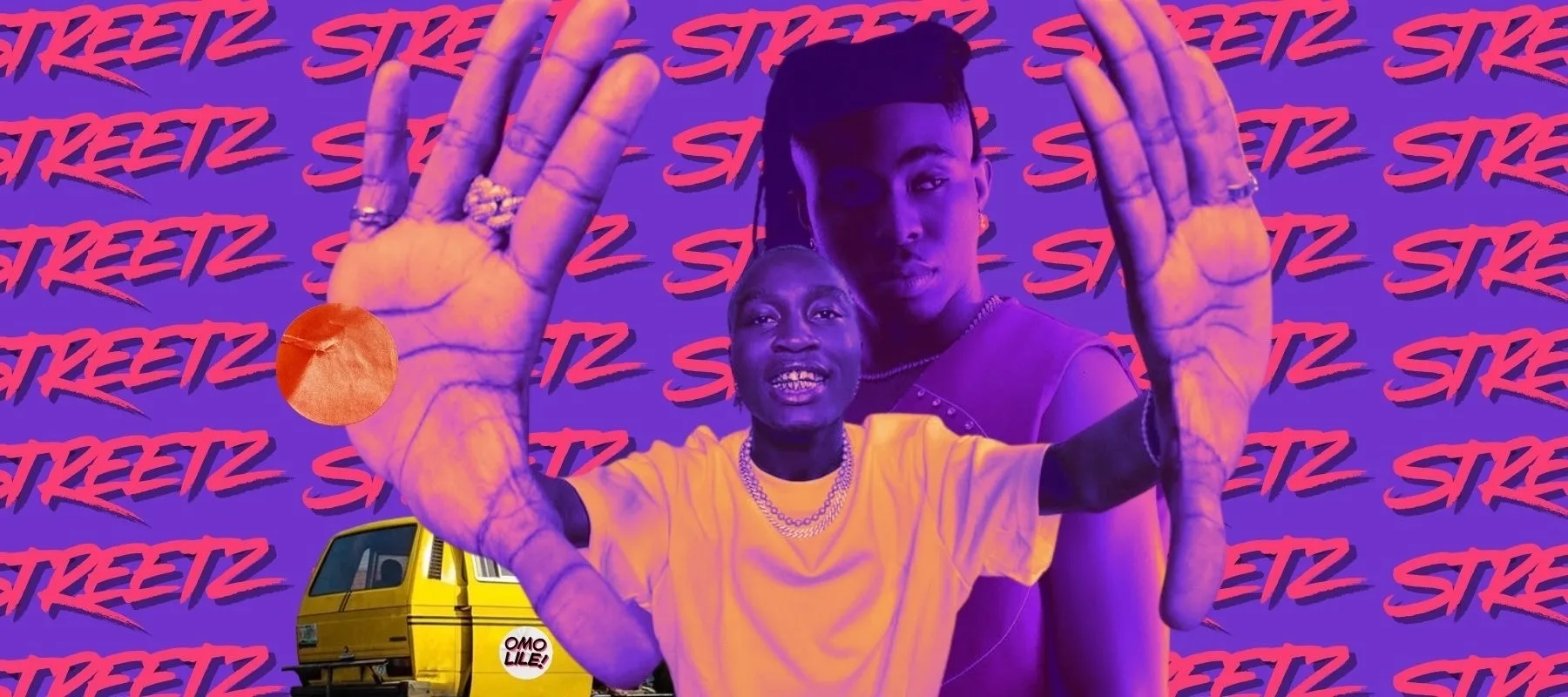
Afrobeats has never been one thing whether sonically or thematically. Its earliest iterations, drawn from R&B, Hip-Hop, Highlife, Reggae, Fuji, Dancehall and more, always carried two parallel instincts: the desire to move bodies and the need to tell hard truths. The same genre that gave us many groove-first hedonistic records also couched weary laments. Even within the same album, artists like Wande Coal would pivot from club records to gut-spilling vulnerability.
In Nigeria, the word “street” has often operated as a proxy for class. It describes the artists who come up without industry backing, and whose music spreads from motor parks, betting shops, and neighbourhood DJs. Its genesis lies in the ghettos of Ajegunle in the 1990s. Artists like Daddy Showkey, Baba Fryo, and African China were some of the original chroniclers. Their Galala and Konto music was built on social commentary.
They sang about police brutality, political corruption, and the suffocating poverty of their environment. These are issues that the Nigerian youth of today continue to contend with. The never-ending socio-economic pressures create a profound need for emotional expression and catharsis, which music readily provides. Hence, the societal backdrop cultivated the emergence of more specific and introspective thematic styles and the rise of what can be termed “Afroadura.”
Olamide’s enduring veteran status is most acutely felt in his precursory role, with tracks like “Anifowose” being just one of many examples for street-pop’s lyrical verisimilitude. The song is built on a poignant sample of Fuji legend K1 De Ultimate, which recounts Olamide’s own foundational story of growing up in Bariga. This foundation, built over years of delivering unfiltered narratives, paved a broader road for a new generation of artists who harnessed a similar emotional depth. Bella Shmurda’s anthem of urban disillusionment, “Vision 2020,” alongside the late Mohbad’s tragically resonant “Peace,” offered candid articulations of existential dread and aspiration. Similarly, T.I Blaze’s unvarnished pleas on “Sometimes” and “Try” and Balloranking’s poignant narrative of survival in “Trench Kid” expanded this sonic composition. These songs demonstrate spectral honesty in their delivery, one that transcends mere storytelling to become a definitive document of their generation’s struggles, triumphs, and the visceral melancholy that underpins it all.
A portmanteau of “Afro” and the Yoruba word for prayer, “adura,” part of the profound emotional gravity of Afroadura comes from its religious texture. The songs function as outright supplications channeling the anxieties and aspirations of the hustle directly to a spritutual entity, most commonly the God of Abrahamic religions. On “Aiye,” Barry Jhay sings, “Baba, ma je ki wahala mi ja s′ofo / Edumare, shower your blessings, ma-ma je kin p’ofo,” a plea for his struggles to yield financial fruits. Oritse Femi’s “Mercies of the Lord” begins with the chant, “Mercies of the Lord, come down now to your children / Oluwa sokale lawa omo re nbere,” which is a collective petition. More recently, Ayox has extended this mode on “Humble Cry,” where he intones, “Ya Allah, ya Robbi / Hear my humble cry.”
Apart from the references to God or Allah, the structure of the songs themselves mimic prayer in the manner of slow builds, repeated refrains, call-and-response patterns. For many of these artists, music is not distinct from faith. It is an extension of it. Not necessarily organised religion, but belief in something higher, or at least heavier, than the material world. The influence of Islamic prayer melodies is clear in the cadences of Seyi Vibez, who alongside Asake arguably popularised this. Seyi’s delivery is urgent and sermon-like, and his songs — “Karma” “Psalm 23,” “God Sent” — exemplify this. On “Amdallah” (a title derived from the Arabic “Alhamdulillah,” meaning “praise be to God”), he anchors the track in Islamic vocabulary. But in the same breath he offers a distinctly biblical allusion: “What God has design / No man fit spoil am.” He is not alone. Asake has helped globalise this sound, with his early songs oscillating between Christian and Islamic forms of supplication. He layered Fuji-inflected vocals over Amapiano log drums and often used choral-style backing vocals to heighten the spiritual intensity.
This surge of emotional candor in Street Pop parallels a broader trend in Afropop, often referred to as “Afrodepression.” Omah Lay is its foremost practitioner. His music, slickly produced and globally palatable, is a catalogue of internal struggles and a demonstration of male vulnerability: loneliness, heartbreak, and mental exhaustion. Victony, too, infuses his music with a palpable sense of fragility, shaped by his own public journey of recovery after a near-fatal accident. Afrodepression, very thematically similar to Afrodura, explores themes of mortality and resilience with a tenderness that contrasts Afrobeats routine coolness.
Moreover, Afroadura is not static as exemplified by new, eager voices like Ayo Maff, Fola, TML Vibez, Muyeez, and so on who are taking its scaffolding and stretching it into new terrain. Since the release of last year’s breakout single “Dealer” with Fireboy DML, and the follow-up Maffian EP, Ayo Maff has steadily re-cast the street-pop prayer style into something at once diaristic and cinematic. His cadence is unusual but it carries the urgency of testimony, turning each track into a vignette of a young hustler trying to outpace lack, responsibility, and mortality. While artists like TML Vibez, Muyeez, bring their own melodic sensibilities to the table, it is Fola who perhaps is currently the most popular example of the scene’s expanding emotional range.
On his breakout track “Alone,” featuring Bhadboi OML, the poignancy of his sound traverses the travails of love and heartbreak. On the track Fola tugs at the thread of romantic despair, emoting “When you on your bikini / Oh, God / Girl, I’m losing, you cheating me / Oh, jo pity me, oh, Lord.” The subgenre has never been one-dimensional, but it is fitting, then, that this new wave has begun to tackle the complexities of love with such gravity, for it is one of the most profound problems of the human condition. This shift is particularly noteworthy given that classic street-pop was often defined by its dismissive, sometimes misogynistic tones and its unfortunate tendency towards slut-shaming. While the specter of misogyny is a common thread in men’s music across genres, many of these new voices have so far handled their narratives with a striking, if nascent, restraint.
Notwithstanding, one thing remains certain: talent will always abound in Nigeria, a truth as constant as the challenges its people face. It is precisely because of this socio-economic tumult that a genre like Afroadura will not only endure but continue to sustain the populace.