



Tune in to listen
Bounce FM

Hope ‘93 was never really about “unbroken years” of democracy: democracy was its vehicle, not its destination.
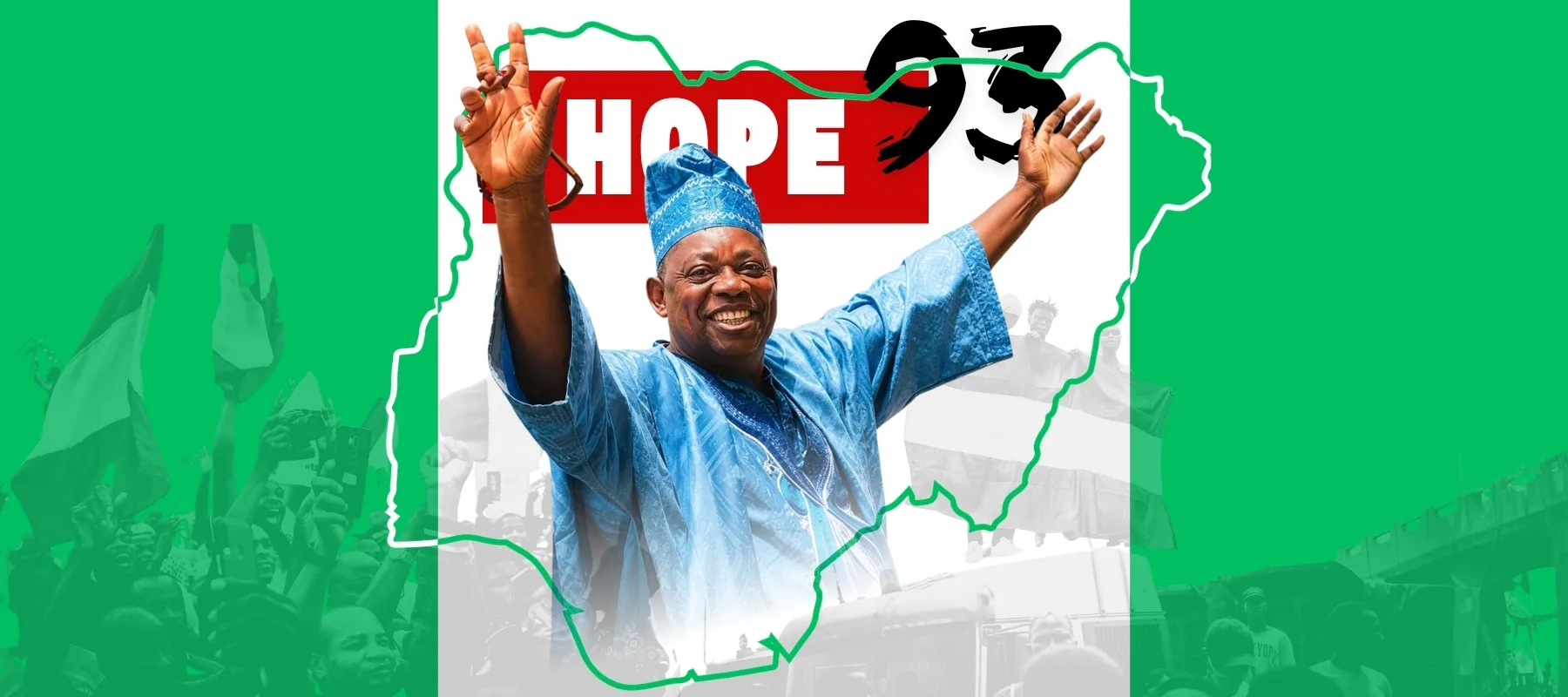
It has been 33 years since Nigeria witnessed one of the most consequential presidential elections in its history. On June 12, 1993, millions of Nigerians across tribal lines, religious divides, and age groups trooped out to vote for “Hope” after nearly a decade of military dictatorship. That election, widely acclaimed as the freest and most credible in Nigerian history, was annulled by then-Military Head of State Ibrahim Babangida, who almost 32 years later, in February 2025, publicly admitted that Moshood Kashimawo Olawale (MKO) Abiola had won.
The annulment and its brutal aftermath — the long struggle to restore democracy and Abiola’s death in detention — tend to dominate how June 12 is remembered. But everything that made that election electric had its roots in the campaign Abiola and the Social Democratic Party (SDP) ran. With a salient promise of hope for a better Nigeria, the SDP presidential candidate helped millions dare to dream of a brighter future.
That campaign is perhaps best remembered for its evergreen television ad, one no political commercial has arguably topped since. The Hope ‘93 ad opens with a man in tattered clothes cataloguing his misery: no work, no food, no house, no light, dirty water, punishing transport fares, school fees pressure, poorly equipped hospitals. It is a one-minute portrait of a country failing its people. Then it pivots to hope, a promise that things could change.
Thirty-three years later, Nigerians are still living inside that ad. A comment on YouTube reads: “2026 here and nothing has changed. We still have all the issues they mentioned. It’s very sad that this country isn’t progressing.” According to the National Bureau of Statistics (NBS), more than 60% of Nigerians are multidimensionally poor, a figure that captures underperforming schools, a broken healthcare system, high unemployment, and below-par living standards. In 2026, government officials are still promising stable electricity.
Today, political leaders have flooded timelines and airwaves with statements marking Democracy Day. President Bola Tinubu, in his broadcast on Friday, also wasted no time extolling the virtues of democratic governance at the top of his address. But these statements all share the same blind spot. Hope ‘93 was never really about “unbroken years” of democracy: democracy was its vehicle, not its destination. The destination was a Nigeria where ordinary people lived with dignity: clean water, reliable power, jobs that paid enough to matter, schools that worked, hospitals that healed.
That distinction is the one Nigerian leaders, from councillors to presidents, have often refused to make.
Former President Muhammadu Buhari’s decision to move Democracy Day from May 29 to June 12 was well-intentioned, a recognition long overdue. But the move also inadvertently narrowed June 12 into a symbol of democratic struggle rather than a social contract. Every annual statement since has reinforced that narrowing. The conversation has become about the form of government, not its content. About the process, not the outcome. About the ballot box, not the life lived after the votes are counted.
This is a convenient oversight. Reducing June 12 to a story about democracy lets leaders off the hook. It allows them to celebrate the principle while ignoring the performance. A governor can stand at a podium and invoke MKO Abiola’s sacrifice without once accounting for the fact that his state’s minimum wage workers are earning ₦70,000 in an economy where that sum barely covers a month of transport and food. A senator can tweet about the sanctity of elections while the constituency he has represented for eight years still lacks a functioning primary health centre.
The man in the Hope ‘93 ad would not recognise what June 12 has become in official memory. He did not vote for abstract governance principles. He voted because a candidate looked him in the eye, through a TV screen, and told him his suffering was not inevitable. He voted for light in his house, clean water from his tap, and a salary that could stretch to the end of the month.
That was the lesson of June 12. Not that democracy is good, but that the government must work for everyone, including the market woman, the okada rider, the teacher earning poverty wages, and the mother delivering her baby by torchlight.
Until Nigerian leaders reckon with that lesson, every Democracy Day broadcast is just another annulment of the promises of June 12.