


Tune in to listen
Bounce FM

Before X deployed the Articles feature, there had been concerns that the platform was suppressing the reach of posts containing external links.
If you’re an average X user with considerable engagement with writers, media organisations, creators and influencers, you will have seen them: full-fledged articles, with embedded media, subheading formats, hyperlinked text, and everything else that makes up a traditional article or blog post. The only difference is that these articles are siloed on X, the social network that once played an indubitable role as a distribution channel for publications.
This feature has been live on X since March 2024, first available to X’s highest subscriber tier, Premium+, before being rolled out to all Premium accounts earlier this year. Like most recent updates to the app, it also has a financial undertone, as it allows monetising these articles by placing them behind a paywall accessible only to each user’s subscribers, should they choose to do so.
Superficially, this seems like a rational move in furtherance of X’s business model. But strip away the nuances, especially as they concern publishers, and it reveals a host of complicating factors that threaten, to put it mildly, how media operates in the digital space.
Second article I’m reading directly on Twitter in less than an hour. What is happening ah, where are the links https://t.co/7LLTfZRp8C
— Shalommm🌸 (@shaquille__t) July 3, 2026
Before X deployed the Articles feature, there had been concerns that the platform was suppressing the reach of posts containing external links, a novel feature that distinguished the platform as a haven for media organisations and practitioners alike, thanks to its role as a quintessential hub for news-sharing and real-time global commentary. For what it once was, no social network quite matched Twitter’s appeal to writers and journalists. For many, maintaining an account was a necessity as it functioned as a collective newsroom, a place where stories were discovered, sourced, discussed and ultimately distributed to an audience you would be hard-pressed to find on rival social networks. According to a 2016 report from the social analytics company Parse.ly, Twitter generated 1.5 per cent of traffic for typical news organisations, and “excels at both conversational and breaking news.” Though not a significant figure, the data from Chartbeat, ten years later, pegs the figure at 0.4% of overall traffic for websites. While this ultimately boils down to several factors, including the paywalling of some of these blogs now, and the broader shift in social consumption toward video content, this is also a direct consequence of X’s throttling posts with external links.
There have been several well-detailed reports lending credence to the discrepancy in reach between posts with and without links on X, but Musk’s response alluded that it was far from an anecdote, when responding to one such report a few months after completing the takeover.
“Our algorithm tries to optimise time spent on X, so links don’t get as much attention,” he tweeted, “because there is less time spent if people click away. Best thing is to post content in long-form on this platform.”
The deprioritisation of links has long been a strategy to introduce X Articles as the fix. And by all indications, particularly with subsequent updates and the continued suppression of outbound links, it is a strategy that is here to stay. After all, if there is one thing that has defined Musk’s reign on the platform, it is his bid to make it a be-all and end-all for its users, and his resistance to anything that infringes on, or attempts to draw users away from the platform.
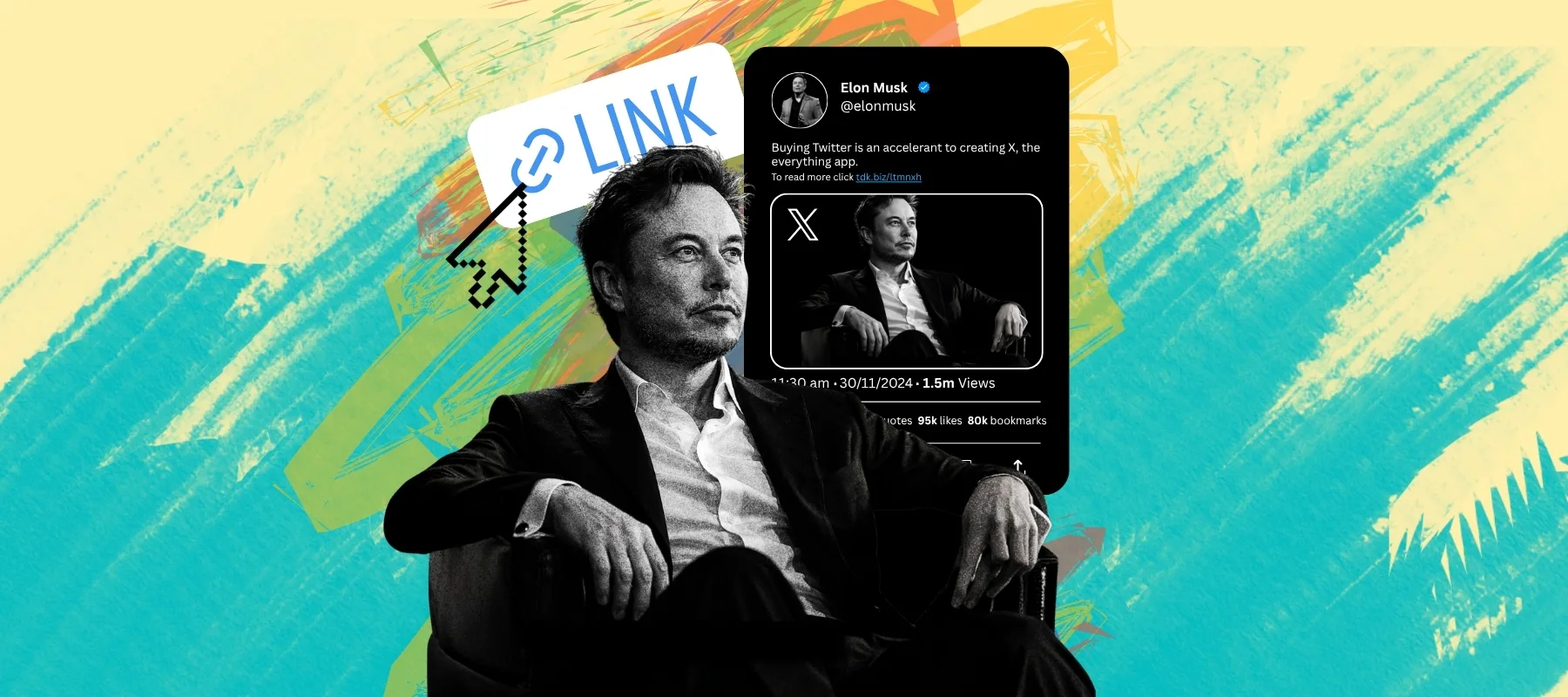
“Buying Twitter is an accelerant to creating X, the everything app,” his 2022 tweet, posted before completing the takeover, famously reads.
Buying Twitter is an accelerant to creating X, the everything app
— Elon Musk (@elonmusk) October 4, 2022
X has doubtlessly been the most mercurial social media platform since Musk took over, with virtually every major update feeding into the owner’s ambition of turning it into the everything app. To achieve that, there has to be a compelling alternative to the many digital experiences users (especially creators, publishers and other players in the media ecosystem who command much of the average user’s attention) would otherwise seek elsewhere, much like it has attempted to do with X Articles.
It is a strategy the company has doubled down on in recent weeks with the rollout of several creator-focused features. For one, X has introduced Live Studio, a new livestreaming command centre built directly into the platform. Announced on July 1 by X’s Head of Product, Nikita Bier, Live Studio allows creators to go live, create private test streams, schedule broadcasts, stream with external software and monitor live audience data, effectively pushing X further into territory occupied by Twitch, Kick and YouTube.
A few days later, the platform followed up with new video recording and editing features designed to help creators produce original content on X instead of simply recycling material from other platforms. Bier framed it as a move to provide a “functional” video editor so videos on X can “finally be original content that doesn’t exist on other platforms.”
These early-stage tools are still limited by device, with a leaning towards iOS, region and, of course, Premium subscription status. Add to that X’s growing investments in xAI and its flagship model Grok, alongside X Money, its fintech product currently in beta, and there is no doubt about the direction the network is on.
To ensure the success of that strategy, however, what becomes of the user experience for all and sundry?
The media are only as valuable as the audience whose attention and engagement they seek with every story they produce. For years, reaching that audience has meant taking content to wherever people already spend their time, much of which is considerably the various social media platforms, which is prominently X for many. With now actively deprioritising that distribution model, this is an issue publishers and other link-sharing creators must contend with
In a conversation with The Grid, multimedia journalist and tech and business analyst Noah Banjo says the dilemma facing publishers is more complicated than simply choosing between links and long-form posts.
“For media houses, it’s a two-way street. They’re already battling declining search rankings, which has been made worse by AI-powered search,’’ Banjo said.
“Additionally, they cannot afford to rely on Google search alone anymore, even with great content. It is now important for them to diversify their content into videos, podcasts, newsletters and whatever other formats they can find. With X Articles now an option, it’s up to each publisher to decide whether to utilise the feature or continue finding innovative ways to distribute content on the platform.”
Some publishers have resorted to posting images or screenshots as opposed to sharing links to their article, while some do that as a lead post before dropping the original story’s link in the replies in a bid to game the algorithm. But Banjo believes these are ultimately workarounds.
“The problem is X wants to make it all about itself. X wants to become the super app where people don’t need to leave. That’s why it has introduced its fintech arm, why it has its AI, and several other features. Do you notice that even if you click on a link on X, it doesn’t open in your default browser anymore? It opens in an in-app browser.”
For the average user, these can be frustrating.
“I’m also an audience, and I’ll say this has been tiring,’’ Banjo added. ‘‘I joined Twitter when it was strictly a short-form platform. Tweets were about 140 characters, then 280. Now you have article-length posts and massive video uploads. That wasn’t the appeal. It was supposed to be short and direct; now it’s become a place where asides catching up with breaking stories, there are now tons of videos, long-form content and even the most unhinged things because Elon has made it that way.’’
So, while X’s algorithm isn’t incentivised toward link-sharing users, it also isn’t ideal for a lot of users, especially those who cut their teeth on the app during Jack Dorsey’s Twitter era. For writer Precious Ajayi, it all points to one thing.
“Media houses will always do what best improves their readership,” Ajayi told The Grid. “It’s important to note that everything we do in the media space doesn’t happen in a vacuum. We operate in an environment influenced by a myriad of constraints. So, in this context, some don’t have an option, and it’s why I have an issue. Elon has created a world that boxes everyone, and it’s problematic because if your users have limited choices, if any, that, to me, is a premonition of censorship in a sense.