



Tune in to listen
Bounce FM

His series moves across action, horror, comedy, and folklore, the same range that defined early Nollywood itself.
Old Nollywood posters were loud, crowded, and impossible to ignore.
In the late 1990s and early 2000s, they did more than promote films, they told the story. Plastered across neighbourhood video clubs and distribution hubs like Ebinpejo Lane in Lagos, Iweka Road in Onitsha and Pound Road in Aba, these maximalist designs compressed entire plots into a single frame: heroes with guns drawn, ghosts looming, villains scowling, all packed into one chaotic collage.
You did not need to watch the film to understand the stakes. The poster already gave it away.
But much of that visual culture was never preserved. As Nollywood moved on, many of those posters disappeared: lost, damaged, or forgotten. When French visual artist François Beaurain visited Lagos in 2015, he found that even filmmakers rarely kept records of their own work, a sign that many of these posters were already slipping into history.
Enter Tife Sonaike, a Nigerian visual artist now working to fill that gap.
Sonaike says he is “archiving Nigerian cinema through illustration.” On March 30, 2026, he began a series reimagining old Nollywood posters. By last Tuesday, April 14, he had completed four, each drawn not from exact references, but from memory.
“Been thinking about how a lot of old nollywood visuals weren’t really preserved like that. So I’m reimagining the posters the way I remember them,” he wrote on Instagram.
The project is as much about the films as it is about the images that once sold them.
It begins with State of Emergency (2000), directed by Teco Benson, a high-stakes action story about rogue soldiers threatening national stability. In true Nollywood fashion, the original poster would have leaned into spectacle — guns, uniforms, chaos. Sonaike distills that into a tighter frame: Smith, played by the late Saint Obi, stands front and centre, pistol drawn, flanked by the troublesome soldiers at the bottom. The meaning lands immediately — conflict, urgency, rebellion — but without the clutter.
starting a series reimagining nollywood posters the way I remember them, number one on the list:
State of Emergency (2000)
Dir. Teco Benson pic.twitter.com/F0RbneoB9E— 7ife (@_tifeboy) March 30, 2026
With Diamond Ring (1998), directed by Tade Ogidan, the tone shifts to supernatural horror. The film’s story — a stolen ring from a corpse and the deadly consequences that follow — made it a defining campus classic. Sonaike’s version leans into the fear that powered both the film and its original poster culture. The ghost of Mrs Gladys, played by Liz Benson, dominates the frame, while a distraught Chidi, played by Teju Ogidan (Babyface), anchors the human cost. It is cleaner, but no less ominous.
New piece from the Nollywood Reimagined series.
Diamond Ring (1998)
Dir. Tade Ogidan pic.twitter.com/z9jyIoEmsB— 7ife (@_tifeboy) April 6, 2026
Then comes Lepa Shandy (2002), directed by Gbenga Adewusi, a Yoruba comedy rooted in everyday survival and sharp-tongued humour. Unlike the high drama of the previous films, its energy lies in character. Sonaike reflects that by centring Lepa Shandy, played by Shade Omoniyi, flanked by Yomi Fash-Lanso and Adewusi. The composition feels lighter, more grounded — a nod to the film’s wit and social texture.
Another one for the archive ✍🏾
Lepashandy (2002)
Dir. Gbenga Adewusi pic.twitter.com/DL6HhMAOyu— 7ife (@_tifeboy) April 9, 2026
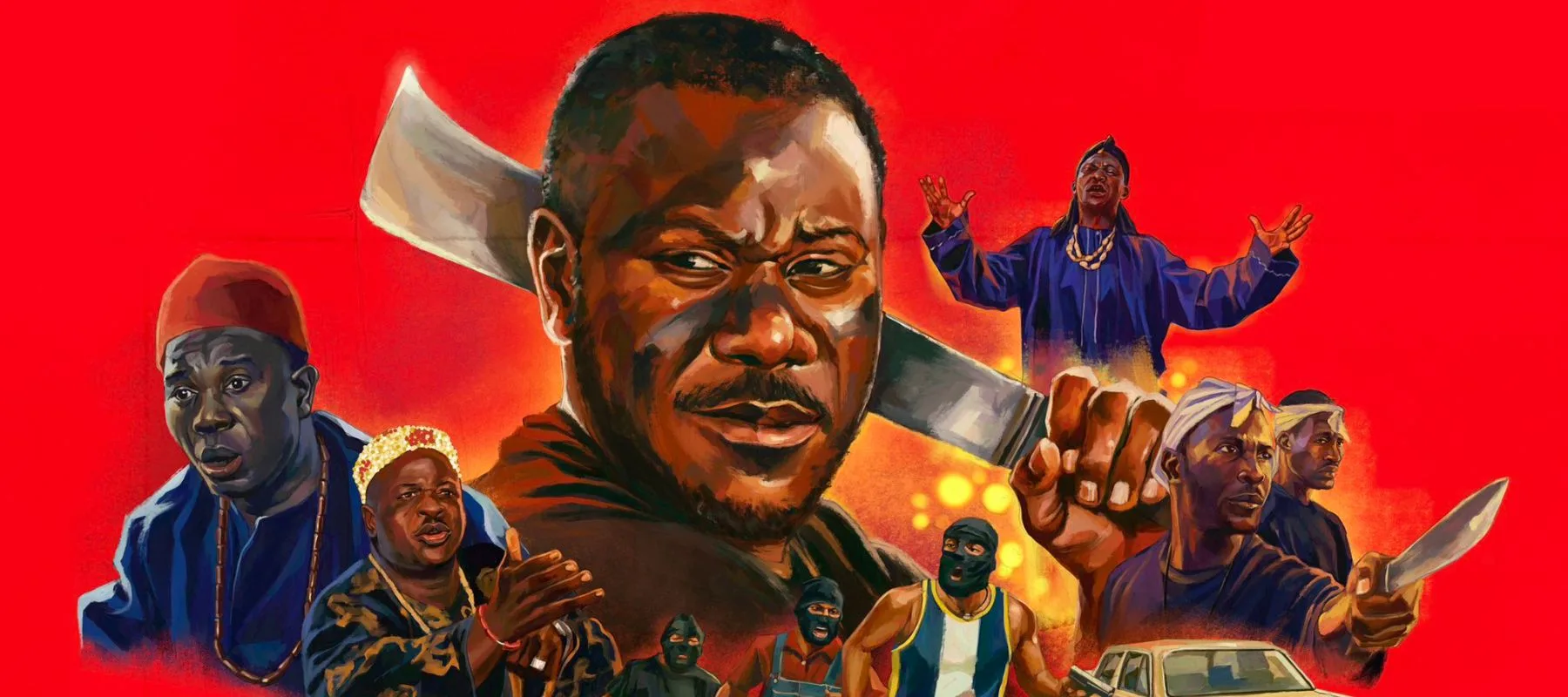
The most visually expansive is Issakaba (2001), directed by Lancelot Oduwa Imasuen. Inspired by vigilante justice and the Bakassi Boys, the film thrived on action and mysticism. Sonaike’s reimagining embraces that scale: Ebube, played by Sam Dede, wields a machete as the scarf-wearing vigilantes close in, sending masked robbers fleeing. It is dynamic and explanatory at once, the kind of visual shorthand old Nollywood posters were built on, but rendered with sharper intent.
Fourth piece from the Nollywood Reimagined series, bringing back that original energy.
Issakaba (2001)
Dir. Lancelot Oduwa Imasuen pic.twitter.com/dZAufNlmoK— 7ife (@_tifeboy) April 14, 2026
Taken together, the series moves across action, horror, comedy, and folklore, the same range that defined early Nollywood itself.
But beyond genre, the project speaks to something larger. Where the original posters were fleeting and often discarded, Sonaike’s illustrations are deliberate acts of recall. He is not just recreating images; he is reconstructing a visual memory that was never properly kept.
In doing so, he turns nostalgia into preservation and gives old Nollywood posters a second life.