



Tune in to listen
Bounce FM

However one feels about the team’s performances and eventual fate, this squad’s symbolism is as relevant as ever.
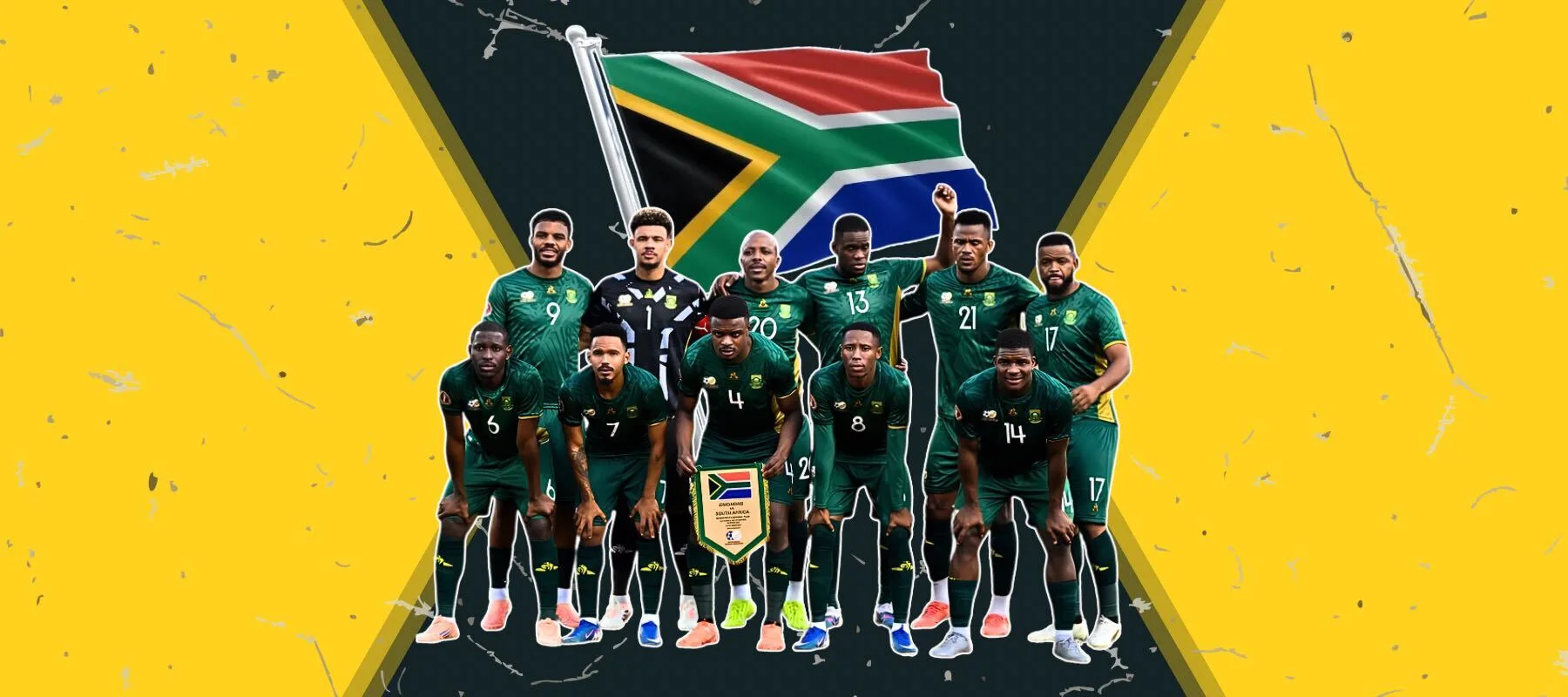
When the Bafana Bafana of South Africa took to the iconic Estadio Azteca for their first World Cup match in 16 years against Mexico in the opening game of the 2026 FIFA World Cup 2026, an unprecedented level of domestic representation was on display, with a staggering 87 per cent of Hugo Broos’ squad plying their trade in the Premier Soccer League.
Not much will be remembered of Bafana Bafana’s opening day display itself, as they turned in a limp performance, falling to what can, in hindsight, be described as Africa’s most disappointing showing of the tournament in North America thus far. The 2010 World Cup hosts attempted to recover in their second match against Czechia, but Teboho Mokoena’s 83rd-minute strike was not enough to spark a comeback from Czechia’s early lead, leaving them with a decisive game against South Korea in Group A’s final proceedings on Thursday, June 25. Anything short of victory would see South Africa become one of the African teams to exit the tournament from the group stage, as has been rightly predicted. Still, however one feels about the team’s performances and eventual fate, this squad’s symbolism is as relevant as ever.
Aside from the substantial domestic league representation, Broos’ squad is also one of only eight nations at this tournament with no players born outside its borders, in an era where diaspora-bred talents have become central to the fortunes of their counterparts, led by DR Congo with 20 foreign-born players and Morocco with 19.
Much has been said about the fluidity of nationality in international football, emboldened by FIFA’s eligibility regulations at its 2020 annual congress, but what does it say about a country’s football ecosystem when its national team can remain so overwhelmingly home-born and grown at a time when globalisation holds sway across the board?
For context, over 130 of the 870 players at the 2022 World Cup in Qatar were born outside the country they represented at the tournament. At this year’s World Cup, nearly one in four players of the 1,248 players in the tournament are representing countries other than their place of birth.
At the 2026 World Cup, nearly one in four players represent a country they weren’t born in. We dig into which countries have the most foreign-born players and more. https://t.co/zT2jxYMH6V
— USA TODAY (@USATODAY) June 21, 2026
South Africa stands uniquely apart from that trend: with the exception of the defensive quartet of Olwethu Makhanya (Philadelphia Union), Ime Okon (Hannover 96), Samukele Kabini (Molde FK), and Mbekezeli Mbokazi (Chicago Fire FC); midfielder Sphephelo Sithole of Tondela FC; and forwards Lyle Foster and Thapelo Maseko of Burnley and AEL Limassol respectively, the remaining 19 men in Broos’ squad all ply their trade in South Africa, with a significant base from Orlando Pirates, who recently scooped their first PSL title in 14 years, and Mamelodi Sundowns, the 2026 CAF Champions League winners.
In many respects, this team embodies the modern South African football itself: humbled, bruised, and now daring to rebuild against unconventional tides.
South Africa made history in 2010 by becoming the first, and only, African country to date to host the World Cup. What followed was a barren spell, as Bafana Bafana went on to miss three AFCONs and three World Cups.
“It was a painful period,” Byron Pillay, a South African reporter, told Bounce Sports. “Coming off the highs of the Clive Barker side that were a source of pride, and then a brilliant hosting of the World Cup in 2010, we thought Bafana Bafana would kick on and continue to ride that wave. Instead, we saw other African sides represent the continent, while South Africa became somewhat of a laughingstock.”
The appointment of Broos in 2021 changed the trajectory for South Africa, with the Belgian coach building his project around the strength of the domestic league. In his first outing with the side, the 2017 AFCON winner with Cameroon steered Bafana Bafana to a third-place finish at the 2023 AFCON in Côte d’Ivoire, with 24 of the 26-man squad drawn from the PSL.
According to Pillay, Broos’ greatest achievement was restoring belief while strengthening the connection between club football and the national team.
“Broos gave Bafana structure and South Africans belief again,” he added. “He trusted PSL players, especially the younger ones. I think that also strengthened the competition within the PSL because players knew that their performances were being noticed by the national team coach. And with players knowing each other and styles of play, and already gelling together in the local league, we have seen a huge influence on the national team, and vice versa.”
The trick wouldn’t work for Bafana Bafana at AFCON 2025, as they fell to a rejuvenated Cameroon side in the round of 16, but it didn’t take much away from a side that had already sealed qualification to the World Cup this summer, having topped Nigeria in Group C of Africa’s qualifiers, despite forfeiting an earlier victory for fielding an ineligible player.
Currently sitting at the bottom of Group A in the ongoing World Cup, this PSL-dominated South African side could still make history as the first domestically represented squad to reach the round of 16, though South Korea poses a stern enough test to torpedo any ounce of optimism.
“Exiting the World Cup at the group stage doesn’t diminish the relevance of this squad,’’ Pillay said. “You can’t have this many local players at a World Cup and still say the league has no quality. Having more players abroad would be good for the individuals themselves and would help strengthen the national team, as they would bring back experience, but I think Bafana have shown that you don’t need international stars to be considered a strong team.”
Football in South Africa has rarely enjoyed a smooth ride. Before the stability and boom of the late 1990s, apartheid’s grip on the country saw FIFA ban it from all competition until 1994, when the institutionalised racial segregation and discrimination was finally dismantled. Two years later, the country hosted and won the AFCON, defeating Tunisia 2-0 at Johannesburg’s First National Bank Stadium. For many in the country’s newly liberated Black communities, it was a rare moment in which the nation could unite around a sporting achievement that resonated across racial lines.
That same year, the Premier Soccer League was established, replacing the National Soccer League. Those concentrated efforts ensured the national team sealed their first-ever World Cup berth with a 1-0 victory over Congo, following their second AFCON appearance in 1998, where they made it to the final before losing 2-0 to Egypt. At their World Cup debut, Bafana Bafana held their own, though draws against Denmark and Saudi Arabia were not enough to advance after an opening loss to the host nation and eventual semi-finalists, France.
With a loss to the co-host and a draw in their second group match already behind them in the ongoing tournament, this is an outcome the current generation of Bafana Bafana will be looking to avoid as they face South Korea in their final group game.
But regardless of where things stand at the end of proceedings in Group A on Thursday, Raphael Abiola, a Nigerian sports editor with over three years of experience covering sports in South Africa, maintains that the PSL’s moment cannot be undone.
“South Africa not qualifying for the knockout stage wouldn’t cancel out the remarkable feat the PSL has achieved,’’ Abiola said. “The PSL was the foundation during the 2023 AFCON, and they came third; Nigeria needed penalties to knock them out. Remember, all these players are playing their first World Cup; it’s a gradual process. They just need to qualify for the competition more frequently and gain more experience on this big stage.”
Pillay shares the same sentiment, adding that “it has been a long return to the World Cup and the magnitude of the occasion may have affected them. But performances like the one against Czechia proved that the team can compete, though they still need more depth and experience.”
One person who won’t be around to oversee the chapter is Broos. The Belgian has already signalled that he will be drawing the curtain on his coaching career after this tournament. He has also been unequivocal about the need for South African players to venture outside the country’s borders to unlock the next level.
“Two truths can co-exist: having the most domestically represented squad at the ongoing World Cup makes me see the PSL differently, because if these players weren’t good enough, the coach wouldn’t call them up. The league is even attracting good players from other African countries, and from South America too,” said Abiola.
“Even so, I still think some of the top South African players need to go to Europe for more exposure, and it would definitely push Bafana Bafana to a new level. The level of competition in European leagues is different from the PSL, so I think some of their best players need to explore it.”
.