



Tune in to listen
Bounce FM

According to a report from Intelpoint, Netflix has invested over $23.6 million and licensed 283 Nigerian titles as of March 2023.

Running a business in Nigeria is one thing; running a subscription-based one is another entirely. The work that goes into funding, distribution, production, and consumption is immense, and it’s further complicated by Nigerian dynamics. But there are examples of companies that appear to be scaling and have found the hack, though the bigger question still remains if they’re really finding success in present-day Nigeria?
When it comes to subscription video on-demand (SVOD) platforms, Netflix is not only a popular choice in Nigeria but globally. The American streaming platform entered the Nigerian market in 2016, and it has since been revolutionary in the entertainment scene, paving access to global content for viewers and, importantly, collaborating with local filmmakers to create Nigerian Netflix original films. According to a report from Intelpoint, Netflix has invested over $23.6 million and licensed 283 Nigerian titles as of March 2023.
Given the platform’s growing footprint in Nigeria and hopes for continued investment, a wave of apprehension swept through the industry in late 2024 when veteran filmmaker Kunle Afolayan implied that the global streaming service was set to exit the Nigerian market. However, as the news gained traction, Netflix refuted the claims, with a spokesperson confirming to TechCabal that they are still very much interested in running their business within the country’s shores. “We are not exiting Nigeria. We will continue to invest in Nigerian stories to delight our audience,” the spokesperson said.
The freshest update on Netflix’s services in Nigeria came earlier this month when the streaming giant announced price increases across its subscription tiers, with the premium plan rising by over 20 percent. While this adjustment is part of a global trend, with markets like South Africa seeing similar changes in April and other Western countries like the United States, Canada, Argentina, and Portugal affected earlier in the year, Nigeria appears to be experiencing the steepest price hikes per capita.
The June 2025 increase marks Netflix’s third in Nigeria within just 14 months, following previous hikes in April and July 2024. This move likely reflects market pressures, either from broader economic challenges or Nigeria’s underwhelming subscriber base. The company may be adopting a high-price strategy to reach its break-even point with fewer active users.
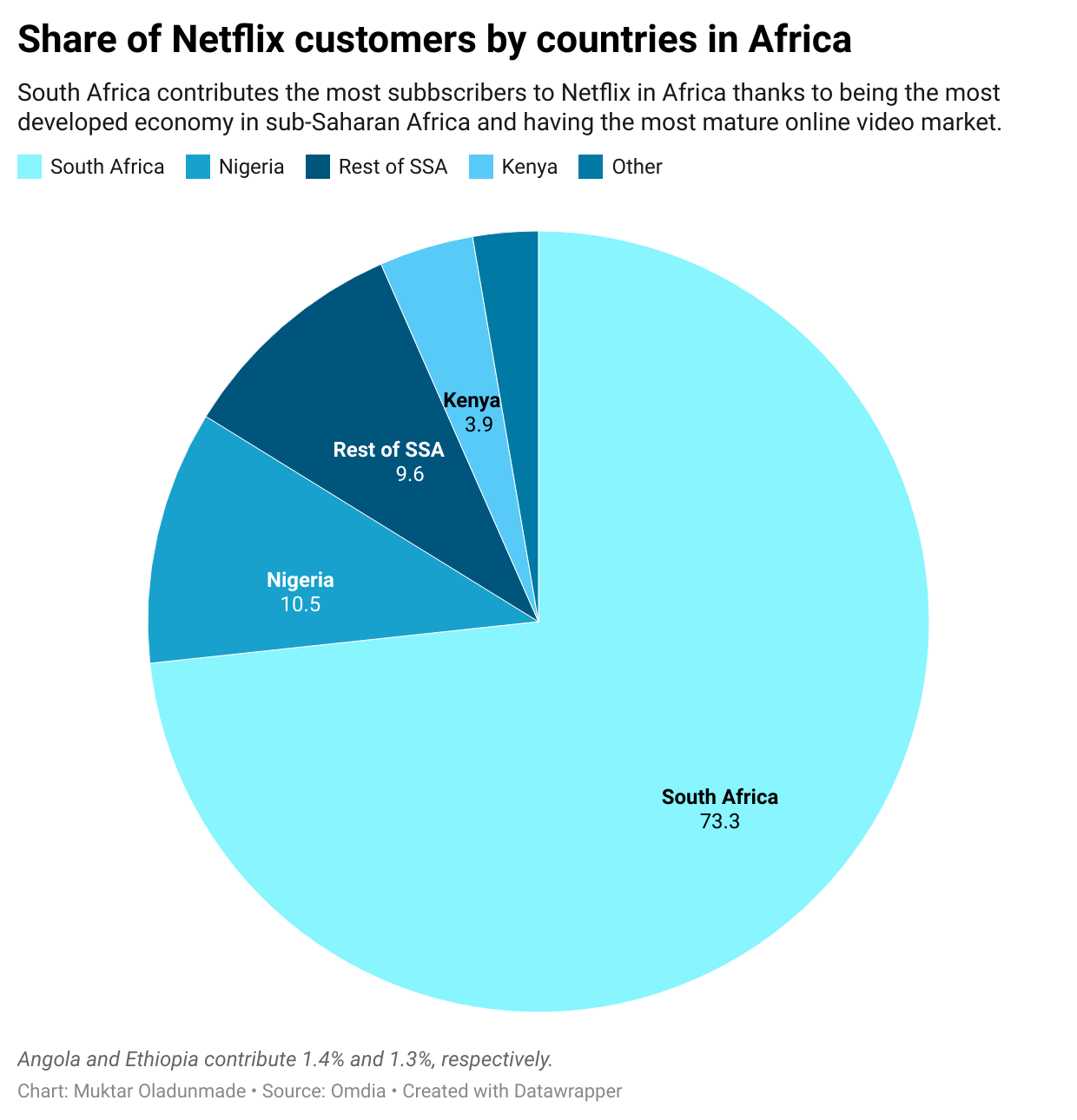
A 2023 report from Omdia lends more flesh to this argument. Per the report, Nigeria accounted for about 11 percent of Africa’s Netflix subscribers, whereas a less populated South Africa accounted for 73.3 percent. Interestingly, South Africa has only experienced price hikes twice since Netflix entered the region in 2016.
The impact of Netflix’s unprecedented hikes in Nigeria, coupled with the country’s limited purchasing power, certainly gives us insight into the challenges of streaming in Nigeria. But a more raw and grounded case of this is that of IROKOtv which appears to have finally lost hope in the Nigerian market after years of frantically trying to beat the tides.
IROKOtv set out to be the African Netflix in 2011. Backed by Tiger Global, a venture capital firm that was one of the early funders of Netflix, Jason Njoku launched the SVOD with Nollywood content being its major product. However, about 15 years down the line, the company had admitted losing its bet on the Nigerian market, as revealed in a March 2025 blog post by Njoku.
“Between the revenues we generated and the venture capital we raised ($35 million) over the first ten years, we easily spent $100 million trying to win,” his post read in part. “But we weren’t winning; we weren’t losing either. We were just there, in full survival mode, operating in the toughest conditions possible.”
“The local market in Nigeria simply collapsed. We saw it and stubbornly decided to keep investing and doubling down until we were all tapped out, having burnt through most of the post-exit capital.”
The signs of IROKOtv moving on from the Nigerian market date back to 2023 when some users noticed the abrupt disappearance of the app from app stores, and their website going dark. However, in an explanation to TechCabal, Njoku at the time framed the blackout as necessary for the company’s strategy of decentering Nigeria and Africa in pursuit of a broader international outlook, a shift which rendered their former structure obsolete after 10+ years of building for Nigeria first.
As he’d come to clarify in his recent blog post: “In 2023, we finally accepted there was no market for paid premium services and exited Nigeria. We haven’t processed any Naira payments there in almost two years. As I humbly survey the wreckage of the last 15 years of streaming in Nigeria and Africa, it’s clear our (then $2k GDP per capita) was too small to support even a $5/mo product. It’s clear this wasn’t even a question of capital.”
While the realism of Njoku’s admission has led to deductions of IROKO closing its shop in Nigeria, the serial entrepreneur has noted differently on X. “@irokotv isn’t shutting down. The March article codifies my thoughts on 15 years of streaming battles. There was no mention of a service shutdown. We stopped accepting Naira payments in 2023. The app is still in store and available but with $ payments. 93% of our revenues are from North America & Europe. It’s been a slog, it’s not my main focus anymore.”
We can talk about the rise and fall of IROKOtv till the cows come home, but what we’re ultimately witnessing goes beyond a change in strategy to embrace less price-sensitive demographics. It speaks to a deeper question about the viability of Nigerian-first or Nigerian-only digital products in a region increasingly dominated by global alternatives.