



Tune in to listen
Bounce FM

Since leaving office in 2023, Malami has become the most recent former chief law officer to be enmeshed in serious legal trouble.
On May 29, 2015, Muhammadu Buhari, a former military ruler of Nigeria, strode into power as a democratically elected president on the gospel of combating corruption. In the buildup to the 2015 presidential election, the majority of voters had become disillusioned with the incumbent president, Goodluck Jonathan, who was widely perceived as being lethargic in the face of rampant corruption in his government. Many Nigerians had come to believe that corruption was holding the country down and hurting both them and their fellow citizens.
It did not help Jonathan’s case for re-election that during a media chat in 2014 — a pre-election year that saw the coalition party, the All Progressives Congress (APC), surging in popularity — he awkwardly suggested that stealing was not corruption. Although the president may have been attempting to make an intellectual argument, that nuance was lost on much of an angry public. The opposition predictably pounced, arguing that his remarks were further evidence that he was not doing enough to curb corruption among his ministers. The Buhari-led opposition eventually prevailed in the March 28 presidential election, making history as the first opposition party to defeat an incumbent president in Nigeria’s democratic history, largely on the promise of crushing public corruption.
Upon assuming office, Buhari promised to restore trust in government and prosecute corrupt officials regardless of political affiliation. “I belong to everybody, I belong to nobody” the famous rhetoric from his inaugural address still rings a bell. But within only a few months, the public began to sour on the new president’s capacity to deliver on his promises of change after he failed to nominate ministers nearly five months into his tenure. Buhari, who said he was holding out for the best, did not release his first list of ministerial nominees until October 6, 2015. That list featured a little-known Senior Advocate of Nigeria (SAN) who would go on to become the chief legal officer of the country. That SAN was Abubakar Malami, a native of Kebbi State. He represented one of the “best” Buhari had to offer.
Ten years later, and after spending eight years as the Attorney-General of the Federation (AGF), Malami has not been a shining representative of the late former president’s “best.”
Since leaving office in 2023, Malami has become the most recent former chief law officer to be enmeshed in serious legal trouble. He is currently facing prosecution by the Economic and Financial Crimes Commission (EFCC) over allegations of money laundering, illicit enrichment, and abuse of office. The charges, which he denies, paint a troubling picture of how public power may have been converted into private wealth on an industrial scale.
At the centre of the case are allegations that Malami, working directly or through close family members, including his wife and son, and corporate vehicles, concealed and transferred large sums of money suspected to be proceeds of unlawful activity. Prosecutors allege that bank accounts linked to him and his family handled billions of naira in suspicious transactions over several years, some of them routed through companies with no clear commercial justification for receiving such funds. These transactions, according to the EFCC, were later used to acquire a sprawling portfolio of high-value assets.
Court filings have detailed dozens of properties traced to Malami and his immediate family across Abuja and other states, including luxury residences, commercial buildings, hotels, filling stations, and other income-generating real estate. An interim court order has already placed 57 of these properties under forfeiture, with estimates around ₦213.2 billion in combined value, pending the outcome of the trial. The scale alone has shocked many Nigerians, particularly because Malami served as the country’s chief legal adviser and was expected to be among the strongest internal checks against the abuse of state power.
Beyond the former AGF’s alleged corruption, he’s also on the hook for allegedly financing the terrorism he purportedly fought while in office. Barely minutes after stepping out of the Kuje Correctional Centre in Abuja — where he was remanded for his money laundering trial — on bail last Monday, January 19, operatives of the Department of State Services (DSS) took him into custody to probe his handling of the list of Nigerian terror financiers released by the United Arab Emirates (UAE) in 2021. Additionally, the erstwhile chief legal officer of Nigeria is also being investigated by the DSS over an arms cache allegedly found in his Kebbi home, which he has denied.
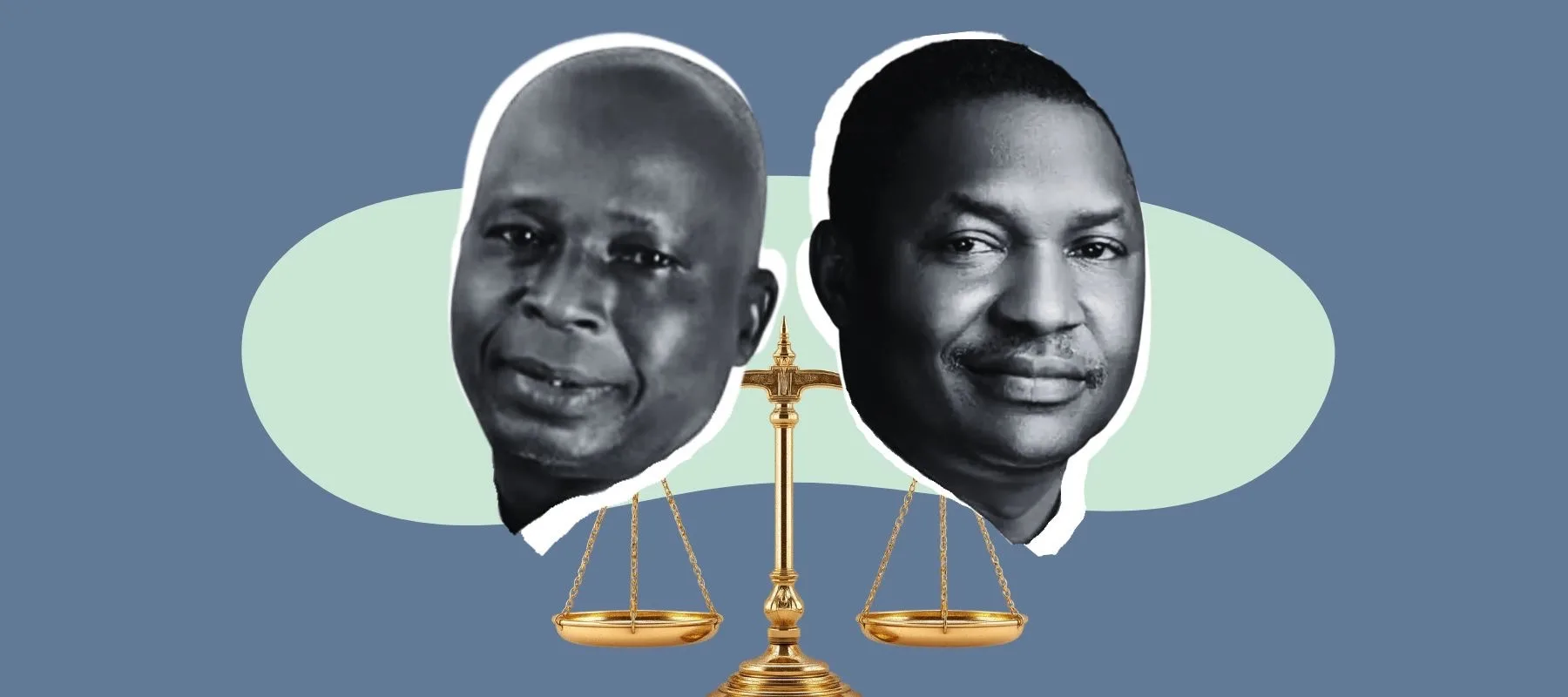
Malami’s case, however, is not occurring in isolation. He is not the first former AGF to face legal scrutiny after leaving office. Mohammed Bello Adoke, who served as AGF under President Goodluck Jonathan, was prosecuted over his role in the controversial OPL 245 oil block deal. That case involved allegations of bribery, money laundering, and abuse of office, and for a time Adoke’s legal battles stretched across multiple jurisdictions. Ultimately, two separate Nigerian courts dismissed the charges against him, effectively clearing him of criminal liability. Adoke has consistently argued that he acted within the law and has since portrayed his ordeal as an example of politicised prosecution.
Michael Aondoakaa, who preceded Adoke as AGF during the Umaru Musa Yar’Adua administration, also faced intense controversy after leaving office. Though he was not criminally convicted, he was investigated and temporarily lost his rank as a SAN over allegations related to professional misconduct. That sanction was later overturned, and Aondoakaa’s title was restored. But in a judgment dated December 10, 2021, and delivered by now-Chief Justice of Nigeria (CJN), Kudirat Kekere-Ekun, the Supreme Court affirmed the verdict of the Federal High Court in Calabar that the former AGF “ought not to be entrusted with any other public office at all.” The sanction was in relation to Aondoakaa asking the former Chairman of the Independent National Electoral Commission (INEC), Maurice Iwu, and the Speaker of the House of Representatives to disregard a judgment of the Court of Appeal. Although the former AGF faced serious ethical issues, he too, like Adoke, has been largely absolved of the most serious accusations levelled against him.
In that sense, Malami’s situation may yet follow a similar trajectory. Under the law, he is presumed innocent until proven guilty, and it remains entirely possible that he could be acquitted of all charges. Nigerian courts have, in the past, shown a willingness to dismiss cases that fail to meet the required evidentiary threshold, regardless of public sentiment. Nonetheless, the broader pattern is difficult to ignore. Three of the last four chief legal officers of the federation — excluding the current AGF, Lateef Fagbemi — have faced significant legal or ethical crises after leaving office, a trend that does little to inspire confidence in the integrity of governance.
This pattern feeds directly into Nigerians’ chronically low trust in government. Many Nigerians already believe that those entrusted with public authority often betray that trust, using office not as a platform for service but as an opportunity for personal enrichment or political protection. While this problem is not unique to the office of the Attorney-General and cuts across ministries, agencies, and levels of government, it is especially disturbing when it implicates the nation’s chief law enforcers and legal advisers.
The AGF occupies a unique and powerful position: part minister, part guardian of the rule of law, and, in theory, a moral compass for the state’s legal conduct. When holders of that office are repeatedly linked — rightly or wrongly — to allegations of corruption, financial impropriety, or law-breaking, the damage goes beyond individual reputations. It erodes faith in the legal system itself and reinforces public cynicism about whether the law is applied evenly or merely wielded as a political instrument.
The details emerging from the Malami case, still unfolding, are therefore significant not only because of what they may say about one man’s conduct, but because of what they reveal about institutional weakness and accountability at the highest levels of the Nigerian state. Even if the courts eventually clear him, the sheer magnitude of the allegations underscores a deeper governance problem: a system that repeatedly places immense power in the hands of individuals without building sufficient safeguards to ensure that such power is not abused. In a country already struggling with public distrust, that is a problem Nigeria can ill afford to ignore. All eyes will now be on the current AGF, Lateef Fagbemi, SAN, to make a honest attempt to change the perception of corruption linked to the Ministry of Justice.