




Tune in to listen
Bounce FM

The consumer implications of this fight are real and cut both ways.
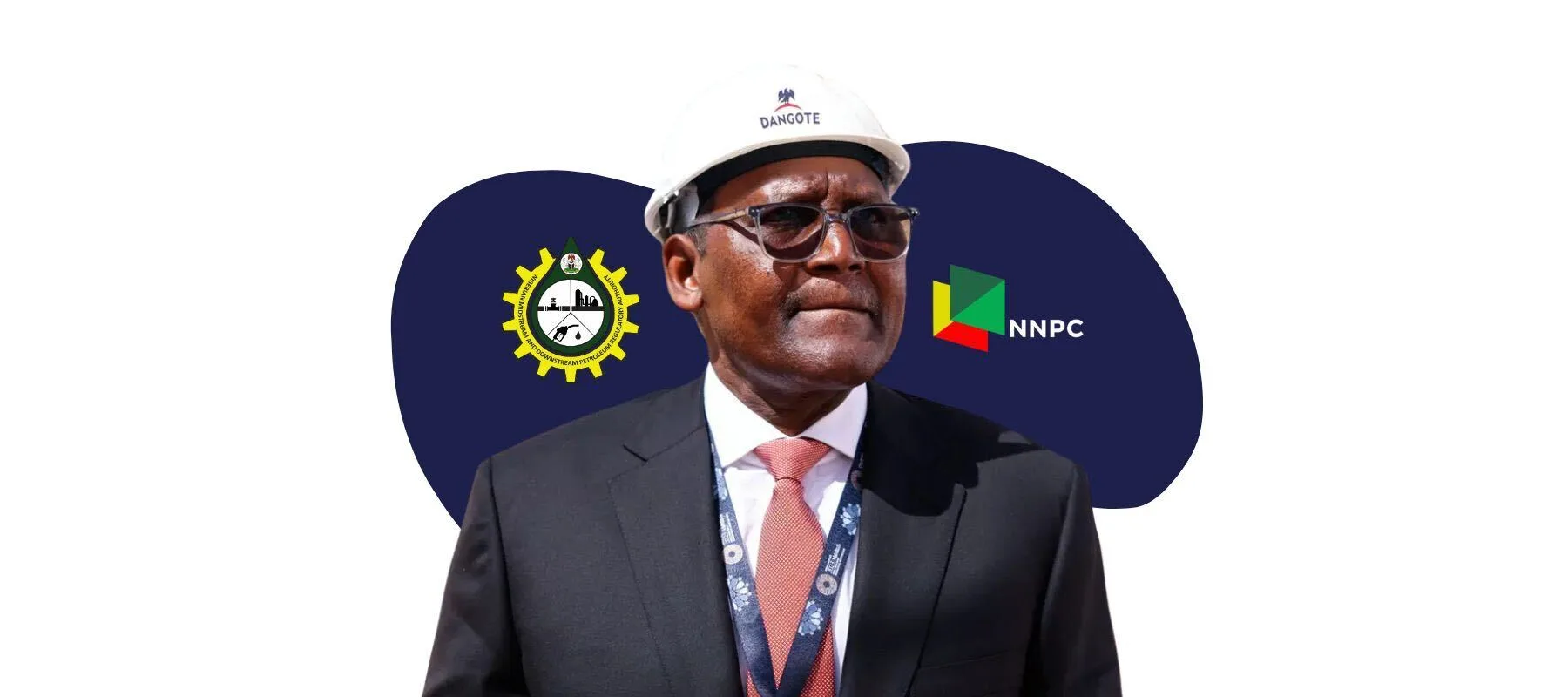
New court documents that became public on Wednesday, June 3, reveal that Dangote Petroleum Refinery has formally accused the federal government and its agencies of deliberately sabotaging its operations — withholding crude oil supply, maintaining a hostile regulatory environment, and continuing to approve fuel import licences even as the refinery operates near full capacity. The allegations were filed in an affidavit before the Federal High Court in Lagos, where the refinery is seeking an urgent interim injunction to stop the Nigerian Midstream and Downstream Petroleum Regulatory Authority (NMDPRA) from issuing or renewing those licences.
According to the affidavit, the refinery claims it receives roughly five crude cargoes per month from the Nigerian National Petroleum Company (NNPC) when it needs at least 13 to run optimally, forcing it to buy crude on international markets at significantly higher prices. It further accuses NNPC, the NMDPRA, and the Nigerian Upstream Petroleum Regulatory Commission (NUPRC) of collectively creating what it calls a hostile operating environment. NNPC has flatly denied the allegations, saying it has not sabotaged the refinery and that crude allocation decisions are governed by “operational realities, commercial arrangements, security considerations, and logistical constraints.” It also asked the court to dismiss the suit as premature and incompetent, arguing the refinery lacks the legal standing to bring the case.
How We Got Here
The new affidavit is the latest chapter in a fight that became public on May 15, when Reuters first reported that Dangote refinery had filed a fresh lawsuit — Suit No: FHC/L/CS/857/2026 — asking the Federal High Court in Lagos to set aside import licences issued by the NMDPRA to NNPC and other petroleum marketers. The company’s legal argument rests on the Petroleum Industry Act (PIA), which it contends only permits fuel imports when domestic production cannot meet demand, a threshold he says is no longer being met, given that the refinery supplied roughly 77 percent of Nigeria’s petrol in the first quarter of 2026.
What makes this revival significant is that it is not the first time. Dangote filed a nearly identical suit in 2024 in Abuja, seeking to nullify import licences and claiming ₦100 billion in damages. In July 2025, the refinery quietly withdrew that case without public explanation, leaving the underlying questions entirely unresolved. The May 2026 filing is that same fight returning in sharper form, with NNPC now formally in court as an adversary and the NMDPRA joining the proceedings.
In its response to Dangote refinery’s complaints, NNPC accuses the private company of seeking monopoly control of Nigeria’s downstream petroleum sector, warns that restricting imports would expose the country to supply disruptions and price instability, and, most directly, argues that Dangote’s petrol is already sold at “significantly high and fluctuating market prices, dictated by its commercial interests,” making the point that consumers have borne the costs of the refinery buying more expensive crude on international markets.
The Depot and Petroleum Products Marketers Association of Nigeria (DAPPMAN) has also weighed in, stating that “a private refinery’s commercial interests should not override a regulator’s mandate.”
What It Means For You
The consumer implications of this fight are real and cut both ways.
If Dangote wins and imports are substantially restricted, Nigeria’s fuel supply becomes dependent on a single private entity with shareholders, including, potentially, public shareholders given a planned IPO later this year. A post-IPO refinery faces pressure to maximise margins, not to keep pump prices low. The price competition that imports currently provide, however imperfect, would be gone.
But the import-dependence model carries its own long-term cost to consumers. Every time the naira weakens against the dollar — which it has done repeatedly — the price of imported fuel rises automatically. The structural case for building and protecting a domestic refinery is a genuine consumer-welfare argument, not just Dangote’s commercial interest.
The honest answer is that the correct balance requires the refinery to demonstrate it can guarantee uninterrupted, nationwide supply at competitive prices before imports are legally curtailed, something NNPC correctly notes has not been independently verified. Protecting a domestic refinery from being starved of crude is legitimate; granting it immunity from competition before it has earned consumer trust is a different matter entirely. Both things can be true at once, which is precisely why this fight keeps returning to court rather than getting resolved anywhere else.
What Happens Next?
Since Dangote refinery began operations in 2024, it has had a tenuous relationship with regulators. After withdrawing its suit seeking to halt fuel imports in July 2025, suggesting that some calm was coming into the relationship, the company’s CEO, Aliko Dangote, went to war with ex-NMDPRA CEO, Farouk Ahmed, in December, accusing him of corruption and regulatory sabotage. Dangote made his accusations on Sunday, December 14, 2025. By Wednesday, December 17, Ahmed had tendered his resignation, indicating the influence the continent’s richest man wields in the midstream and downstream petroleum sectors.
On April 29, 2026, President Bola Tinubu abruptly replaced Ahmed’s successor with Rabiu Umar, a former executive of the Dangote Group, an appointment widely seen as placating the billionaire refinery owner. But barely a week after Umar was confirmed by the Senate, the refinery’s new lawsuit against the NMDPRA became public. Although Dangote refinery sued the agency based on the actions of the former leadership in March, the new leadership, so far, has been unable to engineer a ceasefire.
With Dangote refinery escalating its fight to more government agencies, it is unclear whether even a familiar face is capable of ending the feud.