



Tune in to listen
Bounce FM

This decline did not happen overnight; it followed a predictable chain of shifts in how we now consume entertainment.
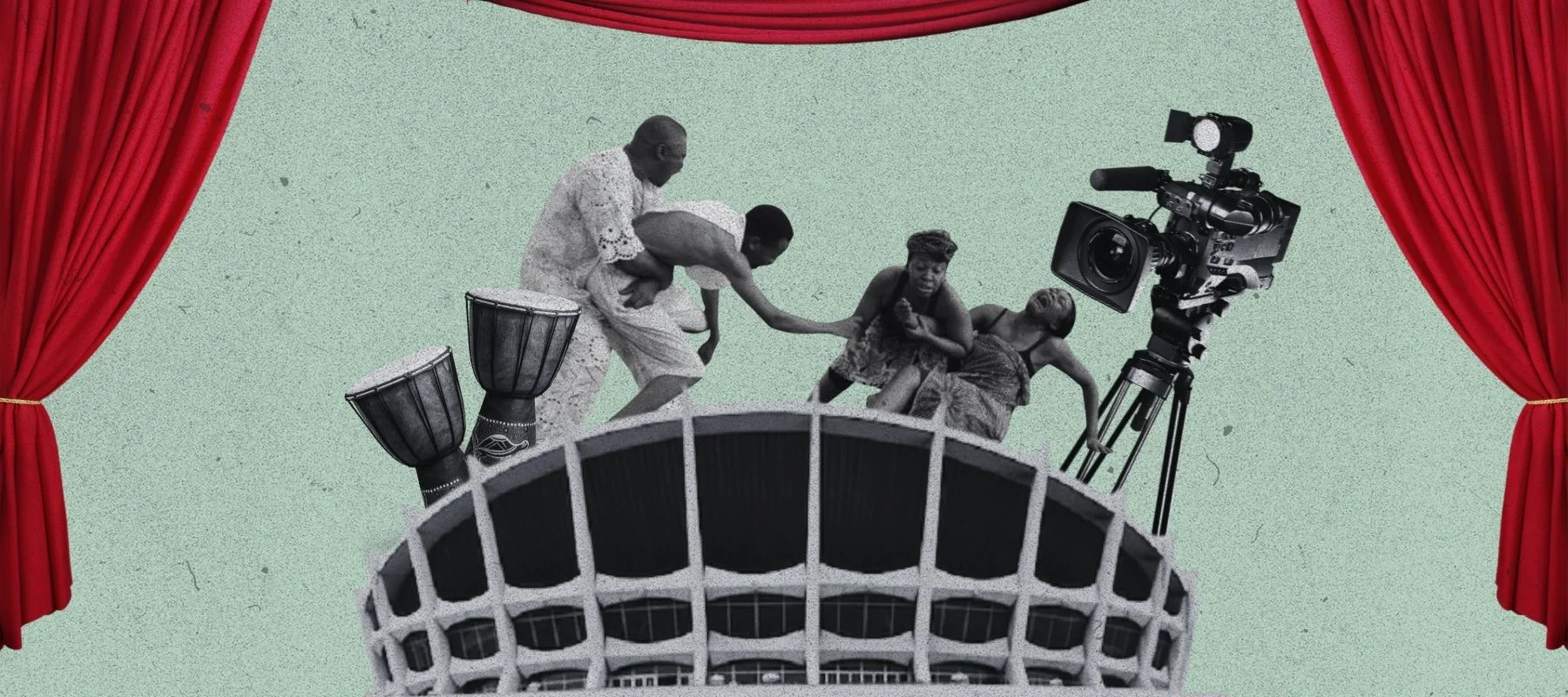
The history of theatre in Nigeria can be traced to the 18th century, when court jesters delivered entertainment in royal settings across various regions of the country. The colourful and theatrical displays of traditional masquerades were sources of comic relief for excited crowds. The Yorubas in today’s southwest Nigeria had the Gẹ̀lẹ̀dẹ́ Masquerade, which celebrated motherhood and combined art and ritual dance to amuse, educate, and inspire worship since 1755. And the Igbos had the Ìjẹ̀lè Masquerade, which provided popular entertainment as young boys and girls sang and danced to the tunes of Akunechenyi music during both festive and solemn occasions. However, theatre did not become a professional art in Nigeria until the 1940s when the late Hubert Ogunde founded his travelling company, the African Music Research Party, later known as the Ogunde Theatre, and by so doing, inaugurated modern Nigerian theatre.
Ogunde’s work marked a turning point in the evolution of the performing arts. He used theatre not merely to entertain, but to critique colonialism and expose the contradictions of Nigerian society. His plays — rich in music, satire, and spectacle — were a blend of tradition and political urgency. Tiger’s Empire (1946) and Strike and Hunger (1945), for instance, were acts of resistance against British imperial rule. Ogunde showed how theatre could galvanise nationalist consciousness, so much so that he became both a dramatist and an activist.
By 1960, as Nigeria prepared for independence, theatre had become so central to public life that the international literary magazine Encounter organised a drama competition for the newly emerging African nations. A young Wole Soyinka entered and won with his metaphysical play A Dance of the Forests. It was a work of extraordinary audacity, warning the soon-to-be independent Nigerian leadership against repeating the follies of their colonial predecessors. Initially, the new Nigerian government embraced the idea of staging Soyinka’s play as part of the independence celebrations. But once officials realised that the script contained a subversive message — criticising the same political class that was to assume power — they withdrew their support. Soyinka, undeterred, staged A Dance of the Forests anyway, in Ibadan, to sold-out audiences, using his prize money from Encounter.
Such was the power of theatre in postcolonial Nigeria — it was art as provocation, art as mirror, art as moral tribunal. Soyinka’s defiance symbolised a generation of dramatists who saw the stage as a battleground for truth. His contemporaries, the likes of J.P. Clark, James Ene Henshaw, and later Femi Osofisan and Ola Rotimi, engaged the theatre in challenging tyranny and confronting moral decay in society. During successive military regimes in the 1970s and 1980s, plays became coded resistance. To write or perform was to risk detention, exile, or worse. Speaking with The Republic, veteran Nigerian playwright and professor emeritus of theatre arts, Femi Osofisan, recalls how some fellow practitioners ended up in detention for their art, while others had to run out of the country. Ogunde, for example, endured severe censorship for staging the unforgettable Yoruba Ronu play, which dramatised the fallout between the Premier of the Western Region, Chief Samuel Ladoke Akintola and the leader of the Action Group (AG), Obafemi Awolowo, on February 28, 1964. After the play portrayed the disgrace and death of Akintola — who was killed in a military coup less than two years later — right in the Premier’s presence, Ogunde was banned from performing in the western region, and his works were banned from being played on the government-owned Western Nigerian Broadcasting Services.
Indeed, theatre halls in Ibadan, Ife, Lagos, and other parts of the country once pulsed with this kind of energy. Similar to most literary productions of those times, audiences came not only to be entertained but to gain awareness and understanding of the topical issues in their communities. A performance could spark public debate, inspire protest, or expose injustice. Theatre was civic engagement, and it thrived in the hands of artists who believed that the stage was an extension of the public square. But today, that spirit has dimmed. Theatre no longer terrifies power. Plays no longer provoke headlines or spark public reckoning.
This decline did not happen overnight; it followed a predictable chain of shifts in how we now consume entertainment. Television knocked stage theatre off its pedestal in the 1980s when families began to gather around home sets instead of community halls. Then came the video boom of the 1990s and early 2000s, when the rise of Nollywood made drama portable and accessible. Nollywood became a practical solution for an impoverished, entertainment-thirsty public seeking an escape from the many political problems in the comfort of their homes. In recent years, streaming platforms — majorly Netflix, Prime Video, and Showmax — have reshaped even that culture, providing cheaper, on-demand entertainment that fits into the fast-paced rhythm of modern life. Now, Nigerians are turning their backs on even streaming platforms for YouTube, which is practically free and widely accessible.
Nonetheless, since 2015, when the first Artistic Director of the National Troupes of Nigeria, Prof. Bayo Oduneye, declared that theatre is dead in Nigeria due to “lack of funds” and government neglect, there have been some efforts by the public and private sectors to revive theatre to its old glory. For example, the Bankers’ Committee, the Central Bank of Nigeria (CBN), the Lagos State Government, and the Ministry of Arts, Culture, and Creative Economy recently spearheaded the ₦68 billion renovation of the National Theatre (now Wole Soyinka Centre for Culture and the Creative Arts). Also, in recent years, the Lagos government and some private organisations have partnered with theatre practitioners such as filmmaker Bolanle Austen-Peters on the Lagos International Theatre Festival (LITF), an annual event for the performing arts in Nigeria. Tosin Ibitoye, a Music and Theatre lecturer at Kwara State University (KWASU), admits to BSide that organisations like Austen-Peters’s Terra Kulture, the MUSON Centre, and more “host top-tier live theatre shows regularly in recent times” and continue to keep theatre alive, despite reduced patronage. Indeed, Terra Kulture hosts regular plays and is also spearheading LITF 2025, where “20 carefully curated plays” are set to take centre stage on November 15 and 16, 2025, at the MUSON Centre, Lagos.
Still, some stakeholders believe that theatre is not at the level it deserves to be, given its cultural significance and the talent available in the industry. At the 2024 edition of the LITF, actor Tosin Adeyemi, who acknowledges the limitations of theatre in Nigeria, told Nollywire that theatre practitioners need support from the public and private sectors to gain access to more theatres in strategic locations such as Lagos, Abuja, and Ibadan, the Oyo State capital. She also called for investments, grants, and funding, which are in short supply for theatre practitioners in Nigeria.
This should concern us all. Beyond its political relevance, theatre matters because of what it offers as an art form. It brings stories to life in a way that no other medium can. The audience sees people, not screens — real voices, real emotions, and real reactions happening in the same space. This immediacy creates a kind of honesty that recorded or edited performances can’t reproduce. The lights, movement, and dialogue all work together to make complex ideas easier to feel and understand. Theatre also builds community. It brings people together to share an experience and reflect on it collectively. In that sense, it helps society develop empathy and awareness, which are just as important as political critique.
If Nigeria is to “make theatre great again,” it will require public and private investment, significant audience participation, and above all, a renewed cultural commitment to truth-telling through art.