



Tune in to listen
Bounce FM

It doesn’t help the defenders of the Nigerian government that the state has largely failed to stem the tide of violent attacks.
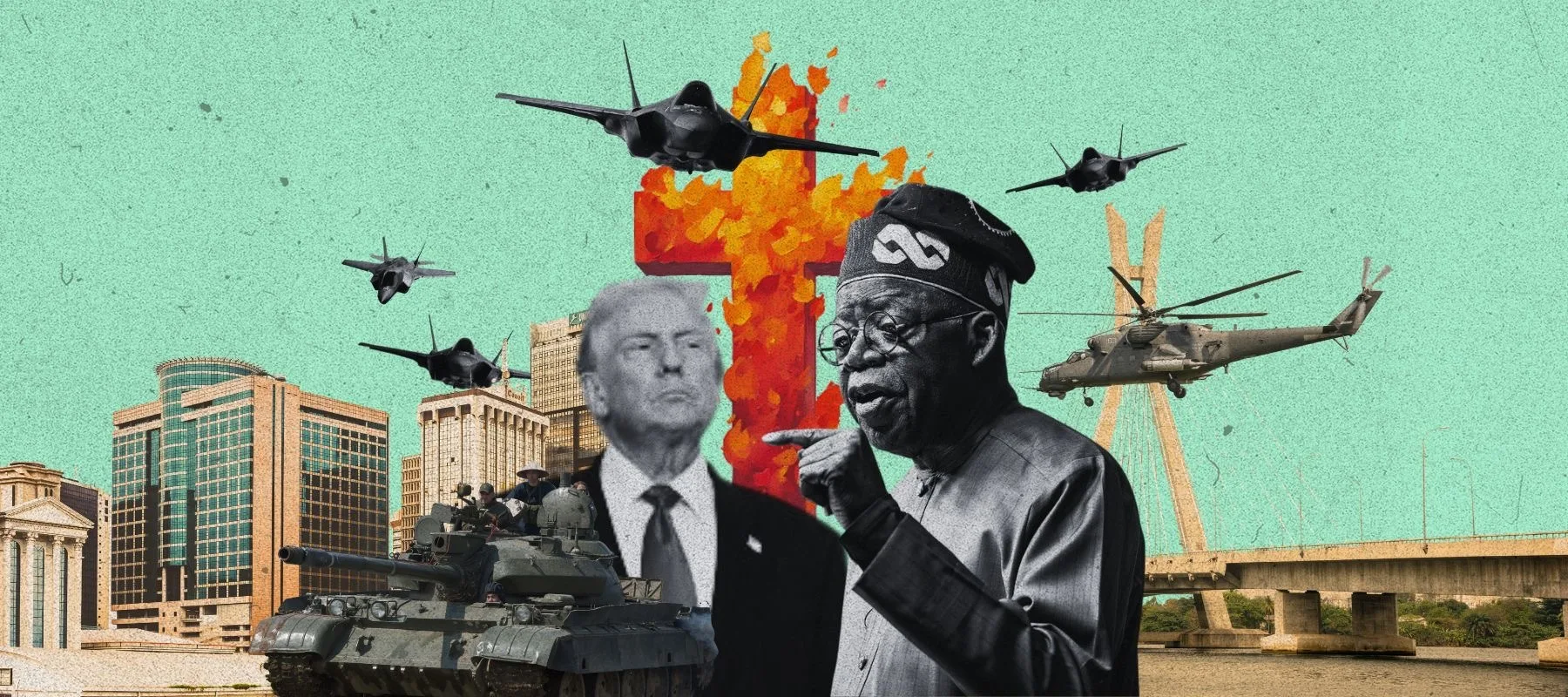
When United States (US) President Donald Trump took to his Truth Social platform last Friday, October 31, 2025, to announce that he had redesignated Nigeria as a “Country of Particular Concern” (CPC) over claims of “Christian genocide,” he kicked off a political firestorm in the country. In the post, Trump claimed that Christianity faced an existential threat in Nigeria because “radical Islamists” were engaged in a “mass slaughter” of Christians.
It was the second time the US president would make such a move. Toward the end of his first term in office, on December 2, 2020, he had also designated Nigeria a CPC due to alleged religious freedom violations. However, his successor, now former President Joe Biden, removed the country from the list against the advice of the independent US Commission on International Religious Freedom (USCIRF), which had recommended that Nigeria remain on it.
CPC is a classification reserved for countries accused of engaging in or tolerating severe violations of religious freedom under the US International Religious Freedom Act of 1998 (IRFA). These violations include acts of torture, mass killings, imprisonment, or systemic discrimination based on religion or belief. After the US designated Nigeria a CPC in 2020, it announced a waiver of sanctions that usually accompany such a move in the “important national interest of the United States.” But this time, Trump has not only threatened to immediately stop all aid and assistance to Nigeria but also instructed his Department of War to prepare for possible military action inside the country to “completely wipe out the Islamic terrorists who are committing these horrible atrocities.”
Yes sir.
The killing of innocent Christians in Nigeria — and anywhere — must end immediately. The Department of War is preparing for action. Either the Nigerian Government protects Christians, or we will kill the Islamic Terrorists who are committing these horrible atrocities. pic.twitter.com/C0v9RHGoS1
— Pete Hegseth (@PeteHegseth) November 1, 2025
The latest CPC designation came after intense lobbying of Trump by some Republican lawmakers in recent weeks to sanction Nigeria for allegedly allowing the “persecution of Christians.” US Senator Ted Cruz introduced a bill aimed at sanctioning the Nigerian government for “ignoring and even facilitating the mass murder of Christians by Islamist jihadists.” Similarly, a member of the US House, Riley Moore, has claimed that Nigeria is the deadliest country in the world for Christians.
Officials in Nigeria are ignoring and even facilitating the mass murder of Christians by Islamist jihadists.
It’s time to hold those responsible accountable. My Nigeria Religious Freedom Accountability Act would target these officials with powerful sanctions and other tools.…
— Senator Ted Cruz (@SenTedCruz) October 3, 2025
Nigeria is the deadliest country in the world for Christians and the world stands by silently.
That's why I'm urging @SecRubio to designate Nigeria as a Country of Particular Concern to unlock diplomatic levers to protect our brothers and sisters in Christ. 🧵
— Rep. Riley M. Moore (@RepRileyMoore) October 6, 2025
However, President Bola Tinubu on Saturday, November 1, pushed back against claims of religious intolerance and defended his country’s efforts to protect religious freedom. The Nigerian president stated that the characterization of Nigeria as religiously intolerant “does not reflect our national reality, nor does it take into consideration the consistent and sincere efforts of the government to safeguard freedom of religion and beliefs for all Nigerians.” The Minister of Foreign Affairs, Yusuf Tuggar, also insisted that there is no genocide in Nigeria.
The stance of Nigerian officials aligns with that of media and human rights organizations that have pushed back against the claims of Christian persecution in Nigeria. They contend that radical Islamist groups have been indiscriminate in their actions, attacking Christians, Muslims, and others, and that summing up the violence as “Christian genocide” oversimplifies the crisis. Indeed, ideologically driven jihadist groups such as Boko Haram and ISWAP have attacked mosques, killed clerics, and raided communities irrespective of religious belief.
However, it doesn’t help the defenders of the Nigerian government that the state has largely failed to stem the tide of violent attacks since July 2009, when Boko Haram began its armed struggle against Nigeria. Nor does it help that various offshoots of violent groups — especially terrorists commonly referred to as bandits and killer herdsmen — have since emerged, escalating attacks against citizens. It’s certainly not a plus for the Nigerian government that the very morning of the day Trump redesignated Nigeria as a CPC, reports emerged of the killing of Reverend Yahaya Kambasiya of the United Church of Christ in Nigeria (UCCN) and the abduction of more than 20 worshippers during an attack in Kaduna State. It was the second assault on the church in ten months, following a December 2024 Christmas Eve attack that left another pastor dead and about 50 people kidnapped. Later that same day, gunmen killed at least 17 people in fresh attacks across communities in Plateau and Kaduna States.
Over the past 16 years, violent killings have become a staple in Nigeria due to the constant failure of successive governments to bring non-state actors under control. There have been so many killings that Nigerians have become numb to death and destruction. This year alone, there have been several incidents in which dozens of people were killed in a single attack. For instance, in April, gunmen killed at least 52 people and displaced nearly 2,000 others over several days of attacks in Plateau State, which has a history of ethno-religious clashes between farmers and cattle herders. It was the worst outbreak of violence since December 2023, when more than 100 people were killed in the same state. Nearly two weeks later, more violence erupted in Plateau as at least 51 more people were killed. That same week, suspected killer herdsmen also killed at least 56 people in two local government areas of Benue State.
The draconian blasphemy laws in Northern Nigeria have also not helped the perception of state-backed religious violence. Although Nigeria’s federal government is secular, sharia law operates alongside common law in 12 mostly Muslim northern states, and some of those states have sought the death penalty for people accused of blasphemy. For example, the Supreme Court held its first hearing in September in a high-profile blasphemy case involving Yahaya Sharif-Aminu, a Sufi Muslim musician who was sentenced to death by a sharia court in Kano State in 2020 for sharing song lyrics deemed to insult the Prophet Mohammed. Incidentally, his case was one of those the first Trump administration cited when it designated Nigeria as a CPC in 2020.
Blasphemy accusations have also fueled mob justice, with perpetrators often facing no consequences. In May 2022, for instance, a female student, Deborah Samuel, was gruesomely murdered by her classmates in Sokoto State over blasphemy allegations. When arrests were made, hundreds of people demonstrated in solidarity with the murder suspects. More than three years after the killing, no one has been brought to justice. Just over a year after Samuel’s murder, a court freed the two suspects — Bilyaminu Aliyu and Aminu Hukunchi — after the police allegedly sabotaged the case. More recently in August, a woman was burnt to death in Niger State, also in Northern Nigeria, accused of blaspheming the Prophet Muhammad. More than two months after her murder, the police are yet to report any arrest. Even terrorists have been let off the hook. In nine years, Nigerian authorities have let at least 2,553 terrorists escape prosecution by deeming them “repentant.”
It would therefore be incredibly naive and dishonest to claim that there are no targeted religious killings in Nigeria, but it would also be disingenuous to pretend that all terrorist attacks target only Christians. However, if the US president is serious about helping “our cherished Christians” — as he called them — and other vulnerable communities, then instead of brash talk, he should take the diplomatic route and engage the Nigerian government constructively. Surely, Nigeria’s security forces can use all the help they can get. But no one will gain from US forces coming in “guns-a-blazing” without invitation. That would create a disaster , not a real solution.
Even as the Nigerian government pursues diplomacy with the US, it’s hard to ignore the fact that this nearly three-year-old administration has not had an ambassador in any country, including the US, since Tinubu recalled them in September 2023. As US lawmakers lobbied to sanction Nigeria, the country had no top diplomat in the US capital pushing back — a symbol of the maladministration that has become synonymous with the Nigerian government.
The Nigerian government can make all the denials it wants, but there is no escaping the fact that its gross incompetence has led the country to this point where another country’s president now derides Nigeria as a “disgraced country.” The last thing the Nigerian government should want is a direct confrontation with Trump, whom his critics describe as erratic and unpredictable. Rather than exchanging barbs or issuing hollow statements, the Tinubu administration must engage the US competently and strategically. Nigerians themselves have expressed deep scepticism about the idea of US boots on the ground and not without reason. America’s past interventions around the world have often left behind destruction and division. Yet, Nigeria must seize this moment to press publicly for what truly matters: advanced intelligence-sharing, counterterrorism technology, and critical military hardware to strengthen its own forces. Let the US put its money where its mouth is.
More importantly, the government must finally demonstrate that it can and will protect its citizens — Christian, Muslim, or otherwise. Until Nigeria decisively ends the cycle of massacres, displacement, and despair that has defined its recent history, the noise from outsiders will not stop.